Twenty killed in suicide bombing at Damascus church

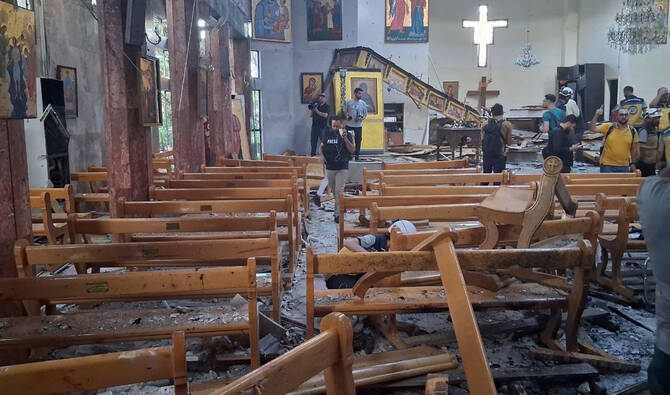
In this photo released by the Syrian official news agency SANA, journalists and Civil Defense workers inspect the damage inside Mar Elias church where a suicide bomber detonated himself in Dweil’a in the outskirts of Damascus, Syria, on June 22, 2025. (SANA)
Short Url
Updated 22 June 2025
Follow

Twenty killed in suicide bombing at Damascus church

  • It was the first suicide bombing in Damascus since Bashar Assad was toppled
  • Syria’s interior ministry said the suicide bomber was a member of Daesh group

At least 20 people were killed and dozens injured when a suicide bomber blew himself up at the Mar Elias Church in the Dweila neighborhood of Syria’s capital Damascus on Sunday, health authorities and security sources said.

It was the first suicide bombing in Damascus since Bashar Assad was toppled in December. Syria’s interior ministry said the suicide bomber was a member of Daesh (Islamic State). He entered the church, opened fire and then detonated his explosive vest, a ministry statement added.

A security source, speaking on condition of anonymity, said two men were involved in the attack, including the one who blew himself up.

Daesh has been behind several attempted attacks on churches in Syria since Assad’s fall, but this was the first to succeed, another security source told Reuters.

Syria’s state news agency cited the health ministry as saying that 52 people were also injured in the blast.

A livestream from the site by Syria’s civil defense, the White Helmets, showed scenes of destruction from inside the church, including a bloodied floor and shattered pews and masonry.

Syrian President Ahmed Al-Sharaa, who led the offensive against Assad before taking over in January for a transitional phase, has repeatedly said he will protect minorities.

“We unequivocally condemn the abhorrent terrorist suicide bombing at the Mar Elias Greek Orthodox Church in Damascus, Syria,” the Greek foreign ministry said in a statement.

“We demand that the Syrian transitional authorities take immediate action to hold those involved accountable and implement measures to guarantee the safety of Christian communities and all religious groups, allowing them to live without fear.”

Daesh had previously targeted religious minorities, including a major attack on Shiite pilgrims in Sayeda Zainab in 2016 — one of the most notorious bombings during Assad’s rule.

The latest assault underscores the group’s continued ability to exploit security gaps despite the collapse of its territorial control and years of counterterrorism efforts.


Hundreds mourn in Syria’s Homs after deadly mosque bombing

Updated 4 sec ago
Follow

Hundreds mourn in Syria’s Homs after deadly mosque bombing

HOMS: Hundreds of mourners gathered Saturday despite rain and cold outside of a mosque in the Syrian city of Homs where a bombing the day before killed eight people and wounded 18.
The crowd gathered next to the Imam Ali ibn Abi Talib Mosque in the Wadi Al-Dhahab neighborhood, where the population is predominantly from the Alawite minority, before driving in convoys to bury the victims.
Officials have said the preliminary investigations indicate explosive devices were planted inside the mosque but have not yet publicly identified a suspect.
A little-known group calling itself Saraya Ansar Al-Sunna claimed responsibility for the attack in a statement posted on its Telegram channel, in which it indicated that the attack intended to target members of the Alawite sect, an offshoot of Shia Islam whom hard-line Islamists consider to be apostates.
The same group had previously claimed a suicide attack in June in which a gunman opened fire and then detonated an explosive vest inside a Greek Orthodox church in Dweil’a, on the outskirts of Damascus, killing 25 people as worshippers prayed on a Sunday.
A neighbor of the mosque, who asked to be identified only by the honorific Abu Ahmad (“father of Ahmad“) out of security concerns, said he was at home when he heard the sound of a “very very strong explosion.”
He and other neighbors went to the mosque and saw terrified people running out of it, he said. They entered and began trying to help the wounded, amid blood and scattered body parts on the floor.
While the neighborhood is primarily Alawite, he said the mosque had always been open to members of all sects to pray.
“It’s the house of God,” he said. “The mosque’s door is open to everyone. No one ever asked questions. Whoever wants to enter can enter.”
Mourners were unable to enter the mosque to pray Saturday because the crime scene remained cordoned off, so they prayed outside.
Some then marched through the streets chanting “Ya Ali,” in reference to the Prophet Muhammad’s cousin and son-in-law whom Shiite Muslims consider to be his rightful successor.