

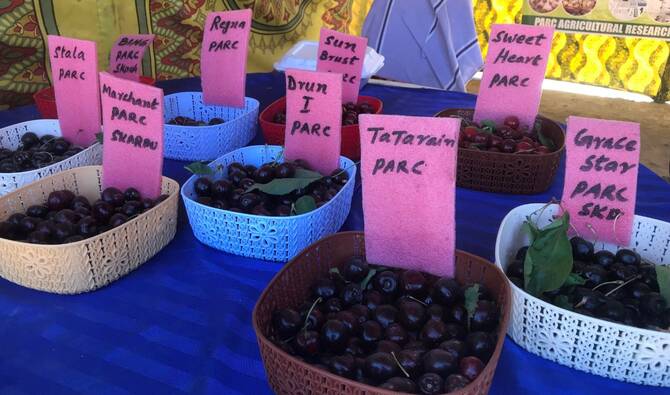
Cherry festival in northern Pakistan draws crowds amid growing exports to China

Different verities of cherries displayed at a stall at the 5th National Cherry Festival in Skardu. Pakistan on June 20, 2025. (AN Photo)
Short Url
Updated 22 June 2025
Follow

Cherry festival in northern Pakistan draws crowds amid growing exports to China

  • Gilgit-Baltistan, which produces 9,000 tons of cherries, exported over a quarter of the crop to China last year
  • Agricultural experts say the region’s cold climate is ideal for growing cherries, apricots and apples

SKARDU, Gilgit-Baltistan: As Pakistan begins to export cherries to neighboring China, a colorful one-day festival in Skardu this week drew hundreds of visitors, highlighting the potential of agri-tourism and cherry farming in the northern Gilgit-Baltistan (GB) region, officials and growers said.

Home to the Khunjerab Pass — the highest paved international border crossing in the world — GB is often described as Pakistan’s gateway to China.

The region’s cold climate is ideal for growing high-quality fruits such as cherries, apricots and apples.

“This is the 5th National Cherry Festival, and we are organizing Agri-Mela as part of the festival,” Zakir Hussain, deputy director at the GB agriculture department, told Arab News on Friday.
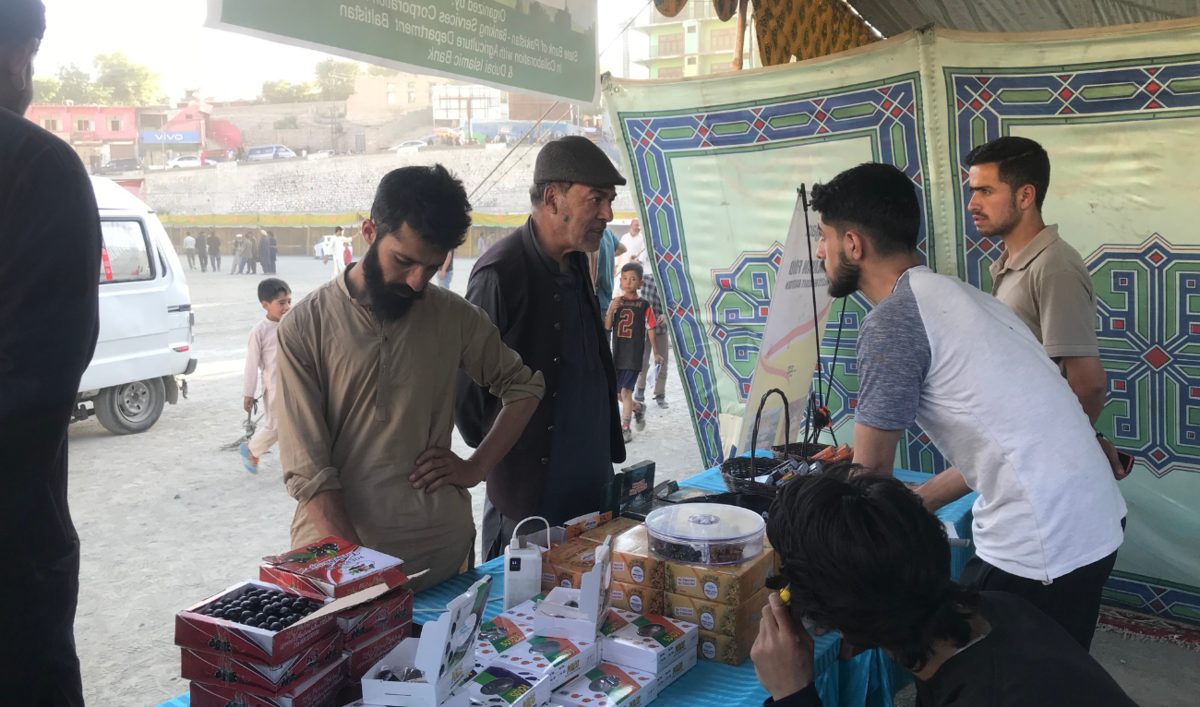


Visitors sample different verities of cherries displayed at a stall at the 5th National Cherry Festival in Skardu. Pakistan on June 20, 2025. (AN Photo)

 “The aim of this festival is to introduce cherry as a cash crop.”

He said the event, organized in collaboration with the State Bank of Pakistan, aimed to raise awareness about harvesting, marketing and the economic importance of cherries.

According to the GB agriculture department, the region produces 8,000 to 9,000 tons of cherries annually, with dried cherry marketing now also underway.

“Almost 3,000 tons of cherries had been exported to China in 2024,” Hussain said, adding that GB was the leading cherry-producing region in Pakistan.

Local farmers say the festival boosts their income and visibility.


A cherry farmer displays his produce at the 5th National Cherry Festival in Skardu. Pakistan on June 20, 2025. (AN Photo)

“We have been growing cherries for the last 12 to 13 years and we have 200 to 300 cherry trees in our orchard,” said Skinder Ali, a 40-year-old farmer. “Whenever the festival is held in Gilgit-Baltistan, we participate. And due to this event, we get access to the market at the national level.”

The festival also attracted tourists from other parts of the country.

“We especially came to Skardu to see the cherries, and we are from Islamabad,” Zohra Begum, a 52-year-old visitor, said. “We have been visiting [the stalls] for the last hour... The taste of cherries is very good ... So far we have purchased 10 kilograms. Let’s see how much we purchase later.”

“I am a traveler and biker from Lahore,” said Mohsin Abbas, another tourist. “We were in Shigar last night when we came to know about the festival. So we came here... We have tasted the cherries and they are very delicious.”

Ghulamullah Saqib, an agriculture expert and trainer, said the region’s climate is well suited for cherries, which require 800 to 1,000 chilling hours to bear fruit.

“There are 14 varieties of cherry that are found in Gilgit-Baltistan,” he added.


Pakistan top military commander urges ‘multi-domain preparedness’ amid evolving security threats

Updated 9 sec ago
Follow

Pakistan top military commander urges ‘multi-domain preparedness’ amid evolving security threats

  • Asim Munir says Pakistan faces layered challenges spanning conventional, cyber, economic and information domains
  • His comments come against the backdrop of tensions with India, ongoing militant violence in western border regions

ISLAMABAD: Pakistan’s top military commander Field Marshal Asim Munir on Tuesday stressed the need for “multi-domain preparedness” to counter a broad spectrum of security challenges facing the country, saying they ranged from conventional military threats to cyber, economic and information warfare.

Pakistan’s security environment has remained volatile following a brief but intense conflict with India earlier this year, when the two nuclear-armed neighbors exchanged missile and artillery fire while deploying drones and fighter jets over four days before a ceasefire was brokered by the United States.

Pakistan has also been battling militant violence in its western provinces of Khyber Pakhtunkhwa and Balochistan, where authorities say armed groups operate from across the border in Afghanistan and receive backing from India. Both Kabul and New Delhi have rejected claims.

The military has also warned that disinformation constitutes a new form of security threat, prompting tighter regulations that critics say risk suppressing dissent. Munir also pointed to a “complex and evolving” global, regional and internal security landscape while addressing participants in the National Security and War Course at the National Defense University (NDU).

“These challenges span conventional, sub-conventional, intelligence, cyber, information, military, economic and other domains, requiring comprehensive multi-domain preparedness, continuous adaptation and synergy among all elements of national power,” he said, according to a military statement.

“Hostile elements increasingly employ indirect and ambiguous approaches, including the use of proxies to exploit internal fault lines, rather than overt confrontation,” he continued, adding that future leaders must be trained and remain alert to recognize, anticipate and counter these multi-layered challenges.

Munir also lauded the NDU for producing strategic thinkers who he said were capable of translating rigorous training and academic insight into effective policy formulation and operational outcomes.