

Pro-Palestinian protest leader defiant despite US deportation threat

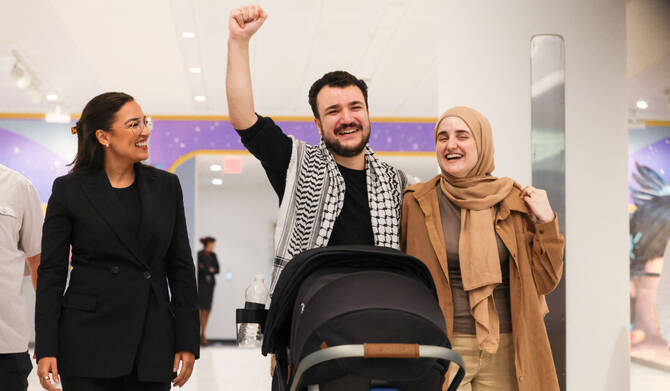
Columbia University graduate student Mahmoud Khalil gestures next to his wife Dr. Noor Abdalla and U.S. Rep. Alexandria Ocasio-Cortez (D-NY) at Newark airport, a day after he was released from immigration custody, in Newark, New Jersey, U.S., June 21, 2025. (REUTERS)
Short Url
Updated 22 June 2025
Follow

Pro-Palestinian protest leader defiant despite US deportation threat

  • Khalil, a legal permanent resident in the United States who is married to a US citizen and has a US-born son, had been in custody since March facing potential deportation

NEWARK, United States: Mahmoud Khalil, one of the most prominent leaders of US pro-Palestinian campus protests, pledged Saturday to keep campaigning after he was released from a federal detention center.
“Even if they would kill me, I would still speak for Palestine,” Khalil said as he was greeted by cheering supporters at Newark airport, just outside New York City.
Khalil, a legal permanent resident in the United States who is married to a US citizen and has a US-born son, had been in custody since March facing potential deportation.
He was freed from a federal immigration detention center in Louisiana on Friday, hours after a judge ordered his release on bail.
The Columbia University graduate was a figurehead of student protests against US ally Israel’s war in Gaza, and the Trump administration labeled him a national security threat.
“Just the fact I am here sends a message — the fact that all these attempts to suppress pro-Palestine voices have failed now,” said Khalil, who is still fighting his potential expulsion from the United States.
He spoke alongside his wife Noor Abdalla, who gave birth to the couple’s first child while Khalil was in detention, as well as Democratic congresswoman Alexandria Ocasio-Cortez.
“Mahmoud Khalil was imprisoned for 104 days by this administration, by the Trump administration, with no grounds and for political reasons, because Mahmoud Khalil is an advocate for Palestinian human rights,” Ocasio-Cortez said.
“This is not over, and we will have to continue to support this case,” she added.
Khalil, who was born in Syria to Palestinian parents, is not allowed to leave the United States except for “self-deportation” under the terms of his release.
He also faces restrictions on where he can travel within the country.
President Donald Trump’s government has justified pushing for Khalil’s deportation by saying his continued presence in the United States could carry “potentially serious adverse foreign policy consequences.”
Beyond his legal case, Khalil’s team fears he could face threats out of detention.
“We are very mindful about his security, and the irony is that he is the one being persecuted,” Baher Azmy, one of his lawyers, told AFP.
“But he is committed to peace and because he is rejecting US government policy he is under threat,” Azmy added, without elaborating on any security measures in place for Khalil and his family.


Macron pushes back against Trump’s tariff threats, calls for stronger European sovereignty at Davos

Updated 5 sec ago
Follow

Macron pushes back against Trump’s tariff threats, calls for stronger European sovereignty at Davos

  • French president calls for stronger European sovereignty and fair trade rules, signaling Europe will not bow to economic coercion amid US tariff threats 

LONDON: French President Emmanuel Macron warned about global power and economic governance, implicitly challenging US President Donald Trump’s trade and diplomatic approach, at the World Economic Forum in Davos on Tuesday.

Without naming Trump, Macron described a world sliding toward a “law of the strongest,” where cooperation is replaced by coercion and economic pressure becomes a tool of dominance.

His comments come as Europe faces renewed threats of tariffs and coercive measures from Washington following the fallout over Greenland and other trade disputes.

Macron, wearing sunglasses on stage, warned political and business leaders of a world under pressure, marked by rising instability, weakened international law, and faltering global institutions.

“We are destroying the systems that help us solve shared problems,” he said, warning that uncontrolled competition, especially in trade, puts collective governance at risk.

In recent days, Trump has threatened punitive tariffs on European exports, including a 200 percent levy on French wine, after Macron refused to join the “Board of Peace” for Gaza.

Trump also announced a 10 percent tariff on exports from Britain and EU countries unless Washington secured a deal to purchase Greenland from Denmark, a move European officials have privately called economic blackmail.

Macron rejected what he described as “vassalization and bloc politics,” warning that submitting to the strongest power would lead to subordination rather than security.

He also criticized trade practices that demand “maximum concessions” while undermining European export interests, suggesting that competition today is increasingly about power rather than efficiency or innovation.

Macron also said that Europe has long been uniquely exposed by its commitment to open markets while others protect their industries.

“Protection does not mean protectionism,” he said, emphasizing that Europe must enforce a level playing field, strengthen trade defense instruments, and apply the principle of “European preference” where partners fail to respect shared rules.

Macron warned against passive moral posturing, arguing that it would leave Europe “marginalized and powerless” in an increasingly harsh world. His dual strategy calls for stronger European sovereignty alongside effective multilateralism.

The timing of the speech underscored its urgency. Trump recently published private messages from NATO leaders and Macron, following a diplomatic controversy over Greenland.

Macron closed his Davos speech with a clear statement of principles: “We prefer respect to bullying, science to obscurantism, and the rule of law to brutality.”