

Pakistan, Turkiye leaders vow diplomatic push to halt Israel’s military campaigns in Mideast

1 / 2
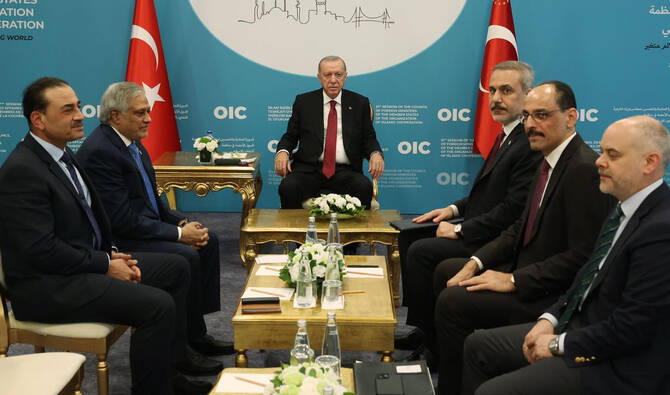
Pakistan’s Deputy Prime Minister Ishaq Dar (right) and Army Chief Field Marshal Asim Munir (left) meet Turkish President Recep Tayyip Erdoğan on the sidelines of the 51st session of the Organization of Islamic Cooperation (OIC) Council of Foreign Ministers in Istanbul on June 21, 2025. (MOFA)
2 / 2
Pakistan’s Deputy Prime Minister Ishaq Dar (second left) and Army Chief Field Marshal Asim Munir (left) meet Turkish President Recep Tayyip Erdoğan (center) on the sidelines of the 51st session of the Organization of Islamic Cooperation (OIC) Council of Foreign Ministers in Istanbul on June 21, 2025. (PID)
Short Url
Updated 21 June 2025
Follow

Pakistan, Turkiye leaders vow diplomatic push to halt Israel’s military campaigns in Mideast

  • The Middle East situation came up during a meeting between Ishaq Dar, Asim Munir and Recep Tayyip Erdoğan
  • Both sides stressed the urgency of halting ‘Israeli aggression’ in Gaza, ensuring unhindered humanitarian aid

ISLAMABAD: Pakistan’s Deputy Prime Minister Ishaq Dar and Army Chief Field Marshal Asim Munir met Turkish President Recep Tayyip Erdoğan on Saturday and agreed to step up diplomatic efforts to halt Israel’s military campaigns in the Middle East, as regional tensions threaten to escalate further.

The meeting took place on the sidelines of the 51st session of the Organization of Islamic Cooperation (OIC) Council of Foreign Ministers in Istanbul, where Muslim-majority nations are grappling with regional crises.

Two of the bloc’s key members — Pakistan and Iran — have recently faced military escalations with regional adversaries. While Pakistan’s brief but intense standoff with India last month ended in a ceasefire, Israel’s strikes on Iranian nuclear and military sites, launched over a week ago, have shown no signs of letting up.

“The leaders [of Pakistan and Turkiye] expressed strong condemnation of the continued Israeli attacks in blatant violation of fundamental principles of international law, reiterated support for Iran’s sovereignty, territorial integrity and its right to self-defense under the UN Charter, agreed to continue diplomatic efforts to de-escalate the situation and urged the international community to play its part in restoring peace and stability in the region,” the Foreign Office in Islamabad said in a statement.

“Both sides emphasized the urgency of galvanizing efforts to bring an immediate halt to the Israeli aggression in Gaza and unhindered provision of humanitarian assistance to the besieged people of Gaza,” the statement added.

As Iran and Israel continue to trade fire, European and regional powers are racing to contain the conflict and bring Iran back to the negotiating table to resume nuclear negotiations that broke down when Israel launched its strike on Tehran and other cities.

During Saturday’s meeting, Dar underscored Pakistan’s commitment to strengthening bilateral ties with Turkiye.

The two sides reaffirmed their desire to deepen cooperation, particularly in light of Turkiye’s diplomatic support for Pakistan during last month’s flare-up with India, which saw both nuclear-armed neighbors exchange missiles, drone fire and airstrikes before tensions subsided under international pressure.

Dar also congratulated Erdoğan on receiving an award from the Islamic Cooperation Youth Forum in recognition of his leadership and the successful organization of the ongoing OIC ministerial session.


Pakistan, global crypto exchange discuss modernizing digital payments, creating job prospects 

Updated 05 December 2025
Follow

Pakistan, global crypto exchange discuss modernizing digital payments, creating job prospects 

  • Pakistani officials, Binance team discuss coordination between Islamabad, local banks and global exchanges
  • Pakistan has attempted to tap into growing crypto market to curb illicit transactions, improve oversight

ISLAMABAD: Pakistan’s finance officials and the team of a global cryptocurrency exchange on Friday held discussions aimed at modernizing the country’s digital payments system and building local talent pipelines to meet rising demand for blockchain and Web3 skills, the finance ministry said.

The development took place during a high-level meeting between Finance Minister Muhammad Aurangzeb, Pakistan Virtual Assets Regulatory Authority (PVARA) Chairman Bilal bin Saqib, domestic bank presidents and a Binance team led by Global CEO Richard Teng. The meeting was held to advance work on Pakistan’s National Digital Asset Framework, a regulatory setup to govern Pakistan’s digital assets.

Pakistan has been moving to regulate its fast-growing crypto and digital assets market by bringing virtual asset service providers (VASPs) under a formal licensing regime. Officials say the push is aimed at curbing illicit transactions, improving oversight, and encouraging innovation in blockchain-based financial services.

“Participants reviewed opportunities to modernize Pakistan’s digital payments landscape, noting that blockchain-based systems could significantly reduce costs from the country’s $38 billion annual remittance flows,” the finance ministry said in a statement. 

“Discussions also emphasized building local talent pipelines to meet rising global demand for blockchain and Web3 skills, creating high-value employment prospects for Pakistani youth.”

Blockchain is a type of digital database that is shared, transparent and tamper-resistant. Instead of being stored on one computer, the data is kept on a distributed network of computers, making it very hard to alter or hack.

Web3 refers to the next generation of the Internet built using blockchain, focusing on giving users more control over their data, identity and digital assets rather than big tech companies controlling it.

Participants of the meeting also discussed sovereign debt tokenization, which is the process of converting a country’s debt such as government bonds, into digital tokens on a blockchain, the ministry said. 

Aurangzeb called for close coordination between the government, domestic banks and global exchanges to modernize Pakistan’s payment landscape.

Participants of the meeting also discussed considering a “time-bound amnesty” to encourage users to move assets onto regulated platforms, stressing the need for stronger verifications and a risk-mitigation system.

Pakistan has attempted in recent months to tap into the country’s growing crypto market, crack down on money laundering and terror financing, and promote responsible innovation — a move analysts say could bring an estimated $25 billion in virtual assets into the tax net.

In September, Islamabad invited international crypto exchanges and other VASPs to apply for licenses to operate in the country, a step aimed at formalizing and regulating its fast-growing digital market.