

Russia’s economy minister says the country is on ‘the brink of recession’

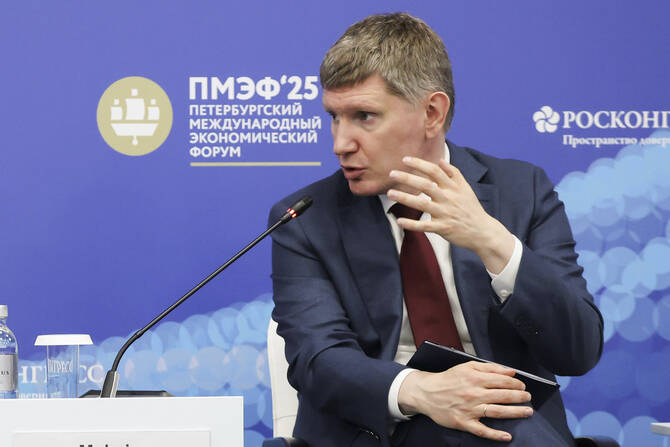
Maxim Reshetnikov, minister of economic development of the Russian Federation, attends a plenary session of the St. Petersburg International Economic Forum in St. Petersburg, Russia, on June 19, 2025. (Roscongress Foundation via AP)
Short Url
Updated 20 June 2025
Follow

Russia’s economy minister says the country is on ‘the brink of recession’

  • Minister delivers warning at the St. Petersburg International Economic Forum
  • Economy ministry also sees export losses due to trade wars at $9 billion

ST. PETERSBURG, Russia: Russia’s economy is “on the brink of going into a recession,” the country’s economy minister said Thursday, according to Russian media reports.
Economy Minister Maxim Reshetnikov delivered the warning at the St. Petersburg International Economic Forum, the annual event in Russia’s second largest city designed to highlight the country’s economic prowess and court foreign investors.
Russian business news outlet RBC quoted the official as saying “the numbers indicate cooling, but all our numbers are (like) a rearview mirror. Judging by the way businesses currently feel and the indicators, we are already, it seems to me, on the brink of going into a recession.”
The economy, hit with a slew of sanctions after the Kremlin sent troops into Ukraine in February 2022, has so far outperformed predictions. High defense spending has propelled growth and kept unemployment low despite fueling inflation. At the same time, wages have gone up to keep pace with inflation, leaving many workers better off.
Large recruiting bonuses for military enlistees and death benefits for those killed in Ukraine also have put more income into the country’s poorer regions. But over the long term, inflation and a lack of foreign investments remain threats to the economy, leaving a question mark over how long the militarized economy can keep going.
Economists have warned of mounting pressure on the economy and the likelihood it would stagnate due to lack of investment in sectors other than the military.
Speaking at a forum session, Reshetnikov said Russia was “on the brink,” and whether the country would slide into a recession or not depends on the government’s actions.
“Going forward, it all depends on our decisions,” Reshetnikov said, according to RBC.
RBC reported Russia’s Finance Minister Anton Siluanov and Central Bank Gov. Elvira Nabiullina gave more optimistic assessments.
Siluanov spoke about the economy “cooling” but noted that after any cooling “the summer always comes,” RBC reported.
Nabiullina said Russia’s economy was merely “coming out of overheating,” according to RBC.

Export losses

On the issue of exports, Russia estimates potential losses due to global trade wars at $9 billion, but expects a gradual stabilization of flows and a possible expansion of supplies to China, Deputy Economy Minister Vladimir Ilyichev said.
President Trump has upended longstanding trade relations since returning to the White House, using erratic tariff threats and aggressive negotiating tactics in a bid to secure better deals from trading partners.
“Overall, we estimate the impact on Russia of this reorientation at $33 billion, of which about $9 billion is the potential loss of Russian exports in third-country markets,” said Ilyichev.


Boys recount ‘torment’ at hands of armed rebels in DR Congo

Updated 2 sec ago
Follow

Boys recount ‘torment’ at hands of armed rebels in DR Congo

BUNIA: Forcibly recruited into a rebel militia affiliated with the Daesh group, two boys revealed the “torment” of living in its camps as members committed massacres in the Democratic Republic of Congo’s northeast.
The two minors freed from the Allied Democratic Forces (ADF) gave AFP an unprecedented account of the shadowy group, notorious for its extreme brutality.
Paluku, a frail 12-year-old, spent two months with the ADF after rebels killed his mother during an attack on his village in eastern North Kivu province. His brother and sister were also captured.
Edouard, 17, spent a gruelling four years with the ADF — formed by Ugandan rebels who took refuge in DRC — after he was kidnapped at age 12.
The two boys, using pseudonyms, spoke on condition of anonymity at a center specializing in the care of minors recruited by armed groups in the region, whose location AFP has chosen not to disclose to avoid potential reprisals.
Their accounts were confirmed by health and security sources.
Round-faced Edouard, a fast-talker, did not mince his words in describing his years of “torment” within the ADF.
“We suffered terribly,” he said.
After their capture, Edouard and Paluku were sent to ADF bases hidden in the dense forest of northeast DRC where the elusive rebels avoid patrols by the Congolese army and Ugandan forces deployed there since 2021.
The bases consist of simple tents and tarps, easy to move in the event of an attack.
Most occupants are women and children, according to security sources, contributing to the group’s operations — but also serving as human shields.
New recruits are swiftly forced to convert to Islam and learn Arabic, but also English and Swahili, Edouard said.
“I was also trained in medicine to treat the wounded, and we learned how to handle weapons and clean them,” he said.
Paluku said he underwent similar training, as well as learning how to “steal food, clothing and medicine to bring back to the ADF camp.”

- Floggings -

Children play a central role in supplying the group, security sources said. Those who fail to bring back loot face severe punishment.
The wives of the ADF commanders, some of whom are particularly influential, also exercise power over the young recruits.
When the fighters go out on “operations,” the youngest among them like Paluku, were “supposed to bring something back for the chief’s wife,” he said, like soap, cooking oil or fabric.
“To get it we have to loot people’s belongings, and if a chief’s wife accuses you to her husband of not bringing back what she asked for, she can demand that you be killed,” he said.
Edouard and Paluku said they were subjected to incessant corporal punishment.
Girls and boys were whipped or thrown into pits for several weeks over the slightest misbehavior.
“I was punished with lashes because I refused to go kill people,” Paluku said with a long stare.
Edouard took part in combat with the group at least three times against the Congolese army or local militias.
“They beat us mostly when we lost our weapons and ammunition, claiming we had wasted them for nothing or lost them on the front,” he explained.
Faced with such an accusation, Edouard said a chief ordered that he be whipped.
“I fell ill because of those lashes. I told the chief outright I was no longer able to go fight on the front, I begged him to send others who were capable, but that made him even more angry, and I was whipped once again,” he said.

- Trauma -

About 10 children freed from the ADF arrive on average each month at the reception center in the troubled northeast Ituri province.
“These children have suffered psychological trauma and torture, and when they arrive here, most are aggressive,” said Madeleine, a psychologist at the center.
After a few weeks spent around other children and staff, their aggression fades, she said.
But there are other scars to contend with.
Edouard became addicted to drugs administered by the rebels after he was wounded in combat.
Suffering from speech disorders, he talks constantly and sometimes incoherently, disturbing other residents, Madeleine said.
After a year at the center receiving ongoing treatment, Edouard recounted the horrors of his experience with a shy smile and a lively, excitable gaze.
Paluku meanwhile had a darker expression, recalling his sister who remains a hostage.
“She has become the wife of one of the ADF chiefs,” he said.