

Pakistan says 3,000 evacuated from Iran as stranded students plead for help

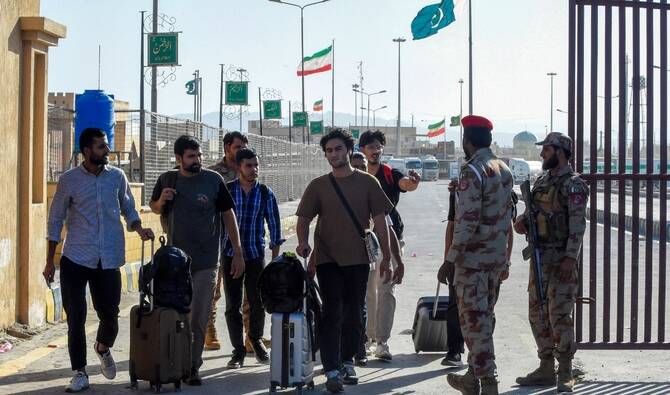
Pakistani students evacuated from Iran walk across the Pakistan-Iran border at Taftan, in Balochistan province on June 18, 2025, amid the ongoing conflict between Israel and Iran. (AFP)
Short Url
Updated 19 June 2025
Follow

Pakistan says 3,000 evacuated from Iran as stranded students plead for help

  • Foreign Office says evacuations are underway via land borders and special flights from neighboring countries
  • Pakistani students stranded in Iran express fear for their safety amid ongoing Israeli missile and airstrikes

ISLAMABAD: The foreign office said on Thursday about 3,000 Pakistani nationals have been evacuated from Iran following the Israeli attack, adding the country’s diplomatic mission is working to facilitate stranded students seeking urgent evacuation.

A week of Israeli air and missile strikes, which began on June 13, has led to the killing of many of Iran’s top-ranking military officials and ordinary people. In response, Tehran’s retaliatory strikes have also killed about two dozen civilians in Israel.

Following Friday’s escalation, Iran closed its airspace to commercial flights, stranding hundreds of expatriates, including Pakistani religious tourists, students and workers.

“The evacuation is moving smoothly and so far, nearly 3,000 Pakistani nationals have already been evacuated,” foreign office spokesperson Shafqat Ali Khan told reporters in his weekly media briefing.

“Our consulates in Zahedan and Mashhad have been active round the clock, extending all possible facilitation and support to our nationals who are in Iran,” he said, expressing gratitude to the Iranian authorities for their sensitivity and all possible facilitation and help extended in this process.

Khan said the Pakistani mission was using multiple routes to evacuate citizens, including via the Gabr and Taftan border crossings, through Ashgabat, Baku and even Baghdad, through special flights.

“It’s an ongoing process as there are logistical challenges at times, but we are working together with the Iranian authorities to resolve them if a problem arises,” he added.

The spokesperson said there is a sizeable Pakistani community in Iran, with many of them living in the neighboring state for years with their families after marrying local people.

STRANDED STUDENTS

Speaking to Arab News from various cities across Iran, Pakistani students expressed serious concerns about their safety and appealed for immediate evacuation.

“I have been stranded here since the suspension of flight operations due to the regional tensions,” Muhammad Hussain, a Pakistani medical student at Qom University of Medical Sciences, told Arab News over the phone.

“The situation is becoming more tense, we are now hearing continuous explosions, which has increased our concern for safety,” he said, adding that he tried to reach out to the Pakistan embassy as well who asked him to travel to the Chabahar border.

“I am unable to get any means to go there,” he said, urging the Pakistan government and the embassy to arrange special transport to take them to border.

“Our families are extremely worried, and we just want to go back,” he added.

Noman Khan, an MBBS student in Urmia, a city in Iran’s Azerbaijan province, said he was part of a group of Pakistani students, including 10 girls, awaiting repatriation amid the ongoing situation.

“We contacted the embassy to evacuate us and, about two days ago, they asked us to book a bus ourselves, promising to send the payment,” he informed, adding that even after more than 60 hours, they were still waiting for the payment without which they were unable to get transport to cross border.

“We have female students with us as well who are also scared as nearby cities were also hit by missiles,” he continued.

“Our city is about two hours away from Tabriz and almost two to three drones were shot down in our city as well.”

Saman Yunus, another medical student at Iran University of Medical Sciences, said that due to the ongoing Iran-Israel conflict, they had been traveling for the past four days.

“The Pakistani Embassy advised us that it would be safer to go to the Chabahar border and assured us that any issues related to accommodation or other needs would be resolved within minutes,” she told Arab News.

However, she said the biggest problem they faced was that the border was not open 24/7 and there was no accommodation available.

“As a result, we had to spend the entire night on the roadside and we contacted both our university and the embassy, but no help was provided,” she continued, adding they were now heading to Pakistani consulate in Zahedan, hoping they would facilitate a safe border crossing.

“A representative there has assured us that they will handle it as soon as possible and ensure we safely cross border,” she added.


Pakistan remembers Benazir Bhutto, first woman PM in Muslim world, on death anniversary

Updated 27 December 2025
Follow

Pakistan remembers Benazir Bhutto, first woman PM in Muslim world, on death anniversary

  • Bhutto was daughter of ex-PM Zulfikar Ali Bhutto who was hanged during reign of former military ruler Gen. Zia-ul-Haq
  • Year before assassination in 2007, Bhutto signed landmark deal with rival Nawaz Sharif to prevent army interventions

ISLAMABAD: Prime Minister Shehbaz Sharif and other Pakistani leaders on Saturday paid tribute to Benazir Bhutto, the first woman prime minister in the Muslim world who was assassinated 18 years ago in a gun and bomb attack after a rally in the city of Rawalpindi.

Born on Jun. 21, 1953, Bhutto was elected premier for the first time in 1988 at the age of 35. She was deposed in 1990, re-elected in 1993, and ousted again in 1996, amid allegations of corruption and mismanagement which she denied as being politically motivated.

Bhutto only entered politics after her father was hanged in 1979 during military ruler Gen. Zia-ul-Haq’s reign. Throughout her political career, she had a complex and often adversarial relationship with the now ruling Sharif family, but despite the differences signed a ‘Charter of Democracy’ in 2006 with three-time former PM Nawaz Sharif, pledging to strengthen democratic institutions and prevent military interventions in Pakistan in the future.

She was assassinated a year and a half later.

“Mohtarma Benazir Bhutto took exemplary steps to strengthen the role of women, protect the rights of minorities, and make Pakistan a peaceful, progressive, and democratic state,” PM Shehbaz Sharif, younger brother of ex-PM Nawaz Sharif, said in a statement on Saturday.

“Her sacrifices and services are a beacon of light for the nation.”

President Asif Ali Zardari, Bhutto’s widower, said Bhutto believed in an inclusive Pakistan, rejected sectarianism, bigotry and intolerance, and consistently spoke for the protection of minorities.

“Her vision was of a federation where citizens of all faiths could live with dignity and equal rights,” he said. “For the youth of Pakistan, her life offers a clear lesson: speak up for justice, organize peacefully and do not surrender hope in the face of adversity.”

Powerful families like the Bhuttos and the Sharifs of Pakistan to the Gandhis of India and the Bandaranaike family of Sri Lanka have long dominated politics in this diverse region since independence from British colonial rule. But none have escaped tragedy at the hands of rebels, militants or ambitious military leaders.

It was Zulfikar Ali Bhutto, Bhutto’s father, who founded the troubled Bhutto dynasty, becoming the country’s first popularly elected prime minister before being toppled by the army in 1977 and later hanged. Both his sons died in mysterious circumstances.

Before her assassination on Dec. 27, 2007, Bhutto survived another suicide attack on her motorcade that killed nearly 150 people as she returned to Pakistan after eight years in exile in October 2007.

Bhutto’s Oxford-educated son, Bilawal Bhutto-Zardari, now leads her Pakistan Peoples Party, founded by her father, and was foreign minister in the last administration of PM Shehbaz Sharif.

Aseefa Bhutto Zardari, Bhutto’s daughter who is currently the first lady of Pakistan, said her mother lived with courage and led with compassion in life.

“Her strength lives on in every voice that refuses injustice,” she said on X.

Pakistan has been ruled by military regimes for almost half its history since independence from Britain in 1947. Both former premiers Imran Khan and the elder Sharif, Nawaz, have alleged that they were ousted by the military after they fell out with the generals. The army says it does not interfere in politics.