Pakistan unveils new EV policy with over $353 million in subsidies for electric bikes, rickshaws

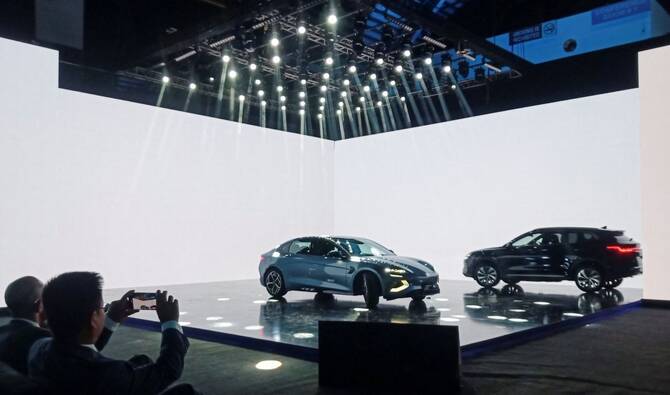
An attendee takes photos of the Chinese electric vehicle BYD models on display, during an event to announce the plans to open a car production plant in Pakistan, in Lahore, Pakistan August 17, 2024. (REUTERS)
Short Url
Updated 19 June 2025
Follow

Pakistan unveils new EV policy with over $353 million in subsidies for electric bikes, rickshaws

  • The new policy for 2025-30 aims to cut $1 billion in fuel costs and 4.5 million tons of emissions
  • Pakistan currently has about 70,000 electric motorcycles, 5,200 electric cars and 450 electric buses

ISLAMABAD: The government on Thursday unveiled Pakistan’s new Electric Vehicle (EV) Policy 2025-30, announcing a five-year subsidy of over Rs100 billion ($353 million) for electric bikes and rickshaws.

The move comes amid a steady rise in electric vehicle adoption in a market traditionally dominated by Japanese automakers. Pakistan’s urban areas exhibit some of the world’s highest levels of air pollution, with road transport being a major contributor.

Chinese and Korean EV brands are increasingly entering the local market, making these vehicles a more frequent sight in cities such as Islamabad, Lahore and Karachi.

“Total subsidy over five years will be over Rs100 billion and it will basically be focused on the two-and-three wheelers,” Haroon Akhtar Khan, a close aide to Prime Minister Shehbaz Sharif, told a news conference. “We will have subsidized financing for 116,053 electric bikes, 3,171 rickshaws.”

“A Rs9 billion [$31 million] subsidy will be allocated, and it is already there in the 2025-26 budget,” he continued.

Khan added the government also allocated a 25 percent quota for women to increase their mobility.

He projected the initiative will help with the annual savings of Rs283 billion ($1 billion) in fuel costs and a reduction of 4.5 million tons of carbon emissions.

Khan said Pakistan’s new EV policy was aimed at disincentivizing internal combustion engine vehicles and promoting electric mobility to help cut greenhouse gas emissions that damage the earth’s ozone layer.

He informed Pakistan has around 70,000 electric motorcycles, 5,200 electric cars and 450 electric buses, adding the government issued 61 manufacturing licenses for electric two- and three-wheelers including motorcycles and rickshaws.

Khan also acknowledged the country lacks adequate EV charging infrastructure and faces challenges related to the absence of safety and quality standards.

He said the government aims for 30 percent of all new vehicles produced over the next five years to be electric.

“So, we are establishing new electric vehicle testing rules, safety and emission standards,” he said.

“We have to make sure that if anybody is manufacturing an electric vehicle there are no emissions,” he continued. “Another thing is battery disposal. We don’t want to create any environmental problem that the battery is not disposed properly.”

The country previously approved an ambitious National Electric Vehicles Policy (NEVP) in 2019, aiming for electric vehicles to make up 30 percent of all passenger car and heavy-duty truck sales by 2030.

The policy set an even more ambitious target of making 90 percent of all vehicle sales electric by 2040.


IMF warns against policy slippage amid weak recovery as it clears $1.2 billion for Pakistan

Updated 11 December 2025
Follow

IMF warns against policy slippage amid weak recovery as it clears $1.2 billion for Pakistan

  • Pakistan rebuilt reserves, cut its deficit and slowed inflation sharply over the past one year
  • Fund says climate shocks, energy debt, stalled reforms threaten stability despite recent gains

ISLAMABAD: Pakistan’s economic recovery remains fragile despite a year of painful stabilization measures that helped pull the country back from the brink of default, the International Monetary Fund (IMF) warned on Thursday, after it approved a fresh $1.2 billion disbursement under its ongoing loan program.

The approval covers the second review of Pakistan’s Extended Fund Facility (EFF) and the first review of its climate-focused Resilience and Sustainability Facility (RSF), bringing total disbursements since last year to about $3.3 billion.

Pakistan entered the IMF program in September 2024 after years of weak revenues, soaring fiscal deficits, import controls, currency depletion and repeated climate shocks left the economy close to external default. A smaller stopgap arrangement earlier that year helped avert immediate default, but the current 37-month program was designed to restore macroeconomic stability through strict monetary tightening, currency adjustments, subsidy rationalization and aggressive revenue measures.

The IMF’s new review shows that Pakistan has delivered significant gains since then. Growth recovered to 3 percent last year after shrinking the year before. Inflation fell from over 23 percent to low single digits before rising again after this year’s floods. The current account posted its first surplus in 14 years, helped by stronger remittances and a sharp reduction in imports. And the government delivered a primary budget surplus of 1.3 percent of GDP, a key program requirement. Foreign exchange reserves, which had dropped dangerously low in 2023, rose from US$9.4 billion to US$14.5 billion by June.

“Pakistan’s reform implementation under the EFF arrangement has helped preserve macroeconomic stability in the face of several recent shocks,” IMF Deputy Managing Director Nigel Clarke said in a statement after the Board meeting.

But he warned that Islamabad must “maintain prudent policies” and accelerate reforms needed for private-sector-led and sustainable growth.

The Fund noted that the 2025 monsoon floods, affecting nearly seven million people, damaging housing, livestock and key crops, and displacing more than four million, have set back the recovery. The IMF now expects GDP growth in FY26 to be slightly lower and forecasts inflation to rise to 8–10 percent in the coming months as food prices adjust.

The review warns Pakistan against relaxing monetary or fiscal discipline prematurely. It urges the State Bank to keep policy “appropriately tight,” allow exchange-rate flexibility and improve communication. Islamabad must also continue raising revenues, broadening the tax base and protecting social spending, the Fund said.

Despite the progress, Pakistan’s structural weaknesses remain severe.

Power-sector circular debt stands at about $5.7 billion, and gas-sector arrears have climbed to $11.3 billion despite tariff adjustments. Reform of state-owned enterprises has slowed, including delays in privatizing loss-making electricity distributors and Pakistan International Airlines. Key governance and anti-corruption reforms have also been pushed back.

The IMF welcomed Pakistan’s expansion of its flagship Benazir Income Support Program, which raises cash transfers for low-income families and expands coverage, saying social protection is essential as climate shocks intensify. But it warned that high public debt, about 72 percent of GDP, thin external buffers and climate exposure leave the country vulnerable if reform momentum weakens.

The Fund said Pakistan’s challenge now is to convert short-term stabilization into sustained recovery after years of economic volatility, with its ability to maintain discipline, rather than the size of external financing alone, determining the durability of its gains.