Turkiye should investigate ‘police violence’ against protesters: Amnesty

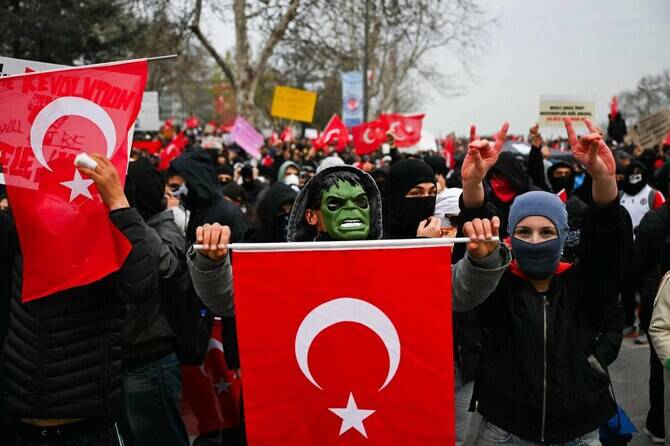
Amnesty International called on Turkish authorities Thursday to launch an investigation into alleged "police violence" during a wave of protests this year, saying some instances "could amount to acts of torture". (AFP/File)
Short Url
Updated 19 June 2025
Follow

Turkiye should investigate ‘police violence’ against protesters: Amnesty

  • Authorities said they arrested nearly 1,900 people during the protests
  • Amnesty said it had “verified dozens of videos documenting how protesters were beaten, kicked and dragged”

ISTANBUL: Amnesty International called on Turkish authorities Thursday to launch an investigation into alleged “police violence” during a wave of protests this year, saying some instances “could amount to acts of torture.”

The arrest of Istanbul mayor Ekrem Imamoglu on March 19, the leading opponent of Turkish President Recep Tayyip Erdogan, sparked Türkiye’s worst street protests in over a decade.

“Our findings reveal damning evidence of unlawful force frequently used by law enforcement officers,” said Esther Major, a deputy director at the global human rights group.

“The authorities used tear gas, pepper spray, kinetic impact projectiles and water cannons against people who were simply exercising their rights,” she said in a statement.

“The violations documented constitute cruel, inhuman, or degrading treatment and, in some cases, may amount to torture,” Major said, calling for the launch of an investigation.

Imamoglu was widely seen as the biggest political rival to Erdogan and his jailing is likely to prevent him from running in the 2028 presidential election.

Authorities said they arrested nearly 1,900 people during the protests, most of whom were accused of participating in illegal gatherings.

The vast majority have since been released.

Amnesty said it had “verified dozens of videos documenting how protesters were beaten, kicked and dragged on the ground by law enforcement officials even when they were dispersing, not resisting or were already restrained.”

The NGO said some “protesters were subjected to water cannon, tear gas, kinetic impact projectiles by police, often at very close range directly targeting the head and upper body, in violation of international human rights law.”

One of them required retinal surgery and may lose sight in one eye, Amnesty said.


GCC ambassadors hold discussions with Japan’s ruling party regarding Iran

Updated 55 min 25 sec ago
Follow

GCC ambassadors hold discussions with Japan’s ruling party regarding Iran

  • KONO Taro, head of international relations for the LDP, participated in the high-level discussions alongside other senior officials
  • Dr. Ghazi Faisal Binzagr, Saudi Arabia’s ambassador to Japan, described the meeting as a timely opportunity to exchange views on the evolving regional situation

TOKYO: Gulf Cooperation Council (GCC) ambassadors met on Tuesday with leaders of Japan’s ruling Liberal Democratic Party (LDP) to explore deeper collaboration across multiple fields and tackle pressing issues related to Iran.

KONO Taro, head of the party’s international relations, participated in the high-level discussions alongside other senior officials.

Dr. Ghazi Faisal Binzagr, Saudi Arabia’s ambassador to Japan, described the meeting as a timely opportunity to exchange views on the evolving regional situation.

Ambassador Binzagr emphasized that during periods of heightened tension, open dialogue with trusted partners like Japan is essential. He noted that diplomacy and clear communication are vital for defusing conflict and maintaining regional stability.

Saudi Ambassador Binzagr further noted that the Gulf countries and Japan share a longstanding history of cooperation founded on mutual trust and common objectives of stability and prosperity. He stated, “In times such as these, it is precisely these enduring partnerships that allow constructive dialogue to prevail, and that help ensure that wisdom and restraint guide the path toward peace and stability in our region."

Kono underscored the strong bonds and active cooperation between Japan and the GCC, noting that Japan views its ties with the GCC as a strategic partnership.