

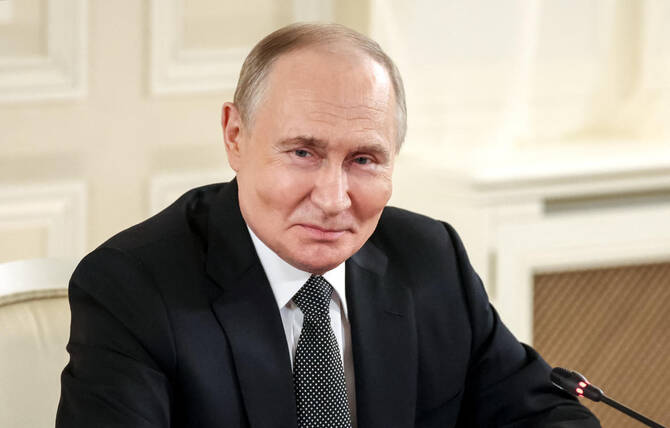
Putin says he does not want to discuss the possible Israeli-US killing of Iran’s supreme leader

Russian President Vladimir Putin said a strategic partnership treaty signed with Tehran in January did not envisage military cooperation and that Iran had not made any formal request for assistance. (Sputnik via Reuters)
Short Url
Updated 19 June 2025
Follow

Putin says he does not want to discuss the possible Israeli-US killing of Iran’s supreme leader

  • Israeli leader Benjamin Netanyahu has openly speculated that Israel’s military attacks could result in regime change in Iran
  • Donald Trump said US knows Supreme Leader Ayatollah Ali Khamenei is ‘hiding but that Washington is not going to kill him ‘for now’

ST PETERSBURG, Russia: President Vladimir Putin on Thursday refused to discuss the possibility that Israel and the United States would kill Iranian Supreme Leader Ayatollah Ali Khamenei and said the Iranian people were consolidating around the leadership in Tehran.

Israeli Prime Minister Benjamin Netanyahu has openly speculated that Israel’s military attacks could result in regime change in Iran while US President Donald Trump said on Tuesday that the US knew where Khamenei was “hiding” but that Washington was not going to kill him “for now.”

Asked what his reaction would be if Israel did kill Khamenei with the assistance of the United States, Putin said: “I do not even want to discuss this possibility. I do not want to.”

When pressed, Putin said he had heard the remarks about possibly killing Khamenei but that he did not want to discuss it.

“We see that today in Iran, with all the complexity of the internal political processes taking place there...that there is a consolidation of society around the country’s political leadership,” Putin told senior news agency editors in the northern Russian city of St. Petersburg.

Putin said all sides should look for ways to end hostilities in a way that ensured both Iran’s right to peaceful nuclear power and Israel’s right to the unconditional security of the Jewish state.

Putin was speaking as Trump kept the world guessing whether the US would join Israel’s bombardment of Iranian nuclear and missile sites and as residents of Iran’s capital streamed out of the city on the sixth day of the air assault.

Putin said he had been in touch with Trump and with Netanyahu, and that he had conveyed Moscow’s ideas on resolving the conflict while ensuring Iran’s continued access to civil nuclear energy.

Iranian nuclear facilities

Questioned about possible regime change in Iran, Putin said that before getting into something, one should always look at whether or not the main aim is being achieved before starting something.

He said Iran’s underground uranium enrichment facilities were still intact.

“These underground factories, they exist, nothing has happened to them,” Putin said.

“It seems to me that it would be right for everyone to look for ways to end hostilities and find ways for all parties to this conflict to come to an agreement with each other,” Putin said. “In my opinion, in general, such a solution can be found.”

Asked if Russia was ready to provide Iran with modern weapons to defend itself against Israeli strikes, Putin said a strategic partnership treaty signed with Tehran in January did not envisage military cooperation and that Iran had not made any formal request for assistance.

Russian Deputy Foreign Minister Sergei Ryabkov said on Wednesday that Moscow was telling the United States not to strike Iran because it would radically destabilize the Middle East.

A spokeswoman for the Russian Foreign Ministry also warned that Israeli strikes on Iranian nuclear facilities risked triggering a nuclear catastrophe.

Putin said that Israel had given Moscow assurances that Russian specialists helping to build two more reactors at the Bushehr nuclear power plant in Iran would not be hurt in air strikes.

Putin said that Moscow had “a very good relationship with Iran” and that Russia could ensure Iran’s interests in nuclear energy.

Russia has offered to take enriched uranium from Iran and to supply nuclear fuel to the country’s civil energy program.

“It is possible to ensure Iran’s interests in the field of peaceful nuclear energy. And at the same time, to address Israel’s concerns about its security,” Putin said. “We have outlined them (our ideas) to our partners from the USA, Israel and Iran.”


Ukraine marks four years since Russian invasion

Updated 7 sec ago
Follow

Ukraine marks four years since Russian invasion

  • Tuesday’s anniversary is expected to see the head of the European Commission, Ursula von der Leyen, and the president of the European Council, Antonio Costa, in Kyiv to mark the occasion

KYIV, Ukraine: Ukraine was on Tuesday marking the fourth anniversary of Russia’s full-scale invasion, with a show of solidarity from its staunchest allies and no immediate end in sight to Europe’s bloodiest conflict since World War II.
Tens of thousands of lives have been lost since the Kremlin ordered troops into Ukraine on February 24, 2022, confident of a quick victory but not expecting the fierce resistance that followed.
The worldwide fallout of the war has been immense, with many European countries increasing their own defense spending in anticipation of a possible confrontation of their own with Russia.
But diplomatic talks between the two sides, relaunched last year by the United States, have so far failed to halt the fighting, which has devastated Ukraine and left it facing the mammoth task — and bill — of reconstruction.
Tuesday’s anniversary is expected to see the head of the European Commission, Ursula von der Leyen, and the president of the European Council, Antonio Costa, in Kyiv to mark the occasion.
Both said they would take part in a “commemoration ceremony” and visit the site of a Ukrainian energy facility damaged by Russian strikes before attending a meeting with President Volodymyr Zelensky.
They are also due to take part in a videoconference meeting with Kyiv’s allies — the so-called “Coalition of the Willing” which includes Britain, France and Germany.

- Impasse -

Russia, which currently occupies nearly 20 percent of Ukrainian territory, bombs civilian areas and infrastructure on a daily basis.
The Russian bombardment has sparked the worst energy crisis since the start of the invasion, during a bitter winter.
Kyiv’s Western allies have slapped heavy sanctions on Moscow, forcing it to redirect its key oil exports toward new markets, particularly in Asia.
Despite heavy losses, Russian troops have in recent months advanced slowly on the frontline, particularly in the eastern Donbas region, which has been the epicenter of the bloody fighting and which Moscow wants to annex.
US-brokered talks are ongoing, with Zelensky unwavering in his demands for security guarantees from Washington before any talk of “compromise,” including on territory, with Russia.
Russia, though, has rejected Ukrainian proposals for the deployment of European troops in Ukraine after any ceasefire deal.
President Vladimir Putin has repeatedly warned that he will pursue his objectives by force if diplomacy fails.

- Reconstruction -

The grinding four-year war has devastated Ukraine, which even before the fighting was one of the poorest countries in Europe.
According to a joint World Bank, European Union and United Nations report with Kyiv, published on Monday, the cost of post-war reconstruction is estimated at around $558 billion over the next decade.
Russia justified sending troops into Ukraine to prevent Ukraine’s ambition to join NATO, arguing that Kyiv’s membership of the transatlantic alliance would threaten its own security.
On Monday, during a medal ceremony to mark “Defenders of the Fatherland Day,” Putin insisted that his soldiers were defending Russia’s “borders” in Ukraine, to ensure “strategic parity” between powers and fight for the country’s “future.”
Ukraine, a former Soviet republic, for its part considers the war to be a resurgence of Russian imperialism aimed at subjugating the Ukrainian people.
In an interview with the BBC broadcast on Sunday, Zelensky said he believed Putin had “already started” World War III.
“Russia wants to impose on the world a different way of life and change the lives people have chosen for themselves,” he told the British public broadcaster.