

Pakistan reduces sales tax on imported solar panels from 18% to 10% amid parliamentary pushback

1 / 2
A worker unloads solar panels from a vehicle at a market, in Karachi, Pakistan March 26, 2025. (REUTERS)
2 / 2
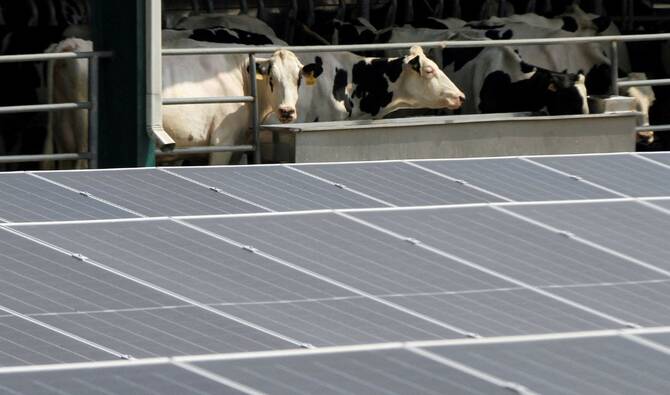
View of solar panels with cows in the background at an Interloop owned dairy farm, in Sheikhupura, Pakistan April 8, 2025. (REUTERS)
Short Url
Updated 19 June 2025
Follow

Pakistan reduces sales tax on imported solar panels from 18% to 10% amid parliamentary pushback

  • The government proposed 18% GST on imported solar panels during budget 2025-26
  • Pakistan imported 17 gigawatts of solar panels in 2024, twice the previous year’s volume

ISLAMABAD: Pakistan’s Deputy Prime Minister Ishaq Dar on Wednesday said the general sales tax (GST) on imported solar panels had been reduced from 18% to 10% for the current year, following concerns raised by a parliamentary finance body.

The Senate Standing Committee on Finance and Revenue had urged the government a day earlier to withdraw the proposed 18% GST on imported solar panels, noting that some stakeholders had begun stockpiling equipment ahead of the federal budget to avoid the new levy.

The country’s proposed federal budget for the 2025-26 fiscal year included an 18% GST on the import and local supply of solar panels and related equipment, prompting concern from industry stakeholders and clean energy advocates.

Pakistan imported 17 gigawatts (GW) of solar panels in 2024, twice the volume recorded the year before, to meet rising consumer demand, according to the Global Electricity Review 2025.

“The 18 percent on top of 46% was an additional burden,” Dar told the National Assembly.

“So, regarding this, after consultations and deliberations, we have decided that this year we will keep a 10% sales tax and not 18%.”

Dar highlighted how this was the most debated subject after the budget was announced.

He also explained that around 46% of components used in solar installations in Pakistan were imported while the remaining 54% including inverters and other equipment were locally sourced and already subject to standard taxation.

Solar energy has supplied 25% of Pakistan’s grid electricity so far this year, placing the country among fewer than 20 globally that generate at least a quarter of their monthly power from solar farms.

Industry stakeholders and clean energy activists had warned that the added cost in tax could slow the rapid adoption of rooftop solar systems by households and businesses, potentially undermining national targets for expanding the share of renewables in the country’s energy mix.

Pakistan increased its solar electricity generation at a rate more than three times the global average in 2025, driven by a surge in solar capacity imports that were over five times higher than in 2022, according to data from Ember, a UK-based energy think tank.

This rapid growth in both capacity and output has propelled solar energy from being the country’s fifth-largest power source in 2023 to the top spot in 2025.


With monitors and lawsuits, Pakistanis fight for clean air

Updated 10 sec ago
Follow

With monitors and lawsuits, Pakistanis fight for clean air

  • Independent air monitors expose gaps in official pollution data
  • Pollution exposure linked to heavy health and economic costs

KARACHI: With pollution in Pakistan hitting record highs in recent years, citizens clutching air monitors and legal papers are taking the fight for clean air into their own hands.

More than a decade ago, engineer Abid Omar had a “sneaking suspicion” that what the government described as seasonal fog was actually a new phenomenon.

“It wasn’t there in my childhood” in Lahore, said the 45-year-old who now lives in coastal Karachi, where the sea breeze no longer saves residents from smog.

With no official data available at the time, Omar asked himself: “If the government is not fulfilling its mandate to monitor air pollution, why don’t I do that for myself?“

His association, the Pakistan Air Quality Initiative (PAQI), installed its first monitor in 2016 and now has around 150 nationwide.

The data feeds into the monitoring organization IQAir, which in 2024 classified Pakistan as the third most-polluted country in the world.

Levels of cancer-causing PM2.5 microparticles were on average 14 times the World Health Organization’s recommended daily maximum.

Schools are often shut for millions of children and hospitals fill up when the smog is at its worst, caused by a dangerous combination of poor-quality diesel, agricultural burning and winter weather.

PAQI data has already played a key role in the adoption of pollution policies, serving as evidence during a 2017 case at Lahore’s high court to have smog recognized as air pollution that is a danger to public health.

Using one of their air monitors, PAQI demonstrated that “the air quality was hazardous inside the courtroom,” Omar said.

The court then ordered the regional government of Punjab to deploy its own monitoring stations — now 44 across the province — and make the data public.

But the government also says private monitors are unreliable and cause panic.

Researchers say, however, that these devices are essential to supplement official data that they view as fragmented and insufficiently independent.

“They got alarmed and shut down some stations when the air pollution went up,” Omar said.

3D-PRINTED MONITORS
Officials have overhauled the management of brick kilns, a major source of black carbon emissions, and taken other measures such as fining drivers of high-emission vehicles and incentivizing farmers to stop agricultural burning.

Worried about their community in Islamabad, academics Umair Shahid and Taha Ali established the Curious Friends of Clean Air organization.

In three years, they have deployed a dozen plug-sized devices, made with a 3D printer at a cost of around $50 each, which clock air quality every three minutes.

Although they do not contribute to IQAir’s open-source map or have government certification, their readings have highlighted alarming trends and raised awareness among their neighbors.

An outdoor yoga exercise group began scheduling their practice “at times where the air quality is slightly better in the day,” said Shahid.

He has changed the times of family outings to minimize the exposure of his children, who are particularly vulnerable, to the morning and evening pollution peaks.

Their data has also been used to convince neighbors to buy air purifiers — which are prohibitively expensive for most Pakistanis — or to use masks that are rarely worn in the country.

’RIGHT TO BREATHE’
The records show air quality remains poor throughout the year, even when the pollution haze is not visible to the naked eye.

“The government is trying to control the symptoms, but not the origin,” said Ali.

Pollution exposure in Pakistan caused 230,000 premature deaths and illnesses in 2019, with health costs equivalent to nine percent of GDP, according to the World Bank.

Frustrated with what they see as government inaction, some citizens have taken the legal route.

Climate campaigner Hania Imran, 22, sued the state in December 2024 for the “right to breathe clean air.”

She is pushing the authorities to switch to cleaner fuel supplies, but no date has been set for a verdict and the outcome remains unclear.

“We need accessible public transport... we need to go toward sustainable development,” said Imran, who moved from Lahore to Islamabad in search of better air quality.

Pollution has multiple causes, she said, and “it’s actually our fault. We have to take accountability for it.”