

Pakistan’s PIA sale draws interest from leading firms, army company ahead of deadline

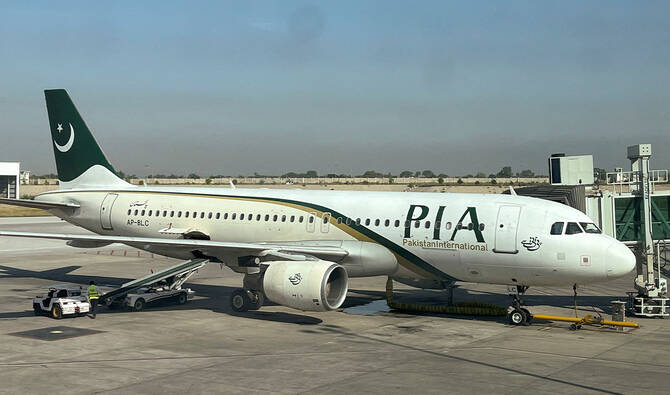
View of a Pakistan International Airlines (PIA) passenger plane, taken through a glass panel, at Islamabad International Airport, Pakistan on October 3, 2023. (Reuters/File)
Short Url
Updated 18 June 2025
Follow

Pakistan’s PIA sale draws interest from leading firms, army company ahead of deadline

  • Pakistan trying to offload state-owned companies to meet IMF demands
  • Previous sales of airline have failed over PIA’s poor conditions, terms

ISLAMABAD: Two of Pakistan’s leading business groups and a company backed by the powerful military will bid for the country’s ailing national carrier, a divestment the government hopes will kickstart the privatizations of state-owned enterprises.

The sale of Pakistan International Airlines will be the first major privatization for around two decades, with the sale of loss-making state-owned enterprises a condition of last year’s $7 billion bailout by the International Monetary Fund.

The government tried unsuccessfully to last year offload a stake in PIA, which is a major burden on its budget, but the sale was aborted because of the poor state of the airline and the conditions attached to any purchase.

Expressions of interest are due by Thursday for an up to 100 percent stake in the airline, with industry insiders expecting more bidders to emerge. They say the deal has been sweetened with a tax incentive and bolstered by signs of a turnaround in PIA’s fortunes.

The Ministry of Privatization did not respond to a request for comment.

Among those planning bids are the Yunus Brothers Group, owners of the Lucky Cement and energy companies; and a consortium led by Arif Habib Limited that includes Fatima Fertilizer, Lake City, and The City School, sources within the companies said.

Fauji Fertilizer Company, which is part-owned by the military, said it will be making an expression of interest, in a notice to the Pakistan Stock Exchange. Fertilizer production is a lucrative sector in Pakistan.

A group of PIA employees has also come forward to bid.

“The employees will use their provident fund and pension, in addition to finding an investor to place a bid. We’re doing this to save jobs and turn around the company,” said Hidayatullah Khan, president of the airline’s Senior Staff Association.

The airline was restructured last year, offloading approximately 80 percent of its legacy debt to the government to make it more attractive to investors. But bidders remain concerned about overstaffing and the ability to fire employees.

Last year’s sale effort failed when the sole bid of $36 million fell far short of a $305 million floor price.

Interested parties walked away before bidding, partly because the government was not willing to give up 100 percent of the company, with bidders saying they did not want the government to remain involved.

Since then, PIA has posted its first operating profit in 21 years, driven by cost-cutting reforms, after making cumulative losses of $2.5 billion.

This success of the current process will depend on whether the government is willing to give up a 100 percent stake, industry insiders said.

They added that a government decision this month to remove the requirement of paying sales tax upfront on the lease of new aircraft, which had been an impediment, will make the deal more attractive.

PIA resumed flights to Europe in January after the European Union lifted a four-year safety ban. The airline has also approached UK authorities for permission to resume services to London and Manchester.

The restoration of international routes is vital to future growth opportunities and successful bidders are likely to bring in foreign airlines as operators. 


Pakistan offers seaport for global cargo transshipment amid Gulf conflict escalation

Updated 12 sec ago
Follow

Pakistan offers seaport for global cargo transshipment amid Gulf conflict escalation

  • Karachi Port Trust says its services can ensure ‘continuity and stability’ of maritime trade
  • The region is currently witnessing significant disruptions to global trade and oil shipments

KARACHI: Pakistan has offered its Karachi seaport for uninterrupted global cargo transshipments as escalating Middle East tensions threaten maritime trade, the country’s largest port operator said on Friday.

Iran has been rocked by joint US and Israeli strikes since Feb. 28 that killed Supreme Leader Ayatollah Ali Khamenei. Tehran retaliated with missile and drone attacks on US, Israeli and allied targets across the Gulf, plunging the region into conflict and uncertainty.

The escalation disrupted air travel, heightened military activity, and disrupted shipping through the Strait of Hormuz, a key route carrying roughly 20 percent of global oil shipments.

The Karachi Port Trust (KPT) said in a statement it was ready to support international shipping lines by offering transshipment services to regional ports, helping ensure the “continuity and stability” of global maritime trade.

“Karachi Port Trust remains fully prepared to support the international maritime community and to provide reliable, efficient, and secure port services in the interest of sustaining regional trade connectivity,” KPT Chairman Shahid Ahmed said, according to a statement circulated by the port authority.

It added the facility could help stabilize maritime trade by offering transshipment services for cargo destined for ports across the region.

The statement said as a demonstration of its capability, international vessels MV TS TACOMA and MV TS SYDNEY arrived in Karachi and discharged large number of containers as transshipment cargo.

“The containers will subsequently be transshipped from Karachi to Jebel Ali in the Middle East,” it continued.

Pakistan Maritime Affairs Minister Junaid Anwar Chaudhry on Thursday highlighted the importance of the Gwadar port city’s transshipment role as major shipping routes face disruption from the ongoing conflict.

The developments come as the Strait of Hormuz, a strategic waterway between Iran and Oman and one of the world’s most critical oil transit routes, has been blocked by Iran which has threatened to attack ships that attempt to transit through it.

US President Donald Trump has assured shipping companies of naval escorts and insurance support to protect vessels.

The escalating tensions have contributed to a sharp rise in energy prices and significant disruptions to tanker traffic through the strategic waterway.

Pakistan has long viewed its seaports as strategic assets that could boost trade with Central Asia and the Gulf region, while helping the country earn valuable foreign exchange.