Pakistani parliamentary body calls for scrapping 18 percent tax on imported solar panels

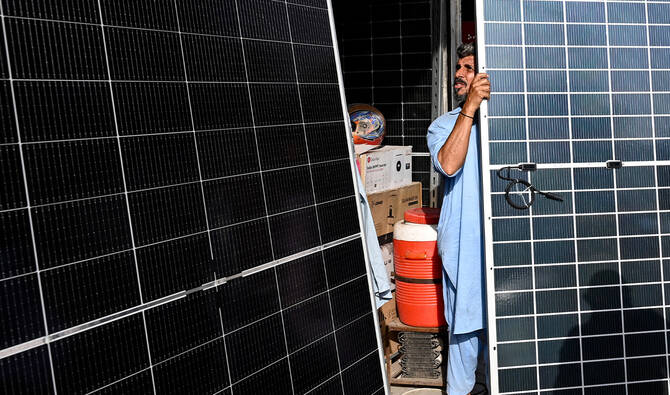
A worker carries solar panels at a market in Lahore, Pakistan, on June 10, 2025. (ANP/File)
Short Url
Updated 18 June 2025
Follow

Pakistani parliamentary body calls for scrapping 18 percent tax on imported solar panels

  • New tax proposals in fiscal year budget 2025–26 have raised concerns among industry players and clean energy advocates
  • Pakistan’s solar generation outpaced global growth by over threefold, provided 25 percent of grid electricity so far this year

ISLAMABAD: Pakistan’s Senate Standing Committee on Finance and Revenue this week urged the government to withdraw a proposed 18 percent general sales tax (GST) on imported solar panels, saying some stakeholders were stockpiling equipment ahead of the federal budget to avoid the new levy.

Under the proposed federal budget for fiscal year 2025–26, the government has included the 18 percent GST on the import and local supply of solar panels and related equipment. The plan has raised concerns among industry players and clean energy advocates who warn that higher costs could slow the rapid uptake of household and commercial rooftop solar systems and undermine national targets for increasing renewable energy’s share in Pakistan’s power mix.

So far this year, solar has provided 25 percent of Pakistan’s grid electricity, placing the country among fewer than 20 worldwide that generate at least a quarter of their monthly power from solar farms.

Pakistan imported 17 gigawatts (GW) of solar panels in 2024 — double the previous year’s volume — to meet surging consumer demand, according to the Global Electricity Review 2025.

“The committee strongly recommended withdrawing the proposed 18 percent GST on solar panels,” the Senate secretariat said in a statement released on Tuesday after the standing committee’s fifth session to review the budget for fiscal year 2025–26.

“Members observed that ahead of the budget, certain stakeholders had imported and dumped solar equipment in anticipation of the tax hike.” 

Senator Saleem Mandviwalla, the chairman of the committee, called the government’s move “discriminatory” in nature.

“The committee rejects the sudden imposition of GST on solar imports and urges immediate withdrawal,” the statement quoted him as saying.

Sharmila Faruqui, a member of the National Assembly’s finance committee, also echoed the Senate panel’s call to scrap the proposed tax.

“I’m in the finance committee and the members have unanimously rejected this tax,” she told Arab News.

Pakistan increased its solar electricity generation at a rate more than three times the global average in 2025, driven by a surge in solar capacity imports that were over five times higher than in 2022, according to data from Ember, a UK-based energy think tank.

This rapid growth in both capacity and output has propelled solar energy from being the country’s fifth-largest power source in 2023 to the top spot in 2025.

With inputs from Reuters 


IMF board to meet tomorrow to consider $1.2 billion disbursement for Pakistan

Updated 11 sec ago
Follow

IMF board to meet tomorrow to consider $1.2 billion disbursement for Pakistan

  • Pakistan, IMF reached a Staff-Level Agreement for second review of $7 billion loan program 
  • Economists view disbursement crucial for cash-strapped Pakistan as it tackles economic crisis

ISLAMABAD: The International Monetary Fund’s (IMF) Executive Board will meet tomorrow, Monday, to consider and approve a $1.2 billion disbursement for Pakistan, according to the global lender’s official schedule. 

The meeting takes place nearly two months after the Fund reached a Staff-Level Agreement (SLA) with Pakistan for the second review of its $7 billion Extended Fund Facility (EFF) and the first review of its $1.4 billion Resilience and Sustainability Facility (RSF). 

The SLA followed a mission led by IMF’s Iva Petrova, who held discussions with Pakistani authorities during a Sept. 24–Oct. 8 visit to Karachi, Islamabad and Washington, DC.

“The International Monetary Fund’s (IMF) Executive Board will convene on Dec. 8 to consider Pakistan’s request for a $1.2 billion disbursement under the Extended Fund Facility (EFF) and the Resilience and Sustainability Facility (RSF), according to the Fund’s updated schedule,” the state-run Pakistan TV reported on Sunday.

Economists view IMF’s bailout packages as crucial for cash-strapped Pakistan, which has relied heavily on financing from bilateral partners such as Saudi Arabia, China and the United Arab Emirates, as well as multilateral lenders including the IMF, World Bank, Asian Development Bank and Islamic Development Bank. 

The South Asian country has been grappling with a prolonged macroeconomic crisis that has drained its financial resources and triggered a balance of payments crisis. Islamabad, however, has recorded some financial gains since 2022, which include recording a surplus in its current account and bringing inflation down considerably. 

Speaking to Arab News last month, Pakistan’s former finance adviser Khaqan Najeeb said the $1.2 billion disbursement will further stabilize Pakistan’s near-term external position and unlock additional official inflows. 

“Continued engagement also reinforces macro stability, as reflected in recent improvements in inflation, the current account, and reserve buffers,” Najeeb said. 

Pakistan came close to sovereign default in mid-2023, when foreign exchange reserves fell below three weeks of import cover, inflation surged to a record 38 percent in May, and the country struggled to secure external financing after delays in its IMF program. Fuel shortages, import restrictions, and a rapidly depreciating rupee added to the pressure, while ratings agencies downgraded Pakistan’s debt and warned of heightened default risk.

The crisis eased only after Pakistan reached a last-minute Stand-By Arrangement with the IMF in June 2023, unlocking emergency support and preventing an immediate default.