

Pakistani parliamentary body calls for scrapping 18 percent tax on imported solar panels

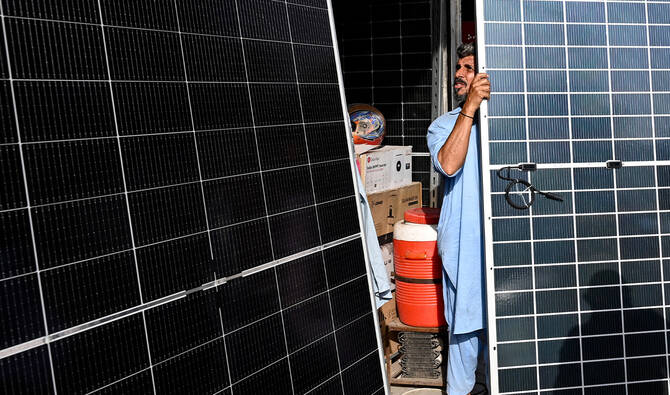
A worker carries solar panels at a market in Lahore, Pakistan, on June 10, 2025. (ANP/File)
Short Url
Updated 18 June 2025
Follow

Pakistani parliamentary body calls for scrapping 18 percent tax on imported solar panels

  • New tax proposals in fiscal year budget 2025–26 have raised concerns among industry players and clean energy advocates
  • Pakistan’s solar generation outpaced global growth by over threefold, provided 25 percent of grid electricity so far this year

ISLAMABAD: Pakistan’s Senate Standing Committee on Finance and Revenue this week urged the government to withdraw a proposed 18 percent general sales tax (GST) on imported solar panels, saying some stakeholders were stockpiling equipment ahead of the federal budget to avoid the new levy.

Under the proposed federal budget for fiscal year 2025–26, the government has included the 18 percent GST on the import and local supply of solar panels and related equipment. The plan has raised concerns among industry players and clean energy advocates who warn that higher costs could slow the rapid uptake of household and commercial rooftop solar systems and undermine national targets for increasing renewable energy’s share in Pakistan’s power mix.

So far this year, solar has provided 25 percent of Pakistan’s grid electricity, placing the country among fewer than 20 worldwide that generate at least a quarter of their monthly power from solar farms.

Pakistan imported 17 gigawatts (GW) of solar panels in 2024 — double the previous year’s volume — to meet surging consumer demand, according to the Global Electricity Review 2025.

“The committee strongly recommended withdrawing the proposed 18 percent GST on solar panels,” the Senate secretariat said in a statement released on Tuesday after the standing committee’s fifth session to review the budget for fiscal year 2025–26.

“Members observed that ahead of the budget, certain stakeholders had imported and dumped solar equipment in anticipation of the tax hike.” 

Senator Saleem Mandviwalla, the chairman of the committee, called the government’s move “discriminatory” in nature.

“The committee rejects the sudden imposition of GST on solar imports and urges immediate withdrawal,” the statement quoted him as saying.

Sharmila Faruqui, a member of the National Assembly’s finance committee, also echoed the Senate panel’s call to scrap the proposed tax.

“I’m in the finance committee and the members have unanimously rejected this tax,” she told Arab News.

Pakistan increased its solar electricity generation at a rate more than three times the global average in 2025, driven by a surge in solar capacity imports that were over five times higher than in 2022, according to data from Ember, a UK-based energy think tank.

This rapid growth in both capacity and output has propelled solar energy from being the country’s fifth-largest power source in 2023 to the top spot in 2025.

With inputs from Reuters 


Imran Khan not a ‘national security threat,’ ex-PM’s party responds to Pakistan military

Updated 06 December 2025
Follow

Imran Khan not a ‘national security threat,’ ex-PM’s party responds to Pakistan military

  • Pakistan’s military spokesperson on Friday described Khan’s anti-army narrative as a “national security threat”
  • PTI Chairman Gohar Ali Khan says words used by military spokesperson for Khan were “not appropriate”

ISLAMABAD: Former prime minister Imran Khan’s Pakistan Tehreek-e-Insaf (PTI) party on Saturday responded to allegations by Pakistan military spokesperson Lt. Gen. Ahmed Sharif Chaudhry from a day earlier, saying that he was not a “national security threat.”

Chaudhry, who heads the military’s media wing as director general of the Inter-Services Public Relations (ISPR), spoke to journalists on Friday, in which he referred to Khan as a “mentally ill” person several times during the press interaction. Chaudhry described Khan’s anti-army narrative as a “national security threat.”

The military spokesperson was responding to Khan’s social media post this week in which he accused Chief of Defense Forces Field Marshal Asim Munir of being responsible for “the complete collapse of the constitution and rule of law in Pakistan.” 

“The people of Pakistan stand with Imran Khan, they stand with PTI,” the party’s secretary-general, Salman Akram Raja, told reporters during a news conference. 

“Imran Khan is not a national security threat. Imran Khan has kept the people of this country united.”

Raja said there were several narratives in the country, including those that created tensions along ethnic and sectarian lines, but Khan had rejected all of them and stood with one that the people of Pakistan supported. 

PTI Chairman Gohar Ali Khan, flanked by Raja, criticized the military spokesperson as well, saying his press talk on Thursday had “severely disappointed” him. 

“The words that were used [by the military spokesperson] were not appropriate,” Gohar said. “Those words were wrong.”

NATURAL OUTCOME’

Speaking to reporters earlier on Saturday, Pakistan’s Defense Minister Khawaja Asif defended the military spokesperson’s remarks against Khan.

“When this kind of language is used for individuals as well as for institutions, then a reaction is a natural outcome,” he said. 

“The same thing is happening on the Twitter accounts being run in his [Khan’s] name. If the DG ISPR has given any reaction to it, then I believe it was a very measured reaction.”

Khan, who was ousted after a parliamentary vote of confidence in April 2022, blames the country’s powerful military for removing him from power by colluding with his political opponents. Both deny the allegations. 

The former prime minister, who has been in prison since August 2023 on a slew of charges he says are politically motivated, also alleges his party was denied victory by the army and his political rivals in the 2024 general election through rigging. 

The army and the government both deny his allegations.