

India regulator says no ‘major safety concerns’ on Air India’s Boeing 787 fleet

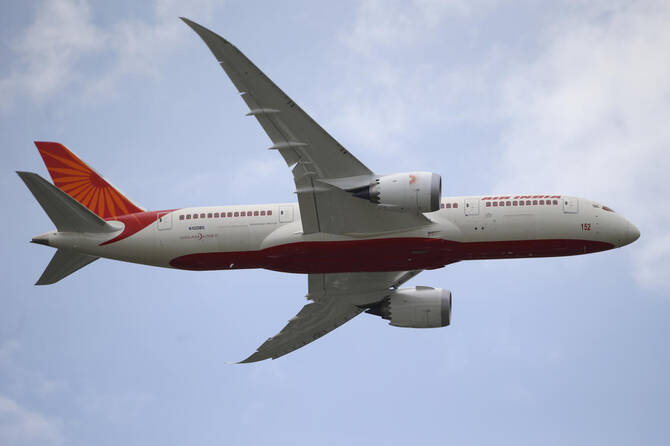
A Boeing 787-8 Dreamliner bound for London with 242 people on board crashed seconds after take-off in Ahmedabad last Thursday, hitting nearby buildings. (AP)
Short Url
Updated 18 June 2025
Follow

India regulator says no ‘major safety concerns’ on Air India’s Boeing 787 fleet

  • 24 of Air India’s 33 Boeing 787 aircraft had completed an ‘enhanced safety inspection’ it had ordered the airline to carry out
  • The regulator raised concerns about recent maintenance-related issues reported by the airline

India’s aviation safety watchdog said on Tuesday surveillance conducted on Air India’s Boeing 787 fleet did not reveal any major safety concerns, days after one of its jets crashed, killing at least 271 people.

“The aircraft and associated maintenance systems were found to be compliant with existing safety standards,” the Directorate General of Civil Aviation said in a statement. The Boeing 787-8 Dreamliner bound for London with 242 people on board crashed seconds after take-off in Ahmedabad on Thursday hitting nearby buildings. All but one passenger on board was killed, along with about 30 people on the ground.

The DGCA also said 24 of Air India’s 33 Boeing 787 aircraft had completed an “enhanced safety inspection” it had ordered the airline to carry out.

The regulator, in a meeting with senior officials of Air India, raised concerns about recent maintenance-related issues reported by the airline.

It advised the carrier to “strictly adhere to regulations,” strengthen coordination across its businesses and ensure availability of adequate spares to mitigate passenger delays, it added.

The DGCA had met senior officials of Air India and Air India Express to review their operations amid increasing flight volumes.


Poland slow to counter Russia’s ‘existential threat’: general

Updated 4 sec ago
Follow

Poland slow to counter Russia’s ‘existential threat’: general

  • The general highlighted a low “pace of technical modernization,” compared to increases in the army’s size
  • Kukula said the Polish army should reach 500,000 soldiers by 2039

WARSAW: Russia poses an “existential threat” to Poland and its military is lagging, the country’s armed forces chief warned senior officials on Wednesday.
Poland, the largest country on NATO’s eastern flank and a neighbor of Russia, Belarus, and Ukraine, is the western alliance’s largest spender in relative terms.
This year, the country is allocating 4.8 percent of its GDP to defense, just shy of the alliance’s five percent target to be met by 2035.
However, that record defense spending was not enough to “make up for nearly three decades of chronic underfunding of the armed forces,” General Wieslaw Kukula, chief of the general staff, argued at the meeting, which included top officers, the defense minister and Poland’s president.
The general highlighted a low “pace of technical modernization,” compared to increases in the army’s size.
Kukula said the Polish army should reach 500,000 soldiers by 2039, compared with around 210,000 at present.
As a result of a lack of updates, some new Polish units “are not achieving combat readiness,” due to insufficient equipment, rather than a personnel shortage, the general argued.
Meanwhile, he added, “the Russian Federation remains an existential threat to Poland.”
Russia “is constantly reorganizing its forces, drawing on the lessons from its aggression in Ukraine, and building up the capacity for a conventional conflict with NATO countries,” he stressed.
Poland is to receive 43.7 billion euros ($51,5 billion) in loans under the European Union’s Security Action For Europe (SAFE) scheme, designed to strengthen Europe’s defensive capabilities.
Warsaw plans to use these funds to boost domestic arms production.
The Polish government claims that Poland will be able to access SAFE finance even if President Karol Nawrocki — backed by Poland’s conservative-nationalist opposition — vetos a law setting out domestic arrangements for its implementation.
Law and Justice (PiS) — the main opposition party — argues that SAFE could become a new tool for Brussels to place undue pressure on Poland, thanks to a planned mechanism for monitoring the funds, which they claim risks undermining Polish sovereignty.