US spies said Iran wasn’t building a nuclear weapon, Trump dismisses that assessment

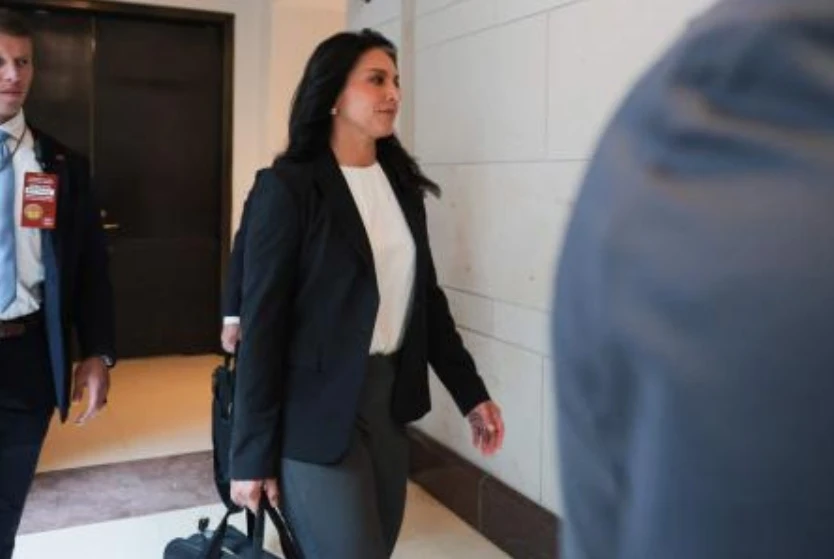
National Intelligence Director Tulsi Gabbard walks into the Defense Subcommittee closed hearing at the US Capitol on Jun. 17, 2025 in Washington, DC. (AFP)
Short Url
Updated 17 June 2025
Follow

US spies said Iran wasn’t building a nuclear weapon, Trump dismisses that assessment

  • The country was not building a nuclear weapon, the national intelligence director told lawmakers
  • Gabbard brushed off the inconsistency, blaming the media for misconstruing her earlier testimony and asserting that “President Trump was saying the same thing that I said“

WASHINGTON: Tulsi Gabbard left no doubt when she testified to Congress about Iran’s nuclear program earlier this year.

The country was not building a nuclear weapon, the national intelligence director told lawmakers, and its supreme leader had not reauthorized the dormant program even though it had enriched uranium to higher levels.

But President Donald Trump dismissed the assessment of US spy agencies during an overnight flight back to Washington as he cut short his trip to the Group of Seven summit to focus on the escalating conflict between Israel and Iran.

“I don’t care what she said,” Trump told reporters. In his view, Iran was “very close” to having a nuclear bomb.

Trump’s statement aligned him with Israeli Prime Minister Benjamin Netanyahu, who has described a nuclear-armed Iran as an imminent threat, rather than with his own top intelligence adviser. Trump was expected to meet with national security officials in the Situation Room on Tuesday as he plans next steps.

Gabbard brushed off the inconsistency, blaming the media for misconstruing her earlier testimony and asserting that “President Trump was saying the same thing that I said.”

“We are on the same page,” she told CNN. Asked for comment, Gabbard’s office referred to those remarks.

In her March testimony to lawmakers, Gabbard said the intelligence community “continues to assess that Iran is not building a nuclear weapon and Supreme Leader Khamenei has not authorized the nuclear weapons program he suspended in 2003.”

She also said the US was closely monitoring Iran’s nuclear program, noting that the country’s “enriched uranium stockpile is at its highest levels and is unprecedented for a state without nuclear weapons.”

Trump’s contradiction of Gabbard echoed his feuds with US spy leaders during his first term, when he viewed them as part of a “deep state” that was undermining his agenda. Most notably, he sided with Russian President Vladimir Putin in 2018 when asked if Moscow had interfered in the 2016 election, saying Putin was “extremely strong and powerful in his denial.”

The latest break over Iran was striking because Trump has staffed his second administration with loyalists rather than establishment figures. Gabbard, a military veteran and former Democratic congresswoman from Hawaii, was narrowly confirmed by the Republican-controlled Senate because of her scant experience with intelligence or managing sprawling organizations.

Gabbard, who left the Democratic Party in 2022 and endorsed Trump in last year’s election, is expected to testify Tuesday in a closed session on Capitol Hill, along with CIA Director John Ratcliffe, during a previously scheduled budget hearing.

Both officials likely would face questions about their views on Iran and Trump’s latest statements. A representative for the CIA did not immediately respond to requests for comment.

The head of the International Atomic Energy Agency has repeatedly warned that Iran has enough enriched uranium to make several nuclear bombs should it choose to do so. Iran maintains its nuclear program is peaceful.

An earlier intelligence report, compiled in November under then-President Joe Biden, a Democrat, also said Iran “is not building a nuclear weapon.”

However, it said the country has “undertaken activities that better position it to produce one, if it so chooses,” such as increasing stockpiles of enriched uranium and operating more advanced centrifuges. The report did not include any estimates for a timeline for how quickly a bomb could be built.

Trump’s immigration agenda is another place where he’s split with intelligence assessments. He cited the Alien Enemies Act, a 1798 wartime law, to deport Venezuelan migrants, which he justified by claiming that the Tren de Aragua gang was coordinating with the Venezuelan government. However, an intelligence assessment in April found no evidence of that.

Gabbard fired the two veteran intelligence officers who led the panel that created the assessment, saying they were terminated because of their opposition to Trump.

In response to those reports, the White House released a statement from Gabbard supporting the president.

“President Trump took necessary and historic action to safeguard our nation when he deported these violent Tren de Aragua terrorists,” the statement said. “Now that America is safer without these terrorists in our cities, deep state actors have resorted to using their propaganda arm to attack the President’s successful policies.”
US and Ukraine ‘a lot closer’ on peace deal, Trump says after meeting with Zelensky

Updated 58 min 14 sec ago
Follow

US and Ukraine ‘a lot closer’ on peace deal, Trump says after meeting with Zelensky

  • Zelensky sees agreement on security guarantees for Ukraine
  • Hurdles to a comprehensive peace deal remain
  • Trump spoke with Putin ahead of meeting on Sunday

PALM BEACH, Florida: US President Donald Trump said on Sunday that he and Ukrainian President Volodymyr Zelensky were “getting a lot closer, maybe very close” to an agreement to end the war in Ukraine, though both leaders acknowledged that ​some of the thorniest details remain unresolved.
The two leaders spoke at a joint press conference late Sunday afternoon after meeting at Trump’s Mar-a-Lago resort in Florida. Trump said it will be clear “in a few weeks” whether negotiations to end the war will succeed.
Zelensky said an agreement on security guarantees for Ukraine has been reached. Trump was slightly more cautious, saying that they were 95 percent of the way to such an agreement, and that he expected European countries to “take over a big part” of that effort with US backing.
Zelensky has said previously that he hopes to soften a US proposal for Ukrainian forces to withdraw completely from the Donbas region of eastern Ukraine, a Russian demand that would mean ceding some territory held by Ukrainian forces.
Both Trump and Zelensky said on Sunday the future of the Donbas had not been settled. “It’s unresolved, but it’s getting a lot ‌closer. That’s a ‌very tough issue,” Trump said.
Just before Zelensky and his delegation arrived at Trump’s Florida residence, Trump ‌and ⁠Russian ​President Vladimir ‌Putin spoke in a call described as “productive” by the US president and “friendly” by Kremlin foreign policy aide Yuri Ushakov.
Ushakov, in Moscow, said Putin told Trump a 60-day ceasefire proposed by the European Union and Ukraine would prolong the war. The Kremlin aide also said Ukraine needs to make a decision regarding the Donbas “without further delay.” And he said the Russian government had agreed to establish working groups to resolve the conflict that will focus on economic and security concerns.


Meeting follows Russian attacks on Kyiv
Zelensky arrived at Mar-a-Lago early Sunday afternoon, as Russian air raids pile pressure on Kyiv. Russia hit the capital and other parts of Ukraine with hundreds of missiles and drones on Saturday, knocking out power and heat in parts of Kyiv. Zelensky has described the weekend attacks ⁠as Russia’s response to the US-brokered peace efforts, but Trump on Sunday said he believes Putin and Zelensky are serious about peace.
The US president said he will call Putin again after meeting with Zelensky. Zelensky ‌had previously told journalists he plans to discuss the fate of the contested Donbas ‍region with Trump, as well as the future of the Zaporizhzhia nuclear ‍power plant and other topics.

Russia claims more battlefield advances 
Putin said on Saturday Moscow would continue waging its war if Kyiv did not seek ‍a quick peace. Russia has steadily advanced on the battlefield in recent months, claiming control over several more settlements on Sunday.
While Kyiv and Washington have agreed on many issues, the issue of what territory, if any, will be ceded to Russia remains unresolved. While Moscow insists on getting all of the Donbas, Kyiv wants the map frozen at current battle lines.
The US, seeking a compromise, has proposed a free economic zone if Ukraine leaves the area, although it remains unclear ​how that zone would function in practical terms.
US negotiators have also proposed shared control over the Zaporizhzhia nuclear plant. Power line repairs have begun there after another local ceasefire brokered by the International Atomic Energy Agency, the agency said on ⁠Sunday.
Russia controls all of Crimea, which it annexed in 2014, and since its invasion of Ukraine nearly four years ago has taken control of about 12 percent of its territory, including about 90 percent of the Donbas, 75 percent of the Zaporizhzhia and Kherson regions, and slivers of the Kharkiv, Sumy, Mykolaiv and Dnipropetrovsk regions, according to Russian estimates.
Putin said on December 19 that a peace deal should be based on conditions he set out in 2024: Ukraine withdrawing from all of the Donbas, Zaporizhzhia and Kherson regions, and Kyiv officially renouncing its aim to join NATO. Zelensky’s past encounters with Trump have not always gone smoothly, but Sunday’s meeting follows weeks of diplomatic efforts. European allies, while at times cut out of the loop, have stepped up efforts to sketch out the contours of a post-war security guarantee for Kyiv that the United States would support.
On Sunday, ahead of the Mar-a-Lago visit, Zelensky said he held a detailed phone call with British Prime Minister Keir Starmer. Trump and Zelensky will hold a phone call with European leaders at some point during the Florida meeting, Trump said. The 20-point plan was spun off from a Russian-led 28-point plan, which emerged from talks between US special envoy Steve Witkoff, Trump’s son-in-law Jared Kushner ‌and Russian special envoy Kirill Dmitriev, and which became public in November.
Subsequent talks between Ukrainian officials and US negotiators have produced the more Kyiv-friendly 20-point plan.