

India evacuates students from Tehran as Israel hits civilian sites

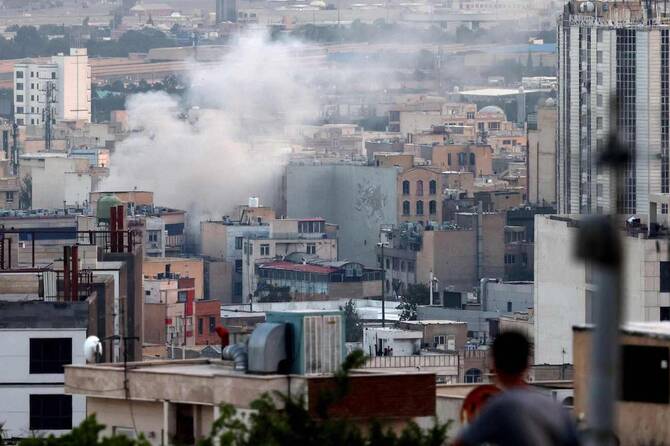
Smoke billows from an explosion in southwest Tehran on June 16, 2025. (AFP)
Short Url
Updated 17 June 2025
Follow

India evacuates students from Tehran as Israel hits civilian sites

  • About 6,000 Indian students are enrolled in Iranian universities
  • So far 110 studying in Urmia have left the country through Armenia

NEW DELHI: India’s Foreign Ministry said on Tuesday it was moving Indian students out of Tehran, as many sought safety after their universities were shut down amid ongoing Israeli airstrikes.

Israeli attacks on Iran started on Friday, when Tel Aviv hit more than a dozen sites — including key nuclear facilities, residences of military leaders, and of scientists — claiming they were aimed at preventing Iran from developing nuclear weapons.

Daily attacks have been ongoing for the past five days after Iran retaliated with ballistic missile strikes against Israel.

As the Israeli military intensified its bombing of civilian targets, hitting Iran’s state broadcaster on Monday, stranded foreigners — including 6,000 Indian students — have been struggling to leave.

“Most of the students here were living in apartments, including me and my friend. The first blast in Tehran happened in Sa’adat Abad district, where me and my friend were living,” Hafsa Yaseen, a medical student at Shahid Beheshti University, told Arab News.

“One of our university’s nuclear scientists was martyred in these blasts. Situation is really bad.”

According to the Iranian Ministry of Health and Medical Education, at least 224 people have been killed and 1,481 wounded in Israeli attacks since Friday. Most of the casualties have been reported in Tehran.

India’s Ministry of External Affairs confirmed in a statement that it was moving those studying at universities in the Iranian capital “out of the city for reasons of safety.”

Yaseen was among a group of a few hundred students moved on Monday to Qom, 140 km south of the capital city.

“Me and my friend were frightened, and we just thought it’s our turn now to die. We were literally calling our parents and telling them goodbye,” she said.

“We are not even safe here, because we are still in Iran (and) anything can happen ... We are in constant fear that we might die and our families are more stressed than us. I just want to request the government of India to evacuate us from here as soon as possible.”

A group of 110 Indian students from Urmia University of Medical Sciences in northwestern Iran has already been assisted by the Indian authorities to leave through the land border with Armenia.

“All the Indian students who had crossed the Iran-Armenia border have now safely reached the capital city, Yerevan. This includes around 90 students from Kashmir Valley, along with others from various Indian states,” said Nasir Khuehami, national convenor of the Jammu and Kashmir Students Union.

“Their flight from Armenia to Delhi is scheduled for tomorrow, with all necessary arrangements being facilitated in coordination with the Indian authorities. This comes as an immense relief to the families.”

The families of those remaining in Iran have been pleading with Indian authorities to also bring them home.

“Please save my daughters. My two daughters study (at) Shahid Beheshti University. They are in great panic — the situation in Tehran is so bad that students are in great panic,” one of the mothers, Mubeena Ali, told Arab News through tears.

“They have been shifted to Qom but they feel afraid ... They are greatly distressed. They want to be evacuated.”


Winter storm packing snow and strong winds to descend on Great Lakes, Northeast

Updated 5 sec ago
Follow

Winter storm packing snow and strong winds to descend on Great Lakes, Northeast

  • The fierce winds on Lake Erie sent water surging toward the basin’s eastern end near Buffalo, New York, while lowering water on the western side in Michigan to expose normally submerged lakebed — even the wreck of a car and a snowmobile

NEW YORK: A wild winter storm was expected to bring strong winds, heavy snow and frigid temperatures to the Great Lakes and Northeast on Tuesday, a day after a bomb cyclone barreled across the northern US and left tens of thousands of customers without power.
The storm that hit parts of the Plains and Great Lakes on Monday brought sharply colder air, strong winds and a mix of snow, ice and rain, leading to treacherous travel. Forecasters said it intensified quickly enough to meet the criteria of a bomb cyclone, a system that strengthens rapidly as pressure drops.
Nationwide, more than 127,000 customers were without power Tuesday morning, more than a third of them in Michigan, according to Poweroutage.us.

BACKGROUND

The storm that hit parts of the Plains and Great Lakes on Monday brought sharply colder air, strong winds and a mix of snow, ice and rain, leading to treacherous travel.

As the storm moved into Canada, the National Weather Service predicted more inclement weather conditions for the Eastern US, including quick bursts of heavy snow and gusty winds known as snow squalls. Blustery winds were expected to add to the arctic chill, with low temperatures dipping below freezing as far south as the Florida panhandle, the agency said.
New York Gov. Kathy Hochul warned that whiteout conditions were expected Tuesday in parts of the state, including the Syracuse metro area.
“If you’re in an impacted area, please avoid all unnecessary travel,” she said in a post on the social platform X.
Snow piled up quickly in Michigan’s Upper Peninsula on Monday, where as much as 2 feet (60 centimeters) fell in some areas, according to the National Weather Service. Meteorologist Ryan Metzger said additional snow was expected in the coming days, although totals would be far lighter.
Waves on Lake Superior that were expected to reach 20 feet (6 meters) on Monday sent all but one cargo ship into harbors for shelter, according to MarineTraffic.com.
The fierce winds on Lake Erie sent water surging toward the basin’s eastern end near Buffalo, New York, while lowering water on the western side in Michigan to expose normally submerged lakebed — even the wreck of a car and a snowmobile.
Kevin Aldrich, 33, a maintenance worker from Monroe, Michigan, said he has never seen the lake recede so much and was surprised on Monday to spot remnants of piers dating back to the 1830s. He posted photos on social media of wooden pilings sticking up several feet from the muck.
“Where those are at would typically be probably 12 feet deep,” he said. “We can usually drive our boat over them.”
Dangerous wind chills plunged as low as minus 30 F (minus 34 C) across parts of North Dakota and Minnesota on Monday. And in northeast West Virginia, rare, nearly hurricane-force winds were recorded on a mountain near Dolly Sods, according to the National Weather Service.
In Iowa, after blizzard conditions eased by Monday morning, high winds continued blowing snow across roadways, keeping more than 200 miles (320 kilometers) of Interstate 35 closed. State troopers reported dozens of crashes during the storm, including one that killed a person.
On the West Coast, the National Weather Service warned that moderate to strong Santa Ana winds were expected in parts of Southern California through Tuesday, raising concerns about downed trees in areas where recent storms had saturated the soil. Two more storms were forecast later this week, with rain on New Year’s Day potentially soaking the Rose Parade in Pasadena for the first time in about two decades.