

Spain says April power outage caused by ‘overvoltage’

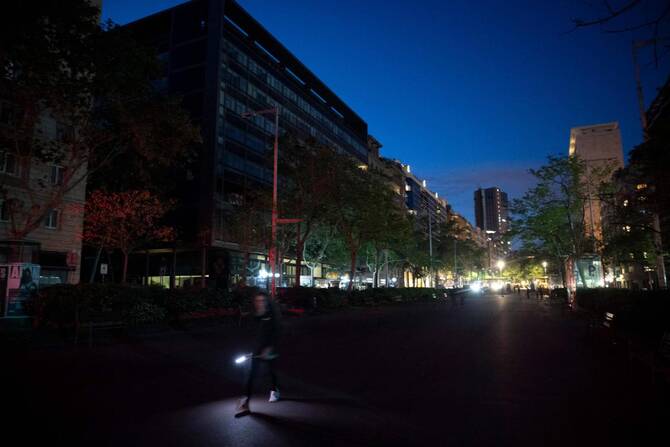
A pedestrian uses a flashlight to walk in a street of Barcelona, without electricity, following a massive power cut affecting the entire Iberian peninsula and the south of France, on Apr. 28, 2025. (AFP/File)
Short Url
Updated 17 June 2025
Follow

Spain says April power outage caused by ‘overvoltage’

  • Ecological Transition Minister Sara Aagesen said the system “lacked sufficient voltage control capacity” that day
  • Authorities have been scrambling to find answers after the April 28 outage

MADRID: A major power outage that struck the Iberian Peninsula in April was caused by “overvoltage” on the grid that led to “a chain reaction,” according to a government report released Tuesday.

The blackout had “multiple” causes, Ecological Transition Minister Sara Aagesen told reporters following a cabinet meeting, adding the system “lacked sufficient voltage control capacity” that day.

Overvoltage is when there is too much electrical voltage in a network, overloading equipment. It can be caused by surges in networks due to oversupply or lightning strikes, or when protective equipment is insufficient or fails.

When faced with overvoltage on networks protective systems shut down parts of the grid, potentially leading to widespread power outages.

Authorities have been scrambling to find answers after the April 28 outage cut Internet and telephone connections, halted trains, shut businesses and plunged cities into darkness across Spain and Portugal as well as briefly affecting southwestern France.

Spanish Prime Minister Pedro Sanchez announced the formation of an inquiry commission led by the Ecological Transition Ministry shortly after the blackout, urging residents not to speculate until detailed results were available.

He had warned that the probe’s conclusions could take several months, given the complexity of the incident.

Aagesen singled out the role of the Spanish grid operator REE and certain energy companies she did not name which disconnected their plants “inappropriately... to protect their installations.”

She also pointed to “insufficient voltage control capacity” on the system that day, due in part to a programming flaw, stressing that Spain’s grid is theoretically robust enough to handle such situations.

Due to these misjudgments “we reached a point of no return with an uncontrollable chain reaction” that could only have been controlled if steps had been taken beforehand to absorb the overvoltage problems, she added.


Guinea dissolves top opposition

Guinea soldiers stand guard in Conakry on September 21, 2025. (AFP file photo)
Updated 7 sec ago
Follow

Guinea dissolves top opposition

  • Political opponents have been arrested, put on trial or driven into exile, while enforced disappearances and kidnappings have multiplied

CONAKRY: Guinea has dissolved 40 political parties, including its three main opposition groups, via a late-night decree, fewer than two months after former junta leader Mamady Doumbouya was sworn in as president.
Doumbouya, who has ruled Guinea with an iron fist, was elected in late December in a vote in which all major opposition leaders were barred.
Guinea’s minister of territorial administration and decentralization ordered the dissolution of the parties late on Friday for “failure to fulfil their obligations.” The decree also stripped them of control of their assets.
Since coming to power in a 2021 coup, Doumbouya has cracked down on civil liberties and banned protests.
Political opponents have been arrested, put on trial or driven into exile, while enforced disappearances and kidnappings have multiplied.
Included among the dissolved groups are Guinea’s three main political parties: the Union of Democratic Forces of Guinea led by its exiled leader Cellou Dalein Diallo, the Rally of the People of Guinea, led by ex-president Alpha Conde, and the Union of Republican Forces.
“This dissolution entails the immediate loss of the legal personality and status of the parties concerned,” the order said.
That includes “all political activities” as well as the use of “acronyms, logos, emblems and other distinctive symbols” associated with the groups, it said.
The parties’ assets have been placed under “sequestration” with a curator appointed to oversee their transfer, the decree said, without specifying to whom or to what entity.
Civil society movements condemned the parties’ dissolution on Saturday, calling it a power grab.
Ibrahima Diallo, a leader in the pro-democracy National Front for the Defense of the Constitution said “the country is sinking into profound uncertainty.”
Two well-known FNDC activists, Oumar Sylla, better known as Fonike Mengue, and Mamadou Billo Bah, have been missing since July 2024.