

Which countries currently have nuclear weapons?

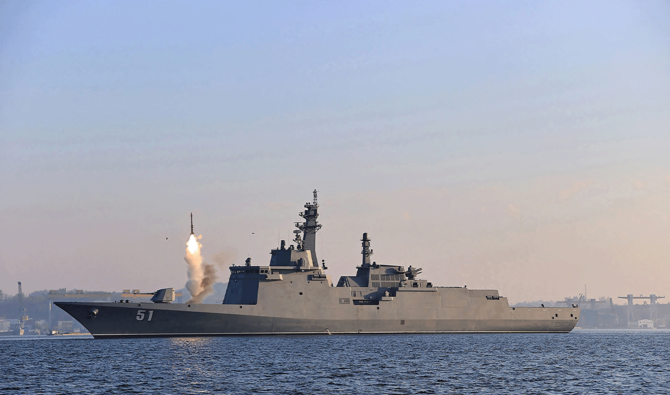
This undated picture released from North Korea's official Korean Central News Agency (KCNA) via KNS on April 30, 2025 shows the test-firing of a weapons system from the deck of North Korea's latest destroyer, the Choe Hyon, during two days of tests on April 28-29 off the coast of an undisclosed location in North Korea. (AFP/KCNA VIA KNS/File)
Short Url
Updated 17 June 2025
Follow

Which countries currently have nuclear weapons?

  • Russia, US, China, France, UK, India, Pakistan and North Korea possess nuclear weapons
  • Israel has never acknowledged having nuclear weapons but is widely believed to have them

Nine countries currently either say they have nuclear weapons or are believed to possess them.

The first to have nuclear arms were the five original nuclear weapons states — the United States, Russia, China, France and the United Kingdom.

All five are signatories to the Nuclear Nonproliferation Treaty, which commits countries that don’t have nuclear arms not to build or obtain them, and those that do to “pursue negotiations in good faith” aimed at nuclear disarmament.

Rivals India and Pakistan, which haven’t signed the NPT, have built up their nuclear arsenals over the years. India was the first to conduct a nuclear test in 1974, followed by another in 1998. Pakistan followed with its own nuclear tests just a few weeks later.

Israel, which also hasn’t signed the NPT, has never acknowledged having nuclear weapons but is widely believed to.

North Korea joined the NPT in 1985 but announced its withdrawal from the treaty in 2003, citing what it called US aggression. Since 2006, it has conducted a string of nuclear tests.

Iran long has insisted its nuclear program is for peaceful purposes only and US intelligence agencies have assessed that Tehran is not actively pursuing the bomb now. But it has in recent years been enriching uranium to up to 60 percent purity — near weapons-grade levels of 90 percent.

In an annual assessment released this week, the Stockholm International Peace Research Institute estimated that the nine countries had the following stockpiles of military nuclear warheads as of January:

Russia: 4,309
United States: 3,700
China: 600
France: 290
United Kingdom: 225
India: 180
Pakistan: 170
Israel: 90
North Korea: 50


Prabowo, Trump expected to sign Indonesia-US tariff deal in January 2026

Updated 23 December 2025
Follow

Prabowo, Trump expected to sign Indonesia-US tariff deal in January 2026

  • Deal will mean US tariffs on Indonesian products are cut from a threatened 32 percent to 19 percent
  • Jakarta committed to scrap tariffs on more than 99 percent of US goods

JAKARTA: Indonesia expects to sign a tariff deal with the US in early 2026 after reaching an agreement on “all substantive issues,” Jakarta's chief negotiator said on Tuesday.

Indonesia’s Coordinating Minister for Economic Affairs Airlangga Hartarto met with US trade representative Jamieson Greer in Washington this week to finalize an Indonesia-US trade deal, following a series of discussions that took place after the two countries agreed on a framework for negotiations in July.

“All substantive issues laid out in the Agreement on Reciprocal Trade have been agreed upon by the two sides, including both the main and technical issues,” Hartarto said in an online briefing.

Officials from both countries are now working to set up a meeting between Indonesian President Prabowo Subianto and US President Donald Trump. 

It will take place after Indonesian and US technical teams meet in the second week of January for a legal scrubbing, or a final clean-up of an agreement text.

“We are expecting that the upcoming technical process will wrap up in time as scheduled, so that at the end of January 2026 President Prabowo and President Trump can sign the Agreement on Reciprocal Trade,” Hartarto said.  

Indonesian trade negotiators have been in “intensive” talks with their Washington counterparts since Trump threatened to levy a 32 percent duty on Indonesian exports. 

Under the July framework, US tariffs on Indonesian imports were lowered to 19 percent, with Jakarta committing to measures to balance trade with Washington, including removing tariffs on more than 99 percent of American imports and scrapping all non-tariff barriers facing American companies. 

Jakarta also pledged to import $15 billion worth of energy products and $4.5 billion worth of agricultural products such as soybeans, wheat and cotton, from the US. 

“Indonesia will also get tariff exemptions on top Indonesian goods, such as palm oil, coffee, cocoa,” Hartarto said. 

“This is certainly good news, especially for Indonesian industries directly impacted by the tariff policy, especially labor-intensive sectors that employ around 5 million workers.” 

In the past decade, Indonesia has consistently posted trade surpluses with the US, its second-largest export market after China. 

From January to October, data from the Indonesian trade ministry showed two-way trade valued at nearly $36.2 billion, with Jakarta posting a $14.9 billion surplus.