

Foreign ownership in Saudi equities tops $105bn despite market pullback

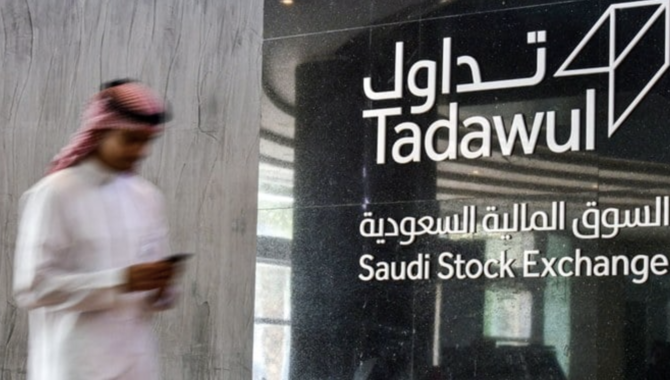
Tadawul has undergone a transformation in recent years to enhance its global appeal. File
Short Url
Updated 17 June 2025
Follow

Foreign ownership in Saudi equities tops $105bn despite market pullback

  • Total value of holdings in the main market fell to SR9.14 trillion
  • Saudi nationals remain dominant in the market, holding SR8.68 trillion

RIYADH: Foreign investors held SR394.58 billion ($105.2 billion) in Saudi equities as of June 12, marking an annual decline of 1.1 percent, although their market share rose amid a broader downturn. 

According to the latest data from Saudi Exchange, the dip in foreign ownership comes as the total value of holdings in the main market fell to SR9.14 trillion, down from SR9.95 trillion in June 2024, as valuations across key sectors — including financials, materials, and energy — softened. 

The increase in foreign investors’ market share — from 4.01 percent to 4.32 percent — is attributed to the overall decline in market size. 

Saudi nationals remain dominant in the market, holding SR8.68 trillion, or 94.94 percent of total ownership, down from SR9.48 trillion, or 95.28 percent, a year earlier.

Investments from Gulf Cooperation Council countries also dipped, with holdings falling from SR70.17 billion to SR67.46 billion, despite their share slightly increasing to 0.74 percent. 

The drop in market capitalization coincided with a 1.5 percent decline in the Tadawul All Share Index on June 12, driven by losses in heavyweight stocks such as Al Rajhi Bank and Saudi Arabian Mining Co. The selloff came amid renewed geopolitical tensions in the region. 

“While solid fundamentals offer a hopeful outlook, the market’s reaction was more heavily influenced by geopolitical tensions,” said Milad Azar, a market analyst at XTB MENA, in comments to Reuters. 

His statement followed the US decision to reposition diplomatic staff in the region, stoking concerns over escalating tensions with Iran. The move added pressure to already cautious markets, where investors have been rebalancing portfolios in response to rising interest rates and shifting risk appetite. 

Despite recent volatility, the long-term outlook for foreign participation remains strong. Saudi Arabia’s inclusion in global emerging market indices — such as MSCI, FTSE Russell, and S&P Dow Jones — continues to support passive fund flows. 

Reforms under Vision 2030, including enhanced transparency, stronger corporate governance, and an expanding privatization pipeline, are widely viewed as central to boosting long-term investor engagement in Saudi Arabia’s capital markets.

The government’s commitment to diversifying the economy has opened new sectors for investment, while regulatory upgrades have helped align local practices with international standards. 

As part of these reforms, Tadawul has undergone a transformation in recent years to enhance its global appeal. The market’s inclusion in major emerging market indices between 2018 and 2019 helped unlock billions in passive fund inflows. Since then, Tadawul has focused on improving disclosure quality, streamlining Qualified Foreign Investor registration, and modernizing its trading and post-trade systems. 

This evolution continues to attract international capital through a growing pipeline of sector-diverse initial public offerings. Recent listings in health care, technology, and consumer goods have provided foreign investors with broader exposure to non-oil growth areas, further supporting portfolio diversification. 

Meanwhile, ongoing efforts to enhance post-trade infrastructure and environmental, social, and governance reporting are expected to improve overall market competitiveness and strengthen the exchange’s appeal to long-term institutional investors.


Arab food and beverage sector draws $22bn in foreign investment over 2 decades: Dhaman 

Updated 28 December 2025
Follow

Arab food and beverage sector draws $22bn in foreign investment over 2 decades: Dhaman 

JEDDAH: Foreign investors committed about $22 billion to the Arab region’s food and beverage sector over the past two decades, backing 516 projects that generated roughly 93,000 jobs, according to a new sectoral report. 

In its third food and beverage industry study for 2025, the Arab Investment and Export Credit Guarantee Corp., known as Dhaman, said the bulk of investment flowed to a handful of markets. Egypt, Saudi Arabia, the UAE, Morocco and Qatar attracted 421 projects — about 82 percent of the total — with capital expenditure exceeding $17 billion, or nearly four-fifths of overall investment. 

Projects in those five countries accounted for around 71,000 jobs, representing 76 percent of total employment created by foreign direct investment in the sector over the 2003–2024 period, the report said, according to figures carried by the Kuwait News Agency. 

“The US has been the region's top food and beverage investor over the past 22 years with 74 projects or 14 projects of the total, and Capex of approximately $4 billion or 18 percent of the total, creating more than 14,000 jobs,” KUNA reported. 

Investment was also concentrated among a small group of multinational players. The sector’s top 10 foreign investors accounted for roughly 15 percent of projects, 32 percent of capital expenditure and 29 percent of newly created jobs.  

Swiss food group Nestlé led in project count with 14 initiatives, while Ukrainian agribusiness firm NIBULON topped capital spending and job creation, investing $2 billion and generating around 6,000 jobs. 

At the inter-Arab investment level, the report noted that 12 Arab countries invested in 108 projects, accounting for about 21 percent of total FDI projects in the sector over the past 22 years. These initiatives, carried out by 65 companies, involved $6.5 billion in capital expenditure, representing 30 percent of total FDI, and generated nearly 28,000 jobs. 

The UAE led inter-Arab investments, accounting for 45 percent of total projects and 58 percent of total capital expenditure, the report added, according to KUNA. 

The report also noted that the UAE, Saudi Arabia, Egypt, and Qatar topped the Arab ranking as the most attractive countries for investment in the sector in 2024, followed by Oman, Bahrain, Algeria, Morocco, and Kuwait. 

Looking ahead, Dhaman expects consumer demand to continue rising. Food and non-alcoholic beverage sales across 16 Arab countries are projected to increase 8.6 percent to more than $430 billion by the end of 2025, equivalent to 4.2 percent of global sales, before exceeding $560 billion by 2029. 

Sales are expected to remain highly concentrated geographically, with Egypt, Saudi Arabia, Algeria, the UAE and Iraq accounting for about 77 percent of the regional total. By product category, meat and poultry are forecast to lead with sales of about $106 billion, followed by cereals, pasta and baked goods at roughly $63 billion. 

Average annual per capita spending on food and non-alcoholic beverages in the region is projected to rise 7.2 percent to more than $1,845 by the end of 2025, approaching the global average, and to reach about $2,255 by 2029. Household spending on these products is expected to represent 25.8 percent of total expenditure in 13 Arab countries, above the global average of 24.2 percent. 

Arab external trade in food and beverages grew more than 15 percent in 2024 to $195 billion, with exports rising 18 percent to $56 billion and imports increasing 14 percent to $139 billion. Brazil was the largest foreign supplier to the region, exporting $16.5 billion worth of products, while Saudi Arabia ranked as the top Arab exporter at $6.6 billion.