


LITTLETON, Colorado: Pakistan is rapidly emerging as a key leader in solar power deployment, and not just within emerging economies.
The South Asian country has boosted solar electricity generation by over three times the global average so far this year, fueled by a more than fivefold rise in solar capacity imports since 2022, according to data from Ember.
That combination of rapidly rising capacity and generation has propelled solar power from Pakistan’s fifth-largest electricity source in 2023 to its largest in 2025.
What’s more, so far in 2025 solar power has accounted for 25% of Pakistan’s utility-supplied electricity, which makes it one of fewer than 20 nations globally that have sourced a quarter or more of monthly electricity supplies from solar farms.
EXCLUSIVE CLUB
Over the first four months of 2025, solar farms generated an average of 25.3% of Pakistan’s utility electricity supplies, Ember data shows.
That average compares with a solar share of 8% globally, around 11% in China, 8% in the United States, and 7% in Europe.
And while the average solar shares in the Northern Hemisphere will climb steadily through the summer months, very few countries will even come close to securing a quarter of all utility electricity supplies from solar farms any time soon.
Indeed, only 17 countries have ever registered a 25% or more share of monthly utility electricity supplies from solar farms, according to Ember.
Those nations are: Australia, Belgium, Bulgaria, Chile, Cyprus, Denmark, Estonia, Germany, Greece, Hungary, Latvia, Lithuania, Luxembourg, the Netherlands, Pakistan, Portugal and Spain. That list is heavily skewed toward Europe, where the power sector shock from Russia’s full-scale invasion of Ukraine in 2022 sparked urgent and widespread power-sector reform and the rapid roll-out of renewable generation capacity.
Indeed, Australia and Chile are the only nations aside from Pakistan that are outside Europe, and all included nations boast a far higher gross domestic product (GDP) per capita than Pakistan.
IMPORT DRIVE
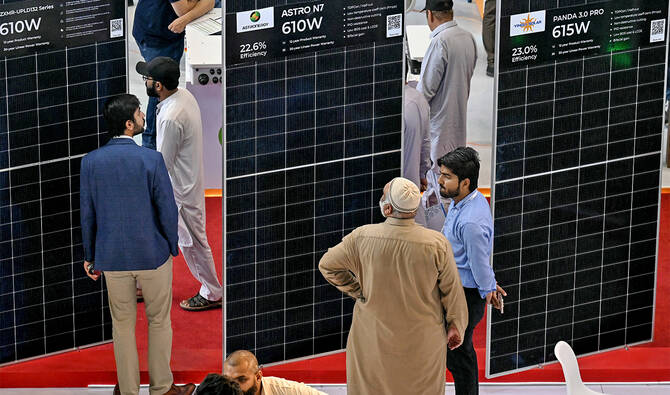
The chief driver of Pakistan’s solar surge has been an accelerating import binge of solar capacity modules from China.
Between 2022 and 2024, Pakistan’s imports of China-made solar components jumped fivefold from around 3,500 megawatts (MW) to a record 16,600 MW, according to Ember.
Pakistan’s share of China’s total solar module exports also rose sharply, from 2 percent in 2022 to nearly 7 percent in 2024.
And that import binge has continued into 2025.
Over the first four months of the year, Pakistan imported just over 10,000 MW of solar components from China, compared with around 8,500 MW during the same period in 2024.
That rise of nearly 18% in imported capacity has lifted Pakistan’s share of China’s solar exports to new highs too, with Pakistan accounting for around 12% of all of China’s solar exports so far this year.
SOLAR-CENTRIC
The frantic deployment of imported solar modules across Pakistan in recent years has upended the country’s electricity generation mix.
So far in 2025, solar is by far the single largest source of electricity, followed by natural gas, nuclear reactors, coal plants and hydro dams.
As solar farms were the fifth-largest supply source for electricity just two years ago, solar’s pre-eminence so far this marks a sharp swing toward renewables within the country’s utility network.
In addition, the country is committed to much more growth in renewable energy generation capacity through the rest of this decade.
Pakistan is targeting 60% of electricity supplies to come from renewable sources by 2030, according to the International Trade Administration.
Through the first four months of 2025, renewable energy sources generated 28% of the country’s electricity, so energy planners are aiming for a more than doubling in that share by the end of the decade.
With solar modules representing the quickest and cheapest means to meet those goals, further rapid build-out of the country’s solar farm system looks likely, which will cement Pakistan’s status as a global solar superpower.


