

Gaza marchers retreat to western Libya after being blocked

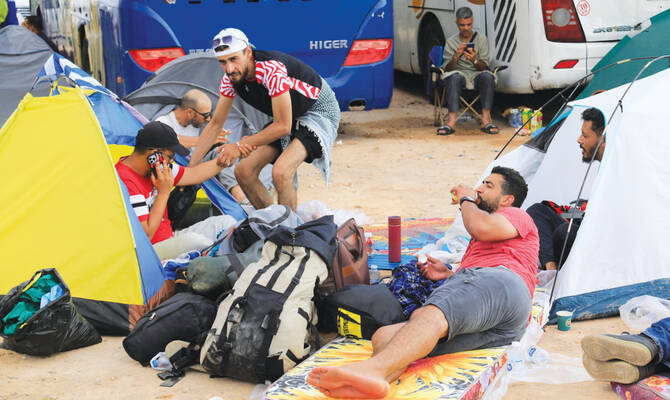
The activists were stuck in Sirte after Libyan authorities blocked them. (AP)
Short Url
Updated 16 June 2025
Follow

Gaza marchers retreat to western Libya after being blocked

  • The ‘Soumoud’ convoy — meaning steadfastness in Arabic — decided to fall back near Misrata, about 200 km east of Tripoli, after being stopped by the eastern authorities

TUNIS: Pro-Palestinian activists on a march aiming to break Israel’s Gaza blockade have retreated to the Misrata region of western Libya after being blocked by the authorities in the country’s east, organizers said on Sunday.

The “Soumoud” convoy — meaning steadfastness in Arabic — decided to fall back near Misrata, about 200 km east of Tripoli, after being stopped by the eastern authorities.

Misrata is administered by the UN-recognized Government of National Unity based in Tripoli, while military commander Khalifa Haftar controls the east.

The convoy of more than 1,000 people from Algeria, Morocco, Mauritania, and Tunisia had been under a “military blockade” since Friday at the entrance to Sirte, a Haftar-controlled area.

Organizers said they were subjected to a “systematic siege,” with no access to food, water, or medicine, and communications severely disrupted.

They also denounced the arrest of several convoy members, including at least three bloggers who had been documenting its journey since its departure from Tunisia on June 9.

In a statement cited by Tunisia’s La Presse newspaper, the Joint Action Coordination Committee for Palestine — the group behind the convoy — demanded the immediate release of 13 participants still held by eastern Libyan authorities.

In an accompanying video, it reaffirmed its intention to continue the mission to Gaza’s Rafah border crossing with Egypt, with the aim of “breaking the blockade and ending the genocide of the Palestinian people resisting in Gaza.”

In Egypt, a separate initiative — the Global March to Gaza, intended to bring together participants from 80 countries — was halted on Friday by authorities en route to the city of Ismailia, east of Cairo.

Dozens of activists were intercepted, reportedly beaten, had passports confiscated, and were forcibly loaded onto buses by police at multiple checkpoints, according to videos shared on social media and with AFP.


Hundreds mourn in Syria’s Homs after deadly mosque bombing

Updated 27 December 2025
Follow

Hundreds mourn in Syria’s Homs after deadly mosque bombing

  • Officials have said the preliminary investigations indicate explosive devices were planted inside the mosque but have not yet publicly identified a suspect

HOMS: Hundreds of mourners gathered Saturday despite rain and cold outside of a mosque in the Syrian city of Homs where a bombing the day before killed eight people and wounded 18.
The crowd gathered next to the Imam Ali ibn Abi Talib Mosque in the Wadi Al-Dhahab neighborhood, where the population is predominantly from the Alawite minority, before driving in convoys to bury the victims.
Officials have said the preliminary investigations indicate explosive devices were planted inside the mosque but have not yet publicly identified a suspect.
A little-known group calling itself Saraya Ansar Al-Sunna claimed responsibility for the attack in a statement posted on its Telegram channel, in which it indicated that the attack intended to target members of the Alawite sect, an offshoot of Shia Islam whom hard-line Islamists consider to be apostates.
The same group had previously claimed a suicide attack in June in which a gunman opened fire and then detonated an explosive vest inside a Greek Orthodox church in Dweil’a, on the outskirts of Damascus, killing 25 people as worshippers prayed on a Sunday.
A neighbor of the mosque, who asked to be identified only by the honorific Abu Ahmad (“father of Ahmad“) out of security concerns, said he was at home when he heard the sound of a “very very strong explosion.”
He and other neighbors went to the mosque and saw terrified people running out of it, he said. They entered and began trying to help the wounded, amid blood and scattered body parts on the floor.
While the neighborhood is primarily Alawite, he said the mosque had always been open to members of all sects to pray.
“It’s the house of God,” he said. “The mosque’s door is open to everyone. No one ever asked questions. Whoever wants to enter can enter.”
Mourners were unable to enter the mosque to pray Saturday because the crime scene remained cordoned off, so they prayed outside.
Some then marched through the streets chanting “Ya Ali,” in reference to the Prophet Muhammad’s cousin and son-in-law whom Shiite Muslims consider to be his rightful successor.