UAE to hit $1tn non-oil trade target 4 years early, says official

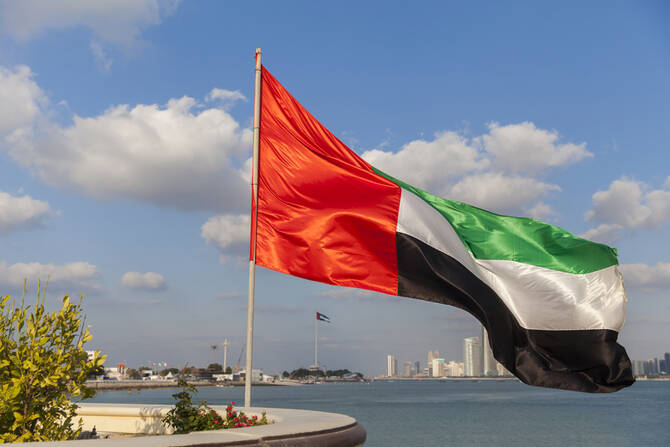
UAE trade is growing ahead of the target pace. Shutterstock
Short Url
Updated 16 June 2025
Follow

UAE to hit $1tn non-oil trade target 4 years early, says official

  • Non-oil foreign trade increased by 18.6% year-on-year in Q1
  • Non-oil exports recorded year-on-year growth of 41%

RIYADH: The UAE is set to achieve its 4 trillion dirhams ($1.089 trillion) target for non-oil foreign trade within two years and ahead of the original 2031 goal, according to the country’s vice president.

In a post on X, Sheikh Mohammed bin Rashid Al-Maktoum highlighted the country’s rapid economic progress, stating that key indicators have surpassed global benchmarks.

This acceleration in trade is mirrored in other areas of the economy. The UAE reported a 4 percent growth in gross domestic product in 2024, with non-oil sectors contributing 75.5 percent of the overall output as diversification efforts gained momentum.

“Our non-oil foreign trade increased by 18.6 percent year-on-year in the first quarter of this year (global average 2-3 percent) — Its volume in the first quarter of this year amounted to 835 billion dirhams. Our non-oil exports grew exceptionally by 41 percent on an annual basis,” Al-Maktoum stated.

He continued: “Our goal is to achieve non-oil foreign trade for the UAE amounting to 4 trillion dirhams by 2031 ... We will reach it within two years ... (four years before the scheduled date).”

Al-Maktoum, who also serves as prime minister, noted that non-oil exports recorded an exceptional year-on-year growth of 41 percent, signaling the country’s strengthening role in international trade.

He further noted that the non-oil sector now contributes 75.5 percent to the national economy, highlighting the country’s successful diversification strategy.

“These are new development indicators for the UAE,” he said, reflecting on the resilience and dynamism of the country’s economy despite global challenges.

Al-Maktoum credited UAE President Sheikh Mohamed bin Zayed Al-Nahyan for leading the country’s transformative economic journey, which he described as achieving “exceptional milestones in the history of the UAE.”

Other countries in the region are also advancing their trade and diversification agendas. 

Saudi Arabia is expanding its non-oil exports, which surged to SR515 billion ($137 billion) in 2024, a 13 percent year-on-year increase and a 113 percent rise since the launch of Vision 2030 in 2016.

Bahrain’s non‑oil sectors are also gaining momentum under its long‑term diversification strategy. In the third quarter of 2024, the non‑oil economy grew by 3.9 percent, accounting for 86.4 percent of real gross domestic product, driving an overall economic expansion of 2.1 percent year on year.


Qatar property transactions reach $177m in late December 

Updated 33 sec ago
Follow

Qatar property transactions reach $177m in late December 

JEDDAH: Qatar’s real estate transactions exceeded 657 million Qatari riyals ($177.4 million) in the week ended Dec. 25, underscoring steady property market activity. 

Data from Qatar’s Ministry of Justice showed that trading across Doha and other municipalities remained elevated, with residential unit sales recorded at 49.4 million riyals during the period, according to the Real Estate Registration Department. 

The figure marks a sharp increase from the previous week, when total real estate transactions reached about 463 million riyals. That earlier period included sales contracts worth 354.26 million riyals and residential unit transactions totaling 108.76 million riyals, the Qatar News Agency reported. 

Qatar’s weekly trading mirrors broader activity across the Gulf region, where major markets such as Dubai and Abu Dhabi have reported strong sales and stable prices, supported by robust residential and commercial demand. 

The weekly activity highlighted sustained investor confidence, reflecting the broader Gulf-wide trend in real estate heading into 2026. 

“The weekly bulletin issued by the department stated that the properties traded included vacant land, houses, residential buildings, residential complexes, commercial shops, commercial and residential buildings, a commercial and administrative building, and residential units,” the QNA report stated.  

Qatar property sales were concentrated in the municipalities of Al-Rayyan, Doha, Al-Wakrah, and Umm Slal, in addition to Al-Daayen, Al Khor, as well as Al Thakhira, and Al-Shamal. They also included key areas including The Pearl Island, and Al-Kharayej, along with Lusail 69, Al-Wukair, Ghar Thuaileb, and Al-Sakhama municipalities. 

The figures highlight sustained activity in Qatar’s real estate market, with a notable week-on-week increase in trading volumes as the year draws to a close. 

The weekly data align with a stronger performance earlier in the year. Qatar’s real estate sector showed resilience in the first half of 2025, supported by rising residential activity, steady office demand and growth in hospitality and retail, according to a September report by Knight Frank. 

Residential transaction values reached 9.23 billion riyals in the second quarter, up 114 percent year on year, led by Doha, Al Daayen and Al Wakrah. Apartment prices rose 3.5 percent to an average of 13,270 riyals per square meter, while villa prices edged lower. Land sales jumped 85 percent, and prime office rents in Lusail held steady at about 115 riyals per square meter. 

Qatar added 718 hotel rooms during the period, while retail assets maintained high occupancy levels, pointing to continued confidence among investors and consumers.