

Former Israeli PM Ehud Barak: Only full-scale war or new deal can stop Iran’s nuclear program

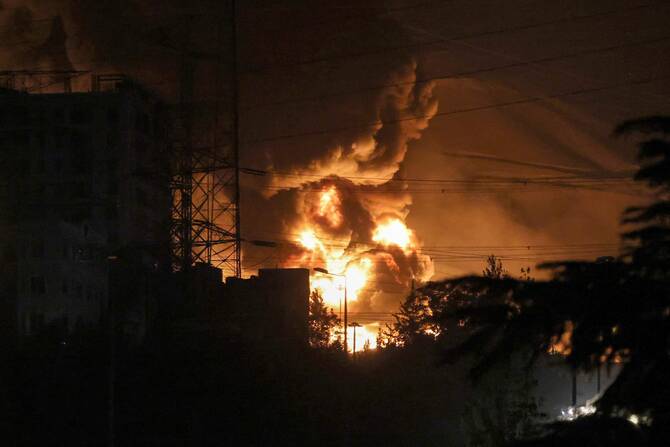
Israel and Iran exchanged fire after Israel unleashed an unprecedented aerial bombing campaign that Iran said hit its nuclear facilities, “martyred” top commanders and killed dozens of civilians. (AFP)
Short Url
Updated 17 June 2025
Follow

Former Israeli PM Ehud Barak: Only full-scale war or new deal can stop Iran’s nuclear program

  • Speaking to CNN’s Christiane Amanpour, Barak said Israel’s ability to hold back Tehran’s program was limited
  • Barak said that while military strikes were “problematic,” Israel viewed the action as justified

LONDON: Former Israeli Prime Minister Ehud Barak has warned that military action by Israel alone will not be enough to significantly delay Iran’s nuclear ambitions, describing the Islamic republic as a “threshold nuclear power.”

Speaking to CNN’s Christiane Amanpour, Barak said that Israel’s ability to hold back Tehran’s program was limited.


“In my judgment, it’s not a secret that Israel alone cannot delay the nuclear program of Iran by a significant time period. Probably several weeks, probably a month, but even the US cannot delay them by more than a few months,” he said.

“It doesn’t mean that immediately they will have (a nuclear weapon), probably they still have to complete certain weaponization, or probably create a crude nuclear device to explode it somewhere in the desert to show the whole world where they are.”

Barak said that while military strikes were “problematic,” Israel viewed the action as justified.

“Instead of sitting idle, Israel feels that they have to do something. Probably together with the Americans we can do more.”

The former premier said that stopping Iran’s progress would require either a major diplomatic breakthrough or a regime change.

“My judgment is that because Iran is already what’s called a threshold nuclear power, the only way to block it is either to impose upon it a convincing new agreement or alternatively a full-scale war to topple down the regime,” he said.

“That’s something that together with the United States we can do.”

But he said he did not believe Washington had the appetite for such a move.

“I don’t believe that any American president, neither Trump or any one of his predecessors, would have decided to do that.”

Israel unleashed airstrikes across Iran for a third day on Sunday and threatened even greater force as some Iranian missiles fired in retaliation evaded Israeli air defenses to strike buildings in the heart of the country.

Israeli emergency services said at least 10 people had been killed in the Iranian attacks, while officials in Iran said that at least 128 people had been killed by Israel’s salvos.


Security, economic and political partnerships in the spotlight at first Jordan-EU Summit

Updated 11 sec ago
Follow

Security, economic and political partnerships in the spotlight at first Jordan-EU Summit

  • Event reflects international confidence in Jordan as a reliable partner in efforts to address security threats, advance peace initiatives, and expand cooperation, analysts say
  • Timing is significant, expert says, given the region faces overlapping crises and threats that place security and defense cooperation at the heart of Jordanian-European relations

AMMAN: The inaugural Jordan-EU Summit underlined the depth of the country’s strategic partnership with Europe, officials and experts said, and confirmed the pivotal role Jordan plays in regional security, political stability and economic cooperation.

Analysts told the Jordan News Agency that Thursday’s summit took place at a sensitive moment for the region, but reflected international confidence in Jordan as a reliable partner in efforts to address cross-border security threats, advance peace initiatives, and expand cooperation in trade, investment and development.

Bashir Al-Dajeh, an expert in security and strategy, said the timing of the summit was significant, given the region is facing overlapping crises and transnational threats that place security and defense cooperation at the heart of Jordanian-European relations.

Jordan’s strategic location positions it on the front lines of efforts to tackle illegal migration, organized crime, drug and arms smuggling and cross-border terrorism, he added. The country has hosted more than 3.5 million refugees over the past decade without compromising its security infrastructure, he noted.

Jordan’s effective border controls were helping to curb irregular migration to Europe and disrupting the plans of extremist groups and trafficking networks, Al-Dajeh said, which was directly benefiting regional and European security.

Khaled Abu Hassan, a member of the Jordanian parliament, said the country’s foreign policy under King Abdullah had reinforced its influence, in the region and internationally, particularly its firm stance in support of the Palestinian cause and a two-state solution to the conflict with Israel.

He said the summit reaffirmed Jordan’s political influence in the shaping of regional balances and advancement of efforts to achieve a just and comprehensive peace. The timing of the meeting also demonstrated the resilience of the nation in managing multiple regional and domestic challenges.

Abu Hassan also highlighted the economic aspects of the summit, including the announcement of a Jordan-EU economic conference in April, as a sign of the international recognition of Jordan’s political and economic role.

Economist Mufleh Aql said the high-level summit reflected a shared desire for a broadening of cooperation to encompass politics, trade, security and renewable energy, and Jordan was well-placed to benefit from access to the EU’s large markets, technology and investment opportunities.

The country could benefit from increased exports, technology transfers and financing for major infrastructure projects in sectors such as water, transport and energy, he added, and in return offer the EU skilled human capital amid labor shortages in Europe.

EU support for Jordan’s positions on issues such as Jerusalem, regional stability, energy and migration further strengthens the partnership, Aql said. Jordan also already benefits from EU grants, concessional loans and exports of agricultural, pharmaceutical and chemical products to European markets, he noted.
