Two police officers killed, two wounded in ambush in Pakistan’s Balochistan province

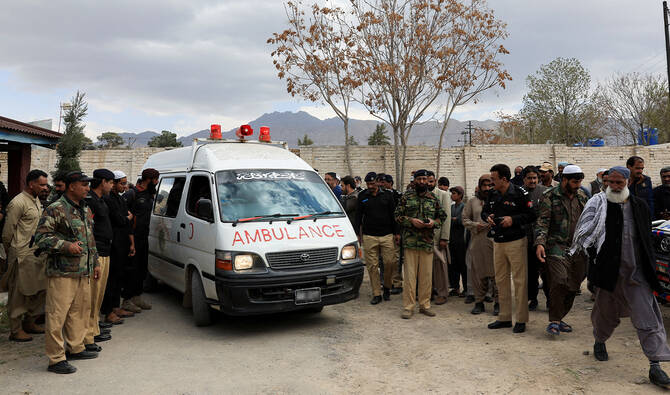
People gather next to an ambulance carrying the bodies of people, who were killed after a train was attacked by separatist militants in Bolan, during the funeral in Quetta, Pakistan, on March 13, 2025. (REUTERS/File)
Short Url
Updated 15 June 2025
Follow

Two police officers killed, two wounded in ambush in Pakistan’s Balochistan province

  • Attack, claimed by BRA separatists, took place late on Saturday in Sui, mountain town about 50km from Dera Bugti city
  • Police were ambushed after they had rushed to the area in two vehicles to respond to reports of a grenade explosion

QUETTA: Two police officers were killed and two others injured when gunmen ambushed a police patrol in Pakistan’s southwestern Balochistan province, officials said on Sunday. 

The attack took place late on Saturday in Sui, a mountainous town about 50km from Dera Bugti city where police had rushed to respond to reports of a grenade explosion.

Jalab Khan, station house officer at Sui Police, said officers were traveling in two vehicles when they were ambushed.

“Nearly a dozen armed men were hiding behind a large rock and attacked our vehicles with heavy gunfire, hand grenades and rocket-propelled grenades,” Khan told Arab News.

“Two policemen were killed on the spot and two sustained bullet wounds,” he said, adding that the attackers fled under the cover of darkness.

The Baloch Republican Army (BRA), an ethnic Baloch separatist group, claimed responsibility for the attack. The BRA has been involved in multiple attacks on security forces and gas infrastructure in Dera Bugti, one of Pakistan’s key natural gas-producing districts.

The group emerged after the killing of veteran Baloch nationalist leader Nawab Akbar Khan Bugti during a military operation in 2006.

Balochistan, which borders Afghanistan and Iran, is a mineral-rich region that is home to Beijing’s investment in the Gwadar deep water port and other projects. It is Pakistan’s largest province by size but smallest by population and the most impoverished. It has long been the site of a separatist insurgency by groups like the BRA, who are fighting for independence.

Pakistan accuses neighboring India and Afghanistan of supporting Baloch separatist militants, a claim they deny. Islamabad also says neighboring Iran does not do enough against militants operating on their shared border. 

“The slain policemen were local residents of Dera Bugti and their bodies have been handed over to families for burial,” said Atta Tareen, the district police officer for Dera Bugti.

A first information police report hasd been registered and Balochistan’s Counter Terrorism Department was leading the investigation, Tareen added.

Pakistan plans digital wheat tracking system, steps up Ramadan price monitoring

Updated 5 sec ago
Follow

Pakistan plans digital wheat tracking system, steps up Ramadan price monitoring

  • Government says adequate stocks available ahead of the upcoming harvesting season
  • It instructs provinces to prevent flour price spikes during the holy month of Ramadan

ISLAMABAD: Pakistan plans to introduce digital traceability and tighter supply chain monitoring in its wheat procurement system under a new long-term policy, the food security ministry said on Saturday, as authorities move to curb price volatility during Ramadan.

The announcement followed a meeting of the National Wheat Oversight Committee chaired by Federal Minister for National Food Security and Research Rana Tanveer Hussain to review procurement arrangements, stock availability and price stability measures ahead of the upcoming harvesting season.

The review comes after riverine floods during last year’s monsoon season damaged farmlands in parts of eastern Punjab, the country’s main wheat-producing region, raising concerns about crop output. Officials at the meeting, however, expressed satisfaction over existing wheat stocks, saying sufficient supplies were available across provinces to meet national consumption needs until the arrival of the new crop.

“The Federal Minister emphasized that the current procurement framework will remain applicable for one year,” the statement said. “He stated that the Federal Government is working on a comprehensive long-term wheat policy for the period 2026–2030, aimed at strengthening national food security through modern reforms.”

“He highlighted that the upcoming policy will focus on digital traceability mechanisms, improved supply chain monitoring, enhanced transparency, and sustained price stability, enabling better coordination between the federal and provincial governments,” the statement added.

The committee was informed that the illustrative wheat procurement price has been fixed at 3,500 rupees ($12.55) per 40 kilograms, and provinces have been asked to ensure smooth implementation of procurement operations.

Special emphasis was also placed on consumer protection during Ramadan.

“The Federal Minister directed all provinces to ensure strict market monitoring and take effective administrative measures to prevent any unnecessary increase in flour prices,” the statement continued.