

Hajj operations set ‘global benchmark’ in crowd management: Sri Lanka envoy

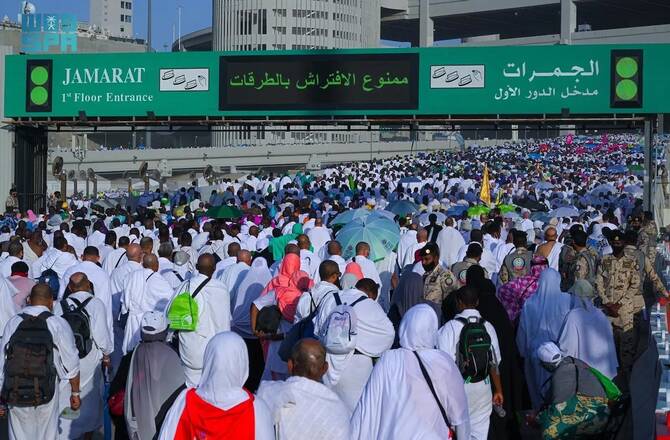
Crowds of pilgrims gather in Mina to perform Hajj rituals on June 7, 2025. (SPA)
Short Url
Updated 15 June 2025
Follow

Hajj operations set ‘global benchmark’ in crowd management: Sri Lanka envoy

  • Almost 1.7m people undertook Hajj pilgrimage this year
  • Saudi authorities used AI systems to manage pilgrim flow

COLOMBO: Saudi Arabia’s organization of this year’s Hajj has set a new standard in crowd management through the use of advanced technologies, Sri Lanka’s envoy said on Sunday, as hundreds of thousands of pilgrims started to return home.

In the 2025 Hajj season, almost 1.7 million people undertook the spiritual journey that is one of the tenets of Islam. More than 1.5 million arrived in the Kingdom from abroad, according to data from the General Authority for Statistics.

Pilgrims started to arrive in May, ahead of the main rituals which this year fell on June 6-10. Many have already departed for their countries of origin but special post-Hajj flights will continue to operate until mid-July.

The way the temporary influx of people has been handled by the Kingdom has “set a global benchmark in crowd management and smart innovation,” said Ameer Ajwad, Sri Lanka’s ambassador to the Kingdom, who this year was part of his country’s Hajj contingent.

Technology has played a key role in monitoring footage from more than 15,000 cameras installed in and around the holy city of Makkah.

The monitoring systems were designed to detect unusual crowd movements and anticipate bottlenecks in foot traffic to help prevent stampedes.

“The Kingdom set an exemplary global benchmark for crowd management by using AI-based crowd monitoring, predictive analytics as well as preventing unauthorized entries,” Ajwad told Arab News.

“Innovations by using advanced technologies such smart tents, digital tools and AI systems were also introduced to facilitate this year’s Hajj arrangements.”

More than 420,000 workers from the public and private sectors, including security services, served pilgrims during this year’s Hajj, GASTAT data shows.

The envoy highlighted the “tireless services rendered by the Saudi security and military officers, as well as guides and volunteers,” and extended gratitude to the Ministry of Health for “providing world-class healthcare services to the Hajj pilgrims (from) around the globe, including heart surgery for a Sri Lankan pilgrim.”

About 3,500 Sri Lankans took part in the pilgrimage this year. Muslims constitute about 10 percent of the 22 million population of the island nation, which is predominantly Buddhist.


Cuba says attacking speedboat had nearly 13,000 rounds of ammunition

Updated 9 sec ago
Follow

Cuba says attacking speedboat had nearly 13,000 rounds of ammunition

  • Firefight took place at a range of 20 meters, Cuba says
  • Incoming crew originally ‌set out on two vessels but ditched one
HAVANA: A commando of Cuban exiles who intended to infiltrate Cuba on a speedboat was armed with nearly 13,000 rounds of ammunition, 13 rifles and 11 pistols, Cuban officials said on Friday, providing new details about Wednesday’s deadly exchange of gunfire at sea. The government in Havana has said 10 Cuban nationals coming from the United States entered Cuban waters and opened fire on a border guard vessel, leading Cuban forces to return fire killing four and wounding six others, who were taken into custody.
In an attempt to dispel doubts about its account to date, senior Cuban Interior Ministry officers displayed the captured armaments from the studio on a special television program, including bins full of at least some of the 12,846 recovered rounds. They also showed pictures of the vessels, each peppered with bullet holes from ‌the firefight they ‌said took place at a range of 20 meters (66 feet).
The confrontation took place ‌at ⁠a fraught moment ⁠in US-Cuban relations, with US President Donald Trump pressuring the island by imposing a virtual oil blockade after capturing and ousting Venezuelan President Nicolas Maduro, a crucial Cuban ally, on January 3.
Cuba has identified the assailants as Cuban exiles, some of whom had been previously placed on a list of accused terrorists, who came from the United States with the intent to sow chaos and attack military units on the Communist-ruled island.
“The intent of this group is to infiltrate, to promote public disorder. To incite the people to unite. To carry out something violent. Attack military units ⁠in order to incite social unrest and to unite the people in order to ‌steal the revolution. That has been duly proven,” said Col. Victor Alvarez ‌of the Interior Ministry.
Cuba says response ‘proportional’
US politicians have expressed skepticism over Cuba’s version of events. Secretary of State Marco ‌Rubio on Wednesday said his government would independently investigate, adding that it was not a US operation and ‌that no US government personnel were involved.
Cuban officers said the infiltrators set out from Marathon in the Florida Keys on two vessels but ditched one at some point due to technical difficulties. They united on one speedboat, which a US official said was reported stolen in Florida. Cuba said it recovered a drone, radios, knives, a portable power plant, bolt cutters and ‌other materiel. They also found emblems of the November 30th Movement and People’s Self-Defense, anti-communist groups that oppose the Cuban government.
Cuba says a patrol of five ⁠border guard members on ⁠a 9-meter boat spotted the incoming vessel shortly after 7 a.m., with some members of the incoming crew in the water, about one nautical mile off a cay on the Caribbean island’s northern coast, about 100 miles (160 km) from Marathon.
The infiltrators opened fire at a distance of 185 meters, striking the captain of the Cuban vessel in the abdomen, Cuba said. Bleeding heavily, the wounded captain remained at the helm and steered toward the enemy vessel, leading to a firefight at a distance of about 20 meters, the officers said.
Cuba called its response “proportional.”
“It is a defensive model that practically never uses firearms, and the use of firearms is proportional to the type of action being carried out against our force,” said Interior Ministry Col. Ybey Carballo.
The captured Cuban nationals were receiving medical care and face charges including armed aggression, illegal entry into national territory, crimes associated with terrorist acts, and arms trafficking, prosecutor Edward Robert Campbell told the program. He said they face prison terms of up to 10 to 15 years for the lesser offenses and 20 to 30 years — or even the death penalty — for the more serious charges.