King Charles III marks Air India tragedy at Trooping the Colour

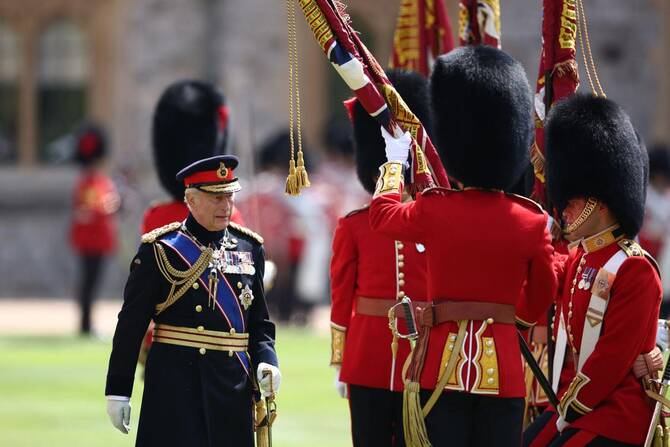
The new Colours are presented to Britain's King Charles III, Colonel in Chief of the Coldstream Guards a ceremony where he presents new Colours to the 1st and 2nd Battalion (Number 7 Company) the Coldstream Guards at Windsor Castle, west of London, on June 13, 2025. (AFP)
Short Url
Updated 14 June 2025
Follow

King Charles III marks Air India tragedy at Trooping the Colour

LONDON: King Charles III and other members of the royal family in uniform wore black armbands and observed a moment of silence during his annual birthday parade Saturday as the monarch commemorated those who died in this week’s Air India plane crash.
Charles requested the symbolic moves “as a mark of respect for the lives lost, the families in mourning and all the communities affected by this awful tragedy,” Buckingham Palace said.
An Air India flight from the northwestern city of Ahmedabad to London crashed shortly after takeoff on Thursday, killing 241 people on board and at least 29 on the ground. The plane was carrying 169 Indians, 53 Britons, seven Portuguese and one Canadian. One man survived.
In addition to being Britain’s head of state, Charles is the head of the Commonwealth, an organization of independent states that includes India and Canada.
The monarch’s annual birthday parade, known as Trooping the Colour, is a historic ceremony filled with pageantry and military bands in which the king reviews his troops on Horse Guards Parade adjacent to St. James’ Park in central London.
The military ceremony dates back to a time when flags of the battalion, known as colours, were "trooped,'' or shown, to soldiers in the ranks so they could recognize them.
All members of the royal family in uniform wore black armbands. The moment of silence occurred while the king was on the dais after reviewing the troops.
Charles’ mother, Queen Elizabeth II, held a similar moment of silence in 2017 when Trooping the Colour took place three days after a fire ripped through the Grenfell Tower apartment bloc in west London, killing 72 people.


Fossils of ‘Java Man,’ first known Homo erectus, return to Indonesia

Updated 6 sec ago
Follow

Fossils of ‘Java Man,’ first known Homo erectus, return to Indonesia

  • Netherlands to repatriate more than 28,000 items in Dubois collection in 2026
  • Fossils excavated in Indonesia were ‘removed against will of people’  

JAKARTA: Prehistoric bones belonging to “Java Man” — the first known fossil evidence of Homo erectus — went on display at Indonesia’s National Museum on Thursday, more than 130 years after they were taken to the Netherlands during Dutch colonial rule.

The parts of the skeleton — a skull fragment, molar and thigh bone — were uncovered along the Bengawan Solo River on Java island in the late 19th century by Dutch anatomist and geologist Eugene Dubois. 

The three items, and a related shell that was scratched by early Homo erectus, are the first in the planned repatriation of more than 28,000 fossils and natural history objects originating in Java and Sumatra that Dubois had removed. 

“Repatriation is a national priority,” Indonesian Culture Minister Fadli Zon said during an official handover ceremony in Jakarta. 

“We bear the responsibility to protect cultural heritage, restore historical narratives and ensure public access to the cultural and scientific heritage that belongs to Indonesia.” 

Fossils of the Java Man, which was hand-carried in a GPS-tracked, climate-controlled suitcase with a diplomatic seal, were some of the first pieces of evidence showing links between apes and humans. 

The fossils are part of the larger Dubois collection that was managed by Naturalis Biodiversity Center, a 200-year-old scientific institution in Leiden. 

The rest of the collection will be transferred to Indonesia in 2026, the Dutch Embassy in Jakarta said in a statement, adding that Indonesia’s National Research and Innovation Agency will take a lead role in preserving and managing the items. 

“This handover marks the beginning of the next phase. We intend to repatriate thousands of items excavated in Indonesia over 130 years ago,” said Marcel Beukeboom, general director of Naturalis Biodiversity Center. 

“This fossil bears witness to an important link in human evolution, while also representing part of Indonesian history and cultural heritage,” he said.

Jakarta started to campaign for the Dutch government to return stolen Indonesian artifacts after declaring independence in 1945, but the Netherlands started to return stolen items only in small numbers in the 1970s. 

Recent efforts by the Indonesian Repatriation Committee have brought back home hundreds of artifacts since 2023, bringing the number to more than 2,000 items so far. 

The repatriation of the Dubois collection was first announced in September, following recommendation by the Netherlands’ Colonial Collections Committee. 

“The Colonial Collections Committee has concluded … that the Dutch state never owned the Dubois collection,” the Dutch government said in a news release issued at the time. 

“The committee believes that the circumstances under which the fossils were obtained means it is likely they were removed against the will of the people, resulting in an act of injustice against them.

“Fossils held spiritual and economic value for local people, who were coerced into revealing fossil sites.” 

The returned fossils are now a centerpiece of “Early History,” a new permanent exhibit at the National Museum in Jakarta that opened to the public on Thursday. 

It explores the history of human civilization throughout Indonesia, with displays including a replica of one of the world’s oldest cave paintings from South Sulawesi and inscriptions from the 4th-century Hindu Kutai Martadipura Kingdom in East Kalimantan.