

Thailand and Cambodia meet over border dispute

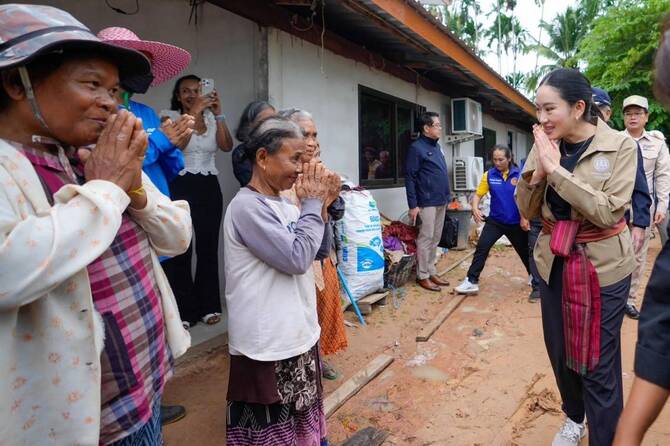
Thailand’s Prime Minister Paetongtarn Shinawatra, right, greets villagers during a visit to Kap Choeng District in Surin Province near the border with Cambodia on June 11, 2025. (Royal Thai Government/AFP)
Short Url
Updated 14 June 2025
Follow

Thailand and Cambodia meet over border dispute

  • Troops from the two countries exchanged fire on May 28 in an area known as the Emerald Triangle
  • The Thai and Cambodian armies both said they had acted in self-defense, but agreed to reposition their soldiers

BANGKOK: Officials from Thailand and Cambodia met Saturday in Phnom Penh, an AFP journalist saw, as the Southeast Asian neighbors sought to resolve a long-running border dispute that last month devolved into clashes.

Troops from the two countries exchanged fire on May 28 in an area known as the Emerald Triangle, where the borders of Cambodia, Thailand and Laos meet, with one Cambodian soldier killed.

The Thai and Cambodian armies both said they had acted in self-defense, but agreed to reposition their soldiers to avoid confrontations.

Thailand has tightened border controls with Cambodia in recent days, while Cambodia ordered troops on Friday to stay on “full alert.”

Officials from the two countries had agreed to resolve the spat at Saturday’s meet in the Cambodian capital Phnom Penh.

Foreign ministry adviser Prasart Prasartvinitchai was leading the Thai delegation, while Chea Lam, minister of state in charge of the Secretariat of Border Affairs, headed the Cambodian contingent.

Neither side commented ahead of the talks.

The row dates to the drawing of the 800-kilometer frontier, largely done during the French occupation of Indochina.

The region has seen sporadic violence since 2008, resulting in at least 28 deaths.

Cambodian Prime Minister Hun Manet announced earlier this month that Cambodia would file a complaint with the International Court of Justice (ICJ) over four disputed border areas, including the site of the latest clash.

The ICJ ruled in 2013 that a disputed area next to Preah Vihear temple belonged to Cambodia, but Thailand says it does not accept the ICJ’s jurisdiction.


Mali, Burkina say restricting entry for US nationals in reciprocal move

Updated 2 sec ago
Follow

Mali, Burkina say restricting entry for US nationals in reciprocal move

ABIDJAN: Mali and Burkina Faso have announced travel restrictions on American nationals in a tit-for-tat move after the US included both African countries on a no-entry list.
In statements issued separately by both countries’ foreign ministries and seen Wednesday by AFP, they said they were imposing “equivalent measures” on US citizens, after President Donald Trump expanded a travel ban to nearly 40 countries this month, based solely on nationality.
That list included Syrian citizens, as well as Palestinian Authority passport holders, and nationals of some of Africa’s poorest countries including also Niger, Sierra Leone and South Sudan.
The White House said it was banning foreigners who “intend to threaten” Americans.
Burkina Faso’s foreign ministry said in the statement that it was applying “equivalent visa measures” on Americans, while Mali said it was, “with immediate effect,” applying “the same conditions and requirements on American nationals that the American authorities have imposed on Malian citizens entering the United States.”
It voiced its “regret” that the United States had made “such an important decision without the slightest prior consultation.”
The two sub-Saharan countries, both run by military juntas, are members of a confederation that also includes Niger.
Niger has not officially announced any counter-measures to the US travel ban, but the country’s news agency, citing a diplomatic source, said last week that such measures had been decided.
In his December 17 announcement, Trump also imposed partial travel restrictions on citizens of other African countries including the most populous, Nigeria, as well as Ivory Coast and Senegal, which qualified for the football World Cup to be played next year in the United States as well as Canada and Mexico.