

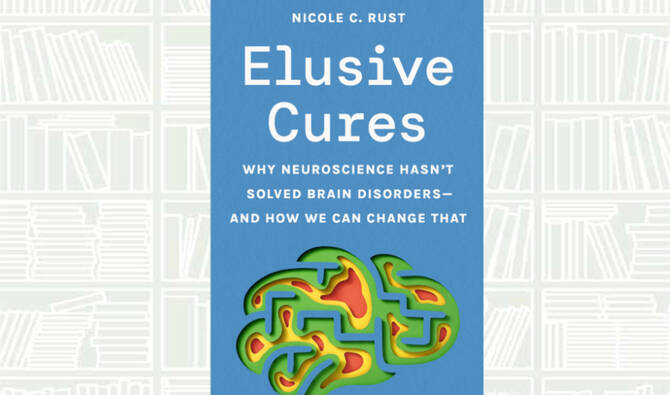
What We Are Reading Today: Elusive Cures

Photo/Supplied
Short Url
Updated 13 June 2025
Follow

What We Are Reading Today: Elusive Cures

  • “Elusive Cures” sheds light on one of the most daunting challenges ever confronted by science while offering hope for revolutionary new treatments and cures for the brain

Author: Nicole C. Rust

Brain research has been accelerating rapidly in recent decades, but the translation of our many discoveries into treatments and cures for brain disorders has not happened as many expected. We do not have cures for the vast majority of brain illnesses, from Alzheimer’s to depression, and many medications we do have to treat the brain are derived from drugs produced in the 1950s—before we knew much about the brain at all. Tackling brain disorders is clearly one of the biggest challenges facing humanity today. What will it take to overcome it? Nicole Rust takes readers along on her personal journey to answer this question.
Drawing on her decades of experience on the front lines of neuroscience research, Rust reflects on how far we have come in our quest to unlock the secrets of the brain and what remains to be discovered.  

“Elusive Cures” sheds light on one of the most daunting challenges ever confronted by science while offering hope for revolutionary new treatments and cures for the brain.


Book Review: ‘Winter Garden’ by Kristin Hannah

Updated 09 January 2026
Follow

Book Review: ‘Winter Garden’ by Kristin Hannah

Kristin Hannah’s “Winter Garden” is a novel that gradually unfolds into something deeply emotional and haunting.

At its heart are two sisters who could not be more different. Meredith has stayed home, building a life around responsibility, family, and the demanding work of running the apple orchard.

Nina has done the opposite, chasing stories across the world as a celebrated photojournalist, avoiding roots and the weight they carry.

Reading “Winter Garden” feels like slowly peeling back layers of a family. The differences between the two sisters feel real, and so does the tension between them.

But what will really move you is their cold, unreachable mother Anya and the way her silence seems to freeze the entire house.

For most of the book readers will ask why she cannot show love. Why is everything so guarded? The only softness in her comes through the Russian fairytale she tells — and even that story is always unfinished.

When the sisters’ father becomes ill and asks that the story finally be told to its end, the novel shifts in a way that genuinely surprises. The fairytale slowly turns into truth. As Anya begins revealing her past in Leningrad — the hunger, the fear, the impossible choices — you feel your perception of her change page by page.

You will start judging her, pitying her, and finally understand that sometimes silence is just another way of surviving.

What makes the book feel personal is the reminder that our parents are not just parents: They are entire worlds of lost dreams, mistakes, heartbreaks, and secrets we may never fully uncover. And sometimes the distance we feel from them has nothing to do with us; it comes from wounds they never healed.

“Winter Garden” is not the kind of novel that grabs you right away. It is slow, heavy at times, and painful. But the emotional payoff is worth it. By the end you feel as though you have been invited into someone’s private grief.