Pakistan warns of ‘first water war’ under nuclear shadow if India cuts off river flows

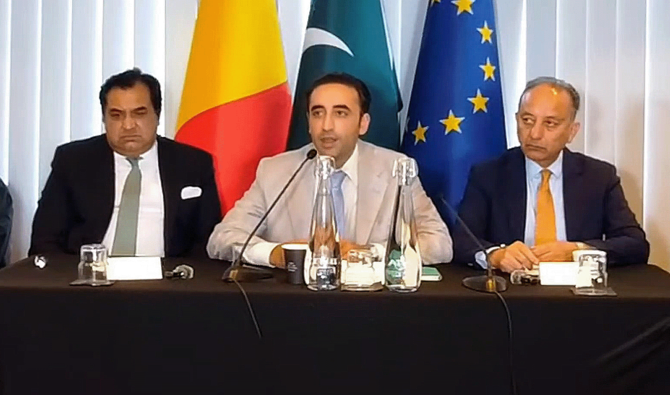
Pakistan's former Foreign Minister, Bilawal Bhutto Zardari (center) addressing to european union think tanks in Brussles, Belgium, on June 13, 2025. (@MediaCellPPP/X)
Short Url
Updated 13 June 2025
Follow

Pakistan warns of ‘first water war’ under nuclear shadow if India cuts off river flows

  • Bilawal Bhutto-Zardari calls Indus Waters Treaty ‘gold standard in diplomacy’ at a think tank in Brussels
  • He condemns Israel’s military strike on Iran, says the region cannot afford the war to continue for long

KARACHI: The head of Pakistan’s diplomatic mission touring world capitals to explain Islamabad’s position on a recent military standoff with New Delhi warned Friday India’s threat to cut off his country’s water supply could lead to the “first water war” between two nuclear-armed states at a think tank in Brussels.

The warning came after New Delhi announced in April it was suspending the 1960 Indus Waters Treaty, a World Bank-brokered agreement seen as a cornerstone of India-Pakistan water cooperation, following a deadly gun attack in Kashmir, which it blamed on Pakistan.

Islamabad denied any involvement and called for an impartial international probe. However, tensions quickly escalated, with both sides deploying fighter jets, missiles, drones and artillery fire before a US-brokered ceasefire was announced by President Donald Trump on May 10.

Bilawal Bhutto-Zardari, Pakistan’s former foreign minister and the current head of the country’s diplomatic outreach, told the European think tank India’s threat to disrupt river flows affecting 240 million people amounted to a “war crime.”

“It would turn this into an existential crisis, and we would be left with no choice but to embark on the first water war… between two nuclear-armed states,” he said.

Bhutto-Zardari described the Indus Waters Treaty as “the gold standard in diplomacy,” noting it had survived multiple wars and had been replicated in over 40 other international water-sharing agreements.

He said recent Indian actions, such as the delayed or excessive release of water, had already damaged Pakistan’s crops and posed a humanitarian risk.

“Just a few days’ delay in water release can have devastating consequences for our agriculture,” he said. “This is the only water supply into Pakistan. In the context of climate vulnerability, the last thing we need is a fault line developing where cooperation once existed.”

His other delegation members maintained undermining the treaty would set a dangerous global precedent, allowing upper riparian states anywhere in the world to disregard binding water-sharing agreements.

“If this treaty is in abeyance, then no treaty signed after World War II is worth the paper it’s written on,” Musadik Malik, the climate change minister, said. “That threatens the rights of lower riparian countries across Africa, South America and beyond.”

Earlier, in a brief exchange with reporters, Bhutto-Zardari welcomed renewed interest from Washington in mediating between India and Pakistan.

“As you have seen, President [Donald] Trump said once again yesterday that he is ready to mediate on Kashmir,” he noted. “At the moment, Pakistan is talking about peace, America is also talking about peace. If anyone is still talking about war, it is India, and, by the grace of God, they will step back from this position soon.”

Responding to a query, Bhutto-Zardari strongly condemned Israel’s military operations against Iran and its broader regional policies.

“We strongly oppose the attack on Iran and the way the war is being waged in this region,” he said. “No amount of condemnation is enough. We demand that this war be stopped and that the entire world plays its role. Peace is very important in our territory. We cannot afford Israel’s war on Iran to continue for long.”


Pakistan remembers Benazir Bhutto, first woman PM in Muslim world, on death anniversary

Updated 22 min 26 sec ago
Follow

Pakistan remembers Benazir Bhutto, first woman PM in Muslim world, on death anniversary

  • Bhutto was daughter of ex-PM Zulfikar Ali Bhutto who was hanged during reign of former military ruler Gen. Zia-ul-Haq
  • Year before assassination in 2007, Bhutto signed landmark deal with rival Nawaz Sharif to prevent army interventions

ISLAMABAD: Prime Minister Shehbaz Sharif and other Pakistani leaders on Saturday paid tribute to Benazir Bhutto, the first woman prime minister in the Muslim world who was assassinated 18 years ago in a gun and bomb attack after a rally in the city of Rawalpindi.

Born on Jun. 21, 1953, Bhutto was elected premier for the first time in 1988 at the age of 35. She was deposed in 1990, re-elected in 1993, and ousted again in 1996, amid allegations of corruption and mismanagement which she denied as being politically motivated.

Bhutto only entered politics after her father was hanged in 1979 during military ruler Gen. Zia-ul-Haq’s reign. Throughout her political career, she had a complex and often adversarial relationship with the now ruling Sharif family, but despite the differences signed a ‘Charter of Democracy’ in 2006 with three-time former PM Nawaz Sharif, pledging to strengthen democratic institutions and prevent military interventions in Pakistan in the future.

She was assassinated a year and a half later.

“Mohtarma Benazir Bhutto took exemplary steps to strengthen the role of women, protect the rights of minorities, and make Pakistan a peaceful, progressive, and democratic state,” PM Shehbaz Sharif, younger brother of ex-PM Nawaz Sharif, said in a statement on Saturday.

“Her sacrifices and services are a beacon of light for the nation.”

President Asif Ali Zardari, Bhutto’s widower, said Bhutto believed in an inclusive Pakistan, rejected sectarianism, bigotry and intolerance, and consistently spoke for the protection of minorities.

“Her vision was of a federation where citizens of all faiths could live with dignity and equal rights,” he said. “For the youth of Pakistan, her life offers a clear lesson: speak up for justice, organize peacefully and do not surrender hope in the face of adversity.”

Powerful families like the Bhuttos and the Sharifs of Pakistan to the Gandhis of India and the Bandaranaike family of Sri Lanka have long dominated politics in this diverse region since independence from British colonial rule. But none have escaped tragedy at the hands of rebels, militants or ambitious military leaders.

It was Zulfikar Ali Bhutto, Bhutto’s father, who founded the troubled Bhutto dynasty, becoming the country’s first popularly elected prime minister before being toppled by the army in 1977 and later hanged. Both his sons died in mysterious circumstances.

Before her assassination on Dec. 27, 2007, Bhutto survived another suicide attack on her motorcade that killed nearly 150 people as she returned to Pakistan after eight years in exile in October 2007.

Bhutto’s Oxford-educated son, Bilawal Bhutto-Zardari, now leads her Pakistan Peoples Party, founded by her father, and was foreign minister in the last administration of PM Shehbaz Sharif.

Aseefa Bhutto Zardari, Bhutto’s daughter who is currently the first lady of Pakistan, said her mother lived with courage and led with compassion in life.

“Her strength lives on in every voice that refuses injustice,” she said on X.

Pakistan has been ruled by military regimes for almost half its history since independence from Britain in 1947. Both former premiers Imran Khan and the elder Sharif, Nawaz, have alleged that they were ousted by the military after they fell out with the generals. The army says it does not interfere in politics.