
KARACHI: Pakistani films that released on the Eid Al-Adha last week attracted the highest Eid box office collections in five years, the sales and marketing head of the country’s largest cinema chain said on Friday.
Pakistani romantic comedy ‘Love Guru,’ starring acting powerhouses Humayun Saeed and Mahira Khan released in cinemas worldwide on Eid-ul-Adha. The other prominent Pakistani movie that released in theaters across the world was “Deemak,” a horror movie with A-list actors Faysal Qureshi, Sonya Hussyn and Samina Peerzada starring in lead roles.
As per official figures released by Love Guru, the Pakistani film collected Rs 12.8 crores [$457,143] in Pakistan during the first three days of Eid Al-Adha, making it the biggest ever Eid weekend opener in the country.
“If we look at Eid [film] business since Covid, we did the biggest business this year [on Eid],” Adnan Ali Khan, the sales and marketing head of Cinepax Cinemas, told Arab News. “Meaning highest in five years.”
He said this does not include The Legend of Maula Jatt film, which enjoyed record-breaking box office business but was not released on Eid.
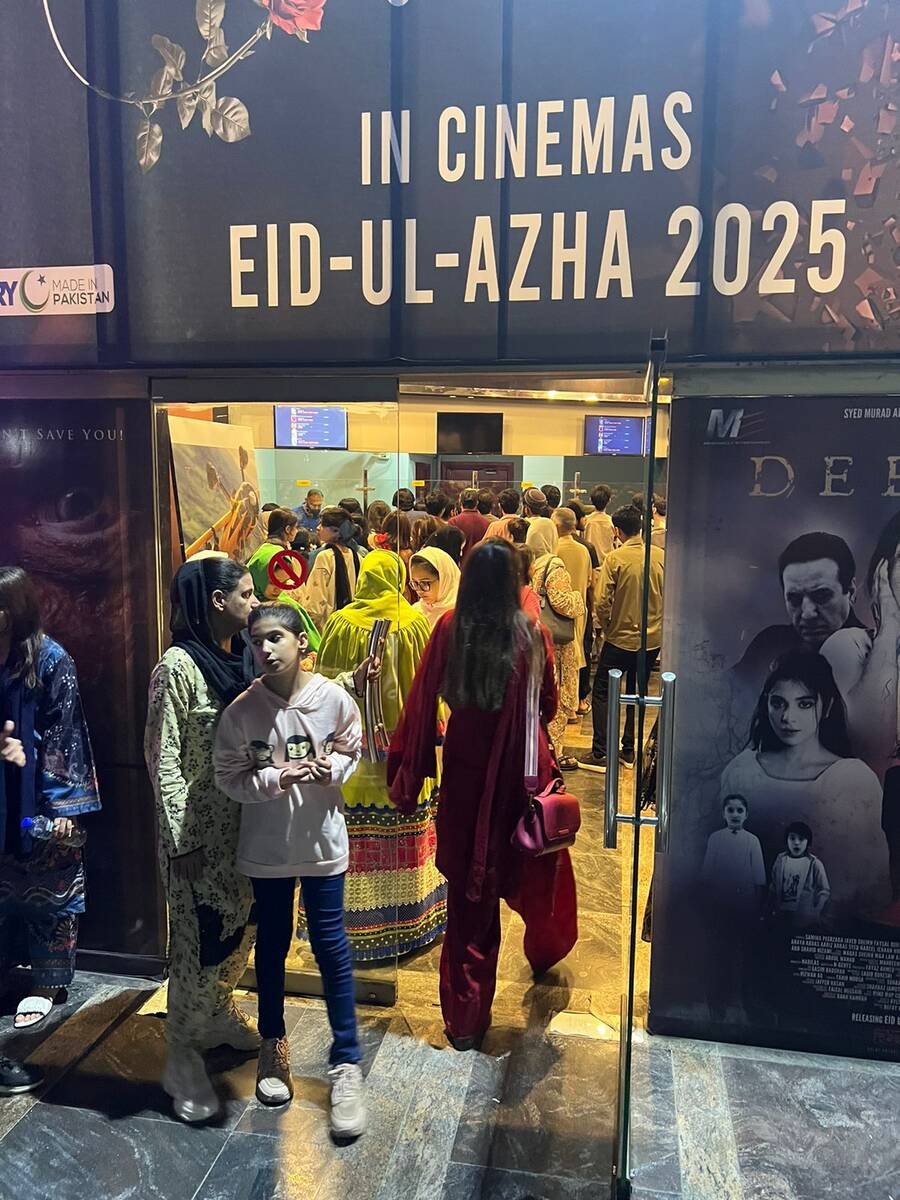
People gather outside cinema hall at the Cinepax, Jinnah Park in Rawalpindi, Pakistan on June 10, 2024, during Eid Al-Adha celebrations in Pakistan. (Photo courtesy: Azadar Kazmi)
“Love Guru got 50 percent of the shows and that is why it generated huge numbers,” Khan explained, adding that Deemak was the second-best performing film on Eid while Hollywood flick “From the World of John Wick: Ballerina” secured the third-highest collections.
The film’s official team announced that its international box office collections for the opening weekend surged to Rs15.4 crores [$546,000]. This means the film raked in a total of Rs28.2 crores [$999,186] in the first three days of the release.
After the first five days of their release, Love Guru’s team said it collected Rs19.10 crores [$676,500] locally while Deemak distributor Nadeem Mandviwalla said the horror flick generated around Rs4 crores [$142,000] at the box office.
Mandviwalla said the film is expected to secure over Rs7 crores [$248,000] in box office collections by the end of this week.
“It is a very encouraging figure for Deemak,” Mandviwalla said.
However, there have been speculations around the authenticity of these figures, particularly at the local box office. There hasn’t been an official detailed division of box office collections in cinemas across Pakistan.
Pakistani film critic Kamran Jawaid, however, brushed aside claims that Love Guru’s box office collections were fabricated.
‘ONLY FOR THE DELUDED’
“When the audience comes out of cinemas in droves at seven in the morning— and that too from multiple shows— then countering claims about fabricated figures is only for the deluded,” Jawaid told Arab News.
He said the high footfall in cinemas across the country puts to rest the opinion that attendances at cinemas are too low due to expensive ticket prices or that audiences no longer harbor interest in Pakistani movie.
“One just has to make movies that people are willing to shell money out on, whether it is Mission: Impossible: The Final Reckoning, which also ran shows till morning two weeks before Eid, or Love Guru,” Jawaid said.
The Pakistani film critic broke down the numbers based on the number of screens and seating capacity of Pakistani cinemas.

People gather outside cinema hall at the Cinepax, Jinnah Park in Rawalpindi, Pakistan on June 10, 2024, during Eid Al-Adha celebrations in Pakistan. (Photo courtesy: Azadar Kazmi)
“Although not big, counting all 91 screens, Pakistan’s total seating capacity is a little above 21,000, which equates to 21 million in ticket sales per show/slot, with an average ticket price of a thousand,” he said.
“An average of four shows per day leads to 84 million in gross income. Depending on the number of screens a film like Love Guru gets — which is roughly between 30-40 percent of the country — per-day estimates range between 25 to 33 million in gross receipts,” Jawaid explained.
“Given that the tickets are selling hot, one cannot refute the legitimacy of the quoted figures.”
Khan said the movies garnered the highest numbers at its cinemas in Packages Mall in Lahore, followed by Jinnah Park in Rawalpindi.
“We are running late night shows every day,” Khan said, adding that the coming weekend was also expected to feature “packed” theaters as the cinemas have bookings in advance.
“We need four Pakistani movies like Love Guru every year,” he said. “However, Deemak has started gaining momentum now alongside Love Guru.”
Jawaid, however, looked toward the future of Pakistani cinema.
“Pakistan’s cinema needs one Love Guru a month to revive audience’s interest,” he said.