

Philippines’ former leader Duterte seeks interim release from ICC

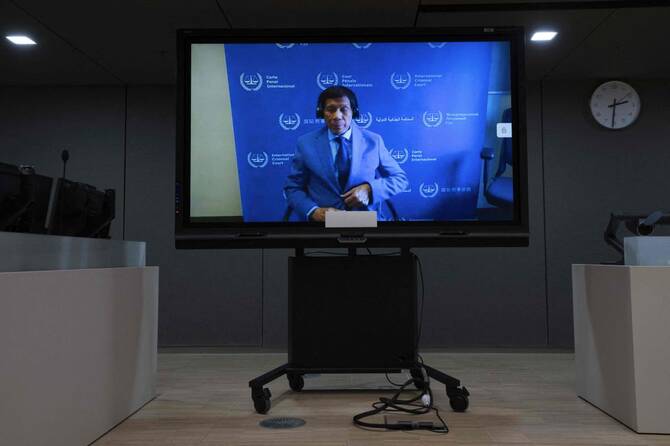
Former Philippine president Rodrigo Duterte is seen on a screen in the courtroom during his first appearance before the International Criminal Court on charge of crimes against humanity over his deadly crackdown on narcotics on March 14, 2025. (AFP)
Short Url
Updated 13 June 2025
Follow

Philippines’ former leader Duterte seeks interim release from ICC

  • Duterte stands accused of crimes against humanity over his years-long campaign against drug users and dealers
  • International Criminal Court prosecutors have agreed not to oppose the request, according to the filing

MANILA: Former Philippine president Rodrigo Duterte’s defense team at the International Criminal Court has filed a motion for his interim release to an unnamed country, stating the prosecution would not object.

The 80-year-old stands accused of crimes against humanity over his years-long campaign against drug users and dealers that rights groups say killed thousands.

In a filing posted to the court’s website late Thursday, defense lawyers said the involved country – the name of which was redacted – had expressed its “principled agreement to receive Mr. Duterte onto its territory.”

ICC prosecutors have agreed not to oppose the request, according to the filing, which said discussions about an interim release had been under way since Duterte’s first court appearance at The Hague on March 14.

“The Prosecution has confirmed its non-opposition to interim release to (REDACTED) (REDACTED) State Party” as long as certain conditions were met, the filing reads.

An annex spelling out the conditions for Duterte’s release was not publicly available, but the defense team’s filing noted that the octogenarian posed no flight risk and cited humanitarian concerns around his age.

Lawyers representing relatives of those killed in Duterte’s drug war condemned the application for release, citing threats made against victims’ families, and saying they had legal avenues to oppose it.

“There is still a procedure within the ICC that requires the prosecution to comment and the ICC Pre Trial Chamber (PTC) to decide on the application for provisional release,” lawyer Neri Colmenares said in a statement.

In an interview with local radio, lawyer Kristina Conti said she believed it was “50-50” the former president would be released.

“I hope the (drug war) victims can weigh in but that would be difficult if (the release is based on) humanitarian grounds, and he is reportedly sick,” she said.

Duterte was arrested in Manila on March 11, flown to the Netherlands that same night and has been held at the ICC’s detention unit at Scheveningen Prison since.

ICC deputy prosecutor Mame Mandiaye Niang is currently overseeing the case against Duterte after Karim Khan stepped aside during an investigation into alleged sexual misconduct.

Requests for comment sent to the ICC prosecutor’s office were not immediately returned.


Old Delhi iftars revive Mughal heritage, one course at a time

Updated 4 sec ago
Follow

Old Delhi iftars revive Mughal heritage, one course at a time

  • Dastarkhwan-e-Jahaanuma iftars have been held in Old Delhi since 2017
  • Muslim and non-Muslim participants arrive from across India and abroad

NEW DELHI: On a rooftop in Delhi’s historic walled city, guests from across India sit on cushions around a low table overlooking Jama Masjid, waiting for its sunset call to prayer — the signal to start a special iftar that will take them back four centuries, to the Mughal era, if only for a while.

Mughals ruled the Indian subcontinent between the 16th and 19th centuries. Originally from Central Asia, they carried traditions borrowed from Arabs, Persians and Ottomans, which they merged with the various local Indian styles — a fusion that marked the global revival of Islamic architecture and culture.

Jama Masjid is one of the most iconic examples of the Mughal style — a scenic background to the curated iftars that bring 40 to 50 people from across India to share a meal, knowledge and experience.

“People getting together from different walks of life, different parts of the country, different religions, different cultures coming together — it was absolutely and completely amazing,” said Arvind Sirohi, who took part in the event with his wife.

“Lovely storytelling, amazing food, and end of the day, right next to Jama Masjid in Old Delhi. The ambience, the environment, the atmosphere came together so beautifully.”

The community-led iftar experience is called Dastarkhwan-e-Jahaanuma — from Urdu words meaning a “spread of food” and “showing the world.”

For Veena Sirohi, it did exactly what the name promised by bringing together people from different communities, different parts of India, and abroad.

“I think that’s a great way of synthesizing different cultures, bringing people together, bringing the human aspect of what we all are ... we are actually all one,” she told Arab News.

“And we had some wonderful comperes who told us about … the history of Ramadan, what goes behind it, how the food is curated, and how each and every item has a specific place in the menu.”

Served in gilded bowls and plates from traditional Indian crockery, with rose petals dotting the dastarkhwan cloth, the dishes were some of the festive Ramadan delicacies, offering a taste of Mughal culinary heritage.

Among them was mutanjan, or fragrant rice cooked with ghee, sugar, saffron, cardamom, and studded with nuts, which for many Indian Muslims is traditionally the first dish to break the fast.

It was followed by shabde, a rich, slow-cooked aromatic meat stew or the Delhi biryani — a fragrant, mildly spiced saffron rice and meat dish, where marinated chicken or mutton is layered with basmati rice and cooked slowly.

The hearty feast closed with nihari, a hearty stew simmered overnight with spices and bone marrow, which emerged in the 18th century and was originally eaten by Mughal royals for breakfast.

“These are the traditional dishes which are not usually available in the market, but are specially prepared by the bawarchees (cooks) of Old Delhi. Some of the dishes are occasional dishes,” said Abu Sufiyan Khan, the founder of Tales of City, the cultural experience company that has been curating Dastarkhwan-e-Jahaanuma since 2017.

The special iftars are hosted once a week throughout the fasting month, usually on weekends. There are variations in dishes served as they come from different kitchens, as Tales of City collaborates with various local artisans and cooks.

“We are curating this with different experts and every time the menu changes,” Khan said.

“We bring all these dishes onto a single dastarkhwan, and we share this meal with the people coming from all over India to break bread together in the holy month of Ramadan, know each other, learn about each other’s culture, and create a dialogue space where we can have more meaningful conversations and an opportunity to get to know each other.”

Those who take part, like Ayandrali Dutta, a food critic, appreciate everything about the experience, especially as it takes place in Old Delhi, where the vibe is always “jovial, lively, in all positive ways” during Ramadan.

“You get to meet interesting people, you get to hear interesting stories ... It’s a great initiative to show what Ramadan is, what kind of food is eaten, talk about the cultures between Lucknow and Delhi and other parts of the country. And it just brings a lot of happiness,” she said.

“I loved it. My heart is happy, my belly is full. Nothing else I can ask for.”