

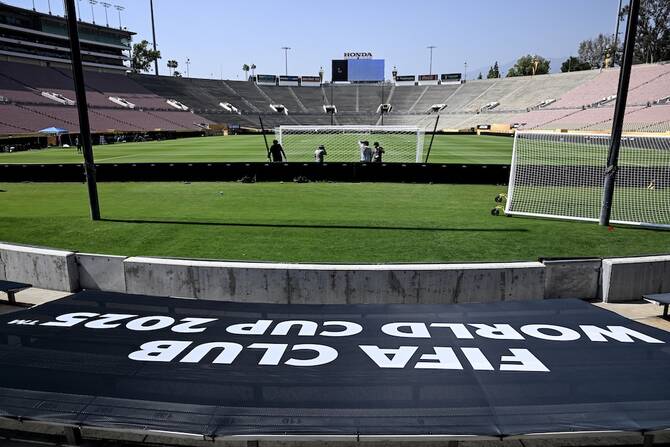

MIAMI: FIFA President Gianni Infantino says the Club World Cup, which kicks off on Saturday, marks a historic “new era” for the game, comparing it to the first World Cup held in 1930.
In an interview with AFP, Infantino also took aim at critics of FIFA’s ticketing policy and said that skeptics who had questioned the need for the tournament would quickly change their minds.
The 32-team competition, with clubs from all continents, gets under way with Inter Miami facing Egyptian club Al Ahly at Hard Rock Stadium.
“It starts a new era of football, a new era of club football. A little bit like when, in 1930, the first World Cup, right, started,” Infantino told AFP.
“Everyone today speaks about the very first World Cup. That’s why it’s also, this World Cup here is historic.”
The first World Cup was held in Uruguay in 1930 and Infantino noted that only European and South American teams took part, adding that the Club World Cup would give a chance to clubs from outside of football’s traditional heartlands to play on the global stage.
“We want to be inclusive. We want to give opportunities to clubs from all over the world,” he said.
“It’s really to globalize football, to make it truly, truly global. Because when you scratch the surface, we say it’s the number one sport in the world, and it is but then the elite is very concentrated in very few clubs, in very few countries,” he said.
The Swiss official, who was general secretary of European body UEFA before taking the helm at FIFA in 2016, said that the club tournament also offered chances to players from over 80 countries.
“Countries who would never have a chance to play in a World Cup are suddenly part of a World Cup and they feel to be part of it, the fans of these players and of these clubs,” added Infantino, who noted several great players of the past who never played in a World Cup,
“A very good friend of mine is George Weah...former legend, great player, Ballon d’Or winner, only African player who ever won the Ballon d’Or, by the way. He never played in a World Cup. He would have been playing in a Club World Cup and made not only his club and also his country proud,” he added.
Infantino dismissed concerns that the tournament added to fixture congestion but acknowledged that some fans were yet to be sure of the value of the tournament, saying though that would quickly change.
“I believe, I’m convinced that, you know, as soon as the ball starts rolling, the whole world will realize what is happening here. It’s something special,” he said.
Reports of low uptake of tickets for same games has led to criticism of FIFA’s ticketing policy with ‘dynamic pricing’, increasingly common in the United States, allowing for prices to rise and fall according to demand.
But Infantino defended the approach and the decision to offer heavy discounts to students in Miami.
“I’m a positive person generally, but they criticize FIFA if the prices are too high, then they criticize FIFA if the prices are too low.
“Then they criticize FIFA if we make ticketing promotions with students. Students! I mean, when I was a student and I didn’t have money, I would have loved FIFA to come to me and say, you want to come and watch a World Cup match?”
“We don’t want to see empty stadiums. I believe the stadiums will be pretty full,” he said.
The FIFA president said that the tournament, which secured a global broadcasting deal with DAZN reported to be worth $1 billion, was already an economic success and stressed that all the money generated from commercial deals would be plowed back into the game.
Asked how he would judge whether the tournament had been a success, Infantino said he would feel it in his ‘heart’ but said he was confident.
“In terms of inclusivity, in terms of economy, in terms of fan interest, you take all of these criteria, we’ll speak again at the end of the club World Cup, but already now, I (feel positive), when I look at the number of tickets sold, and I look at the TV rights,” he said, noting that the games were available on DAZN’s streams for free.
“Tell me one top competition today, where you can watch football for free?” he asked.
The Club World Cup has also been caught up in the US’s fierce debates over immigration control with games being held near Los Angeles, scenes of violent clashes between protesters and immigration officers.
“Security for me and for us is a top priority, always. So when something is happening, like in Los Angeles we are obviously monitoring the situation, we are in constant contact with the authorities, we want fans to go in games in a safe environment,” he said.


