
MOROCCO: Egyptian authorities detained more activists planning to march to Gaza in protest of restrictions on aid reaching the territory, while security forces in eastern Libya blocked a convoy of activists en route to meet them.
Demonstrators from 80 countries planned to march to Egypt’s border with Gaza to spotlight the deepening humanitarian crises facing Palestinians since Israel began blocking aid trucks from entering the coastal enclave in March.
Israel slightly eased restrictions last month, allowing limited aid in, but experts warn the measures fall far short.
The Global March on Gaza was slated to be among the largest demonstrations of its kind in recent years, coinciding with other efforts, including a boat carrying activists and aid that was intercepted by Israel’s military while on its way to Gaza earlier this week.
BACKGROUND
Friday’s detentions come after hundreds arriving in Cairo were earlier detained and deported to their home countries in Europe and North Africa.
Organizers on Friday said authorities confiscated the passports of 40 activists at what they called a “toll booth-turned-checkpoint” being patrolled by riot gear-clad officers and armored vehicles.
Others were detained at hotels.
The group’s spokespeople urged officials from the activists’ home countries to push Egypt to release their citizens.
Friday’s detentions come after hundreds arriving in Cairo were earlier detained and deported to their home countries in Europe and North Africa.
Before authorities confiscated their passports, the activists said they planned to gather at a campsite on the road to the Sinai to prepare for Sunday’s march.
They said authorities had not yet granted them authorization to travel through the Sinai, which Egypt considers a highly sensitive area.
“We continue to urge the Egyptian government to permit this peaceful march, which aligns with Egypt’s own stated commitment to restoring stability at its border and addressing the ongoing humanitarian crisis in Gaza,” the activists said in a statement.
As activists at the checkpoint languished in the heat, Hicham El-Ghaoui, one of the group’s spokespeople, said they would refrain from demonstrating until they were clear on whether Egypt would authorize their protest.
The planned demonstrations cast an uncomfortable spotlight on Egypt, one of the Arab countries that has cracked down on pro-Palestinian activists even as it publicly condemns aid restrictions and calls for an end to the war.
The government has arrested and charged 186 activists with threatening state security since the war began, according to the Egyptian Initiative for Personal Rights.
Many of them said they were protesting peacefully and collecting donations for Gaza.
Still, the severity of the crackdown surprised European activists.
Antonietta Chiodo, who traveled to Cairo from Italy, said those awaiting further instruction had been detained, interrogated, treated harshly by Egyptian authorities, or deported.
Alexis Deswaef, a Belgian human rights lawyer, said he woke up to dozens of security vehicles packed with uniformed officers surrounding Talat Harb Square, where activists had found hotels.
Members of his group snuck out of the lobby as security entered, asking an officer for assistance booking taxis to the Pyramids of Giza, where they’ve been since.
“I am so surprised to see the Egyptians doing the dirty work of Israel,” he said from the Pyramids.
He hoped there would be too many activists outside Cairo at the new meeting point for Egyptian authorities to arrest en masse.
In a divided Libya, Egypt-backed authorities stop a convoy
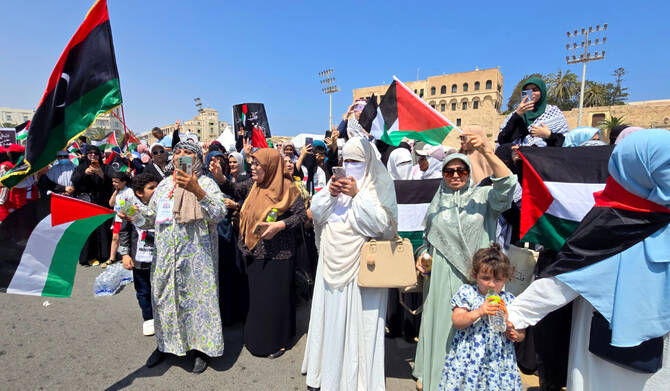
Meanwhile, an aid convoy traveling overland from Algeria picked up new participants along the route in Tunisia and Libya but was stopped in the city of Sirte, about 940 km from the Libya-Egypt border.
Organizers of the overland convoy said late Thursday night they had been stopped by authorities governing eastern Libya, which has for years been divided between dueling factions.
The convoy was allowed to cross from Tunisia to Libya but was halted near the front line.
The Benghazi-based government urged activists to “engage in proper coordination with the official Libyan authorities through legal and diplomatic channels to ensure the safety of all participants and uphold the principles of solidarity with the Palestinian people.”
It said they should return to their home countries and cited Egypt’s public statements that marchers had not been granted authorization.
Organizers leading the overland convoy said authorities had allowed them to camp in Sirte and await further approval.
Their group, which includes thousands of participants, had already traversed parts of Algeria, Tunisia, and the western Libyan cities of Tripoli and Misrata.
Jawaher Shana, one of the convoy’s organizers, said it would eventually continue.
“We didn’t cross 2,000 km all for nothing!” she yelled to a crowd at Sirte Gate, referencing the length of the Mediterranean coastline the convoy had traveled.
The efforts — the activist flotilla, the overland convoy, and the planned march — come as international outcry grows over conditions in Gaza.
Israel has continued to pummel the territory with airstrikes while limiting the flow of trucks carrying food, water, and medication that can enter.
The UN has said the vast majority of the population relies on humanitarian aid to survive, and experts have warned the coastal enclave will likely fall into famine if Israel doesn’t lift its blockade and stop its military campaign.
Over UN objections, a US-backed group has taken control of the limited aid entering Gaza.
But as desperate Palestinians crowd its distribution sites, chaos has erupted, and almost 200 people have been killed near aid sites.
Nearly half a million Palestinians are on the brink of possible starvation, and 1 million others can barely get enough food, according to the Integrated Food Security Phase Classification, a leading international authority.
Israel has rejected the findings, saying the IPC’s previous forecasts had proven unfounded.