

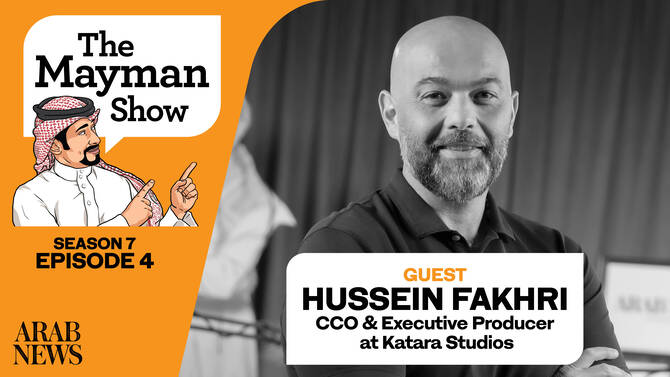

Riyadh: The Arab world’s roots in detailed storytelling means that the region is well suited to making movies, according to Hussein Fakhri, chief commercial officer and executive producer for Katara Studios, and the latest guest on The Mayman Show.
Founded in 2018, the Doha-based production powerhouse is behind regionally iconic projects such as the fantasy short film “The Lost Chapter of Kelileh & Demneh” and the ceremonies for the 2022 FIFA Arab Cup.
“Storytelling, I think, is in our DNA, as Arabs generally, right? We come from a long line of storytellers; it is really part of who we are,” Fakhri said. “For me, the sort of career advancement was very much evolutionary, organic, as I come from an advertising and marketing background.”
Before entering the world of filmmaking and immersive storytelling, Hussein started out in Dublin, Ireland, pioneering digital advertising in a market far from his cultural roots. Hussein left the marketing agency life and now leads Katara’s mission to produce bold, meaningful stories that resonate with a global audience with an unapologetically Arab perspective.
“I had my own advertising agency, and we had so much work that I had to found a film production company to be able to shoot our TV commercials,” Fakhri said. “I would hire filmmakers, and we started doing short films, more brand films and documentaries, and that just sort of evolved. I just love the craft, although I’m not a filmmaker myself, but I just love the business of it.”
Part of the work was instrumental in what eventually evolved into Katara Studios, founded by a group of talented filmmakers, he said. “Watching them work and watching the kind of stuff that they do — just the love for it grew, to be honest.”
The need for premium Arabic content that resonates with a global audience is the main driver for what Katara does creatively, he said.
“We have a huge audience. We have 500 million Arabic speakers. And we have very little premium content for them. There was a gap there that was spotted and an opportunity to be able to create premium content for this primary audience.”
The demand for premium Arabic content and the interest in Arabic culture made for a great recipe for success, he said.
“We also have a lot of people around the world that are very interested in our culture, are very interested in our part of the world. And I don’t think we’ve given them enough content to engage with us, and that’s what we are trying to do, ultimately.”
With a culture as rich and layered as the Arab world’s, authenticity is not simply a goal — it is a responsibility for Katara Studios projects, he said, as they aim to bring stories to life with depth, accuracy, and heart, even when they are infused with other styles of filmmaking.
Katara Studios is producing a fantasy Bedouin Western, and according to Fakhri, a balance for this genre experimentation and cultural authenticity is critical to telling a good story and being innovative without losing its Arab essence.
Asked how Bedouin storytelling could be showcased with this approach to experimental filmmaking, Fakhri said: “You know, I’m so glad you brought up that word because authenticity is the foundation for everything that we try to do. Genuinely, it has to be authentic. Because if it is not authentic — if you’re trying to please an audience just by throwing stuff in there — it shows every time.”
Authenticity required cultural integrity — such as maintaining dialect, accents, costumes and other small and important details in the presentation — and this would then reflect very positively to the film, he said.
“You get every element of it right; it really comes through in the final product. So, we’re very careful to try to be as authentic as possible. And I think we’ve done that with this project,” Fakhri said.

keywords


