

Mixed weather conditions forecast as Pakistan issues advisory for June 13-18

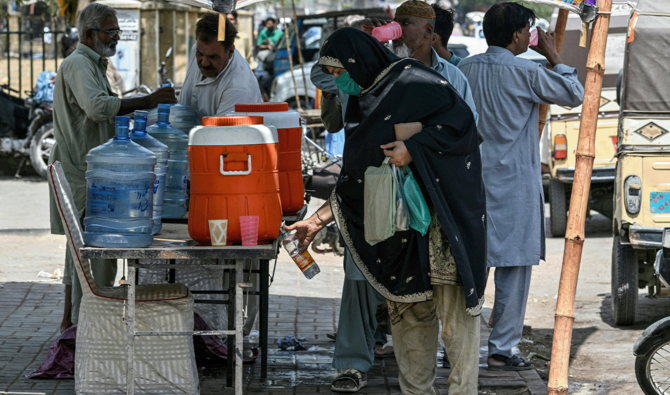
People drink water from a roadside arrangement to stay hydrated on a hot summer day amid the ongoing heatwave in Karachi, Pakistan, on April 21, 2025. (AFP/File)
Short Url
Updated 12 June 2025
Follow

Mixed weather conditions forecast as Pakistan issues advisory for June 13-18

  • Hot weather will persist in much of the country, particularly in the two southern provinces
  • Scattered rainfall and gusty winds are also forecast in the northern regions amid rising heat

ISLAMABAD: Pakistan’s disaster management agency on Thursday issued an impact-based weather advisory warning of hot and dry conditions in most parts of the country, with scattered rain and windstorms expected in northern and upper regions between June 13 and 18.

The National Emergencies Operation Center (NEOC), part of the National Disaster Management Authority (NDMA), said a weak western weather system was expected to affect upper areas of the country and could influence weather patterns across multiple provinces.

“In Punjab, hot weather is expected to persist throughout the week,” the officials statement said.

“However, the Potohar region and upper Punjab, including Islamabad and Rawalpindi, may experience cloudy conditions, scattered rainfall, and windstorms.”

Similar conditions are expected in Khyber Pakhtunkhwa, where mostly hot weather will prevail, but districts such as Chitral, Dir, Haripur, Kohat, Mansehra, Swat, Peshawar and surrounding areas may see scattered rain and gusty winds.

In Gilgit-Baltistan and Azad Jammu & Kashmir, hot weather is forecast, although areas like Astore, Skardu, Hunza, Shighar, Bagh and Neelum Valley could experience isolated rainfall during the same period.

By contrast, Sindh and Balochistan are expected to remain predominantly hot and dry, with no significant rainfall anticipated during the advisory window.

The NDMA said it was closely monitoring the evolving weather situation and coordinating with provincial and district authorities to ensure timely preparedness and response.

It advised residents in heat-prone regions to take precautions, including staying hydrated, avoiding outdoor exposure during peak heat hours (11:00 a.m. to 4:00 p.m.), and checking on vulnerable individuals such as children, the elderly and people with pre-existing health conditions.

“It is also crucial never to leave children or pets unattended in parked vehicles,” the statement said.
The authority urged travelers and tourists visiting northern or hilly regions to stay updated on local weather conditions and to follow safety adviseries.

The NDMA also encouraged the public to use its Pak NDMA Disaster Alert mobile application for real-time updates and emergency alerts.


EU, Pakistan sign €60 million loan agreement for clean drinking water in Karachi

Updated 59 min 3 sec ago
Follow

EU, Pakistan sign €60 million loan agreement for clean drinking water in Karachi

  • Project will finance rehabilitation, construction of water treatment facilities in Karachi city, says European Investment Bank
  • As per a report in 2023, 90 percent of water samples collected from various places in city was deemed unfit for drinking

ISLAMABAD: The European Investment Bank (EIB) and Pakistan’s government on Wednesday signed a €60 million loan agreement, the first between the two sides in a decade, to support the delivery of clean drinking water in Karachi, the EU said in a statement. 

The Karachi Water Infrastructure Framework, approved in August this year by the EIB, will finance the rehabilitation and construction of water treatment facilities in Pakistan’s most populous city of Karachi to increase safe water supply and improve water security. 

The agreement was signed between the two sides at the sidelines of the 15th Pak-EU Joint Commission in Brussels, state broadcaster Radio Pakistan reported. 

“Today, the @EIB signed its first loan agreement with Pakistan in a decade: a €60 million loan supporting the delivery of clean drinking water for #Karachi,” the EU said on social media platform X. 

Radio Pakistan said the agreement reflects Pakistan’s commitment to modernize essential urban services and promote climate-resilient infrastructure.

“The declaration demonstrates the continued momentum in Pakistan-EU cooperation and highlights shared priorities in sustainable development, public service delivery, and climate and environmental resilience,” it said. 

Karachi has a chronic clean drinking water problem. As per a Karachi Water and Sewerage Corporation (KWSC) study conducted in 2023, 90 percent of water from samples collected from various places in the city was deemed unsafe for drinking purposes, contaminated with E. coli, coliform bacteria, and other harmful pathogens. 

The problem has forced most residents of the city to get their water through drilled motor-operated wells (known as ‘bores’), even as groundwater in the coastal city tends to be salty and unfit for human consumption.

Other options for residents include either buying unfiltered water from private water tanker operators, who fill up at a network of legal and illegal water hydrants across the city, or buying it from reverse osmosis plants that they visit to fill up bottles or have delivered to their homes.

The EU provides Pakistan about €100 million annually in grants for development and cooperation. This includes efforts to achieve green inclusive growth, increase education and employment skills, promote good governance, human rights, rule of law and ensure sustainable management of natural resources.