

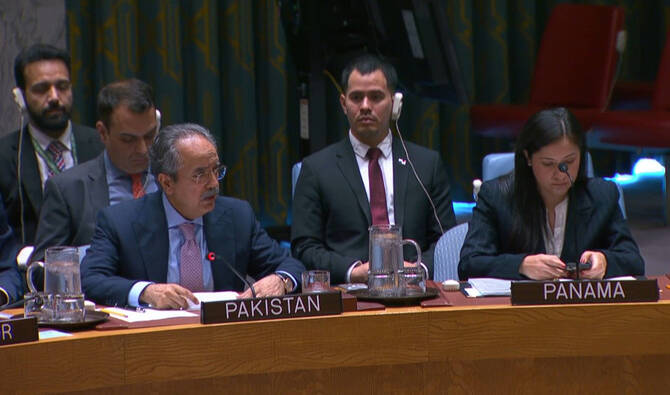
Pakistan urges political inclusion in Iraq ahead of elections, warns UN of regional volatility

Pakistan’s Ambassador to the United Nations Asim Iftikhar Ahmad speaks during a UN Security Council briefing on the United Nations Assistance Mission in Iraq, at the UN Headquarters in New York on June 10, 2025. (Photo courtesy: X/@PakistanUN_NY)
Short Url
Updated 11 June 2025
Follow

Pakistan urges political inclusion in Iraq ahead of elections, warns UN of regional volatility

  • Pakistan reaffirms support for Iraq’s sovereignty, says it should not be pulled into regional confrontations
  • It seeks an inclusive, coordinated transition aligned with Iraq’s priorities as the UN mission nears its end

ISLAMABAD: Pakistan on Tuesday called for greater political inclusion in Iraq ahead of national elections later this year, warning the United Nations that rising regional tensions could undermine the stability of the Arab country.

Speaking at a UN Security Council briefing on the United Nations Assistance Mission in Iraq (UNAMI), Pakistan’s Ambassador to the UN, Asim Iftikhar Ahmad, praised Iraq’s efforts to strengthen democratic institutions and improve governance.

The UN mission was established in 2003 following the US-led invasion, with a mandate to support Iraq’s political transition, humanitarian coordination and national reconciliation. The mission is set to conclude by the end of 2025, as part of a structured drawdown approved by the Security Council last year.

Ahmed said Islamabad supported Iraq’s progress but remained concerned about the broader security situation in the Middle East, including ongoing conflicts in neighboring states and the risk of Iraq being drawn into regional confrontations.

“Pakistan remains concerned about the volatile regional security environment, which poses a risk to Iraq’s stability,” Ahmad told the Council. “We reiterate our firm support for Iraq’s sovereignty, unity and territorial integrity. It is imperative that Iraq not be drawn into regional confrontations.”

The ambassador encouraged all political stakeholders in Iraq to maintain dialogue and inclusivity as the country prepares for national elections in November, urging them to address institutional gaps and reinforce democratic processes.

He also welcomed Iraq’s recent reforms, including the implementation of the federal budget and successful provincial council elections.

Pakistan also highlighted the need for sustained humanitarian attention, particularly for internally displaced persons (IDPs), and acknowledged Iraq’s progress in enabling voluntary returns and reintegration.

As the UNAMI mission approaches the end of its mandate, Pakistan welcomed transition planning but emphasized that the process must remain “inclusive, coordinated and responsive to Iraq’s national priorities.”


Pakistan Supreme Court halts trial of prominent lawyer over alleged anti-military tweets

Updated 57 min 11 sec ago
Follow

Pakistan Supreme Court halts trial of prominent lawyer over alleged anti-military tweets

  • Top court orders lower court to pause proceedings after lawyers allege due-process breaches
  • Mazari-Hazir, husband face charges under cybercrime law that carry up to 14 years in prison

ISLAMABAD: Pakistan’s Supreme Court on Thursday halted the cybercrime trial of prominent human rights lawyer Imaan Mazari-Hazir and her husband, Hadi Ali Chattha, after their lawyers argued that a lower court had recorded witness testimony in their absence, violating due-process rules.

Mazari-Hazir, one of Pakistan’s most outspoken civil liberties lawyers, and Chattha are being prosecuted under the Prevention of Electronic Crimes Act (PECA) over posts on X that authorities say incited ethnic divisions and portrayed the military as involved in “terrorism.” Both reject the allegations. If convicted under the relevant PECA provision, they face a prison term of up to 14 years.

The case has drawn broad attention in Pakistan’s legal community because Mazari-Hazir, who has been repeatedly detained over her criticism of the security establishment, argues that the trial court ignored basic procedural guarantees despite her medical leave request. The case also comes as Pakistan faces sustained scrutiny over the use of PECA against activists, journalists and political dissenters, with lawyers arguing that lower courts often move ahead without meeting minimum fair-trial standards.

The couple’s lawyer, Riasat Ali Azad, said his clients filed a petition in the Supreme Court because the lower court had moved ahead improperly.

“Today, the Supreme Court of Pakistan has stayed the lower court proceedings, the trial court proceedings and has said that the [Islamabad] High Court should decide our pending revision petition for which a date has already been fixed,” he told reporters.

Azad said the violation was clear under Pakistan’s Code of Criminal Procedure, which requires evidence to be recorded in the presence of the accused.

“Yet, on that very day, evidence of four witnesses was recorded in their absence, and a state counsel was appointed to conduct cross-examination on their behalf,” he said. “All these things are against the right to a fair trial under Articles 10 and 10-A.”

A three-judge bench led by Justice Muhammad Hashim Khan Kakar ordered the trial court to pause proceedings and instructed the Islamabad High Court to hear the couple’s pending criminal revision petition first.

The trial had been scheduled to resume on Dec.15, but the Supreme Court’s stay now freezes proceedings before both the additional sessions judge and the special PECA court. 

The Islamabad High Court is expected to hear the criminal revision petition next week.

Chattha, who is also a lawyer, said the SC ruling underscored the need for procedural safeguards.

“It is a victory for the constitution and the law,” he said, arguing that the trial court had ignored their request to re-record witness statements in their presence.