Taliban hang up Kalashnikovs to pen memoirs of Afghan war

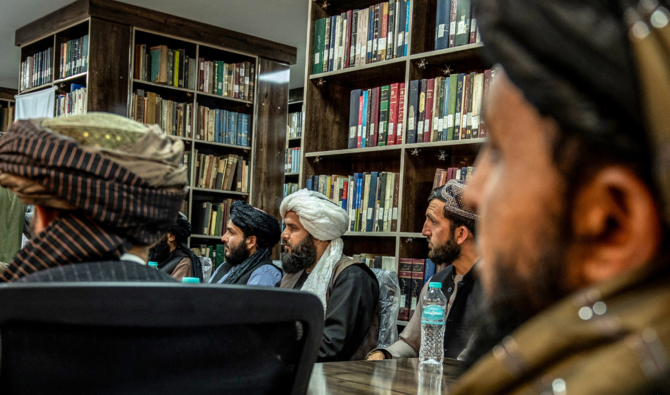
This photograph taken on May 19, 2025, shows Taliban authorities attending an event at the Central Public Library in Kabul. (AFP)
Short Url
Updated 11 June 2025
Follow

Taliban hang up Kalashnikovs to pen memoirs of Afghan war

  • Most Afghan war accounts are from a Western perspective, covering 9/11 to the Taliban’s 2021 return
  • Taliban-authored books praising the group’s ‘victories’ now shape the dominant narrative within Afghanistan

KABUL: Since trading the battlefield for Afghanistan’s halls of power, some Taliban members have also swapped their weapons for pens to tell their version of the 20-year conflict with Western forces, who they accuse of distorting “reality.”

A flood of books has been written, mostly from a Western perspective, about the war between the US-led forces that invaded Afghanistan in the wake of the September 11 attacks until the Taliban’s return to power in 2021.

But in the years since, a proliferation of writings by Taliban figures — praising their exploits and the achievements of the “Islamic Emirate” — is now the reigning narrative in Afghanistan.

“No matter what foreigners have written... they have largely ignored the reality of what happened to us and why we were forced to fight,” author Khalid Zadran told AFP.

A member of the Haqqani network — long viewed as one of the most dangerous militant factions in Afghanistan — he now serves as the spokesman for the capital’s police force.

In his 600-page tome in Pashto published in April, he recounts US incursions in his home province of Khost, his childhood steeped in stories of soldiers’ “atrocities,” and his desire to join the Taliban in the name of his country’s “freedom.”

“I witnessed horrific stories every day — mangled bodies on the roadside,” he writes in “15 Minutes,” a title inspired by a US drone strike he narrowly escaped.

Muhajer Farahi, now a deputy information and culture minister, penned his “Memories of Jihad: 20 Years in Occupation” to “state the facts,” he said.

“America, contrary to its claims, has committed cruel and barbaric acts, destroyed our country with bombs, destroyed infrastructure and has sown discord and cynicism between nations and tribes,” he told AFP from his office in central Kabul.

Little attention is paid in either book to the thousands of civilians killed in Taliban attacks — many of them suicide bombings that entrenched fear across the country for nearly two decades.

Farahi insists the Taliban “were cautious in saving civilians and innocent” lives, while criticising fellow Afghans who collaborated with the pro-Western police as a “stain” on the country.

Rights groups accuse the current Taliban authorities of widespread abuses — particularly against women and girls, who the United Nations say are victims of what amounts to “gender apartheid.”

In his book published in 2023, Farahi claims the Taliban attempted to negotiate — in vain, he insists — with the United States over the fate of Osama bin Laden, whose capture or death Washington demanded after his plane hijackers killed around 3,000 people in the September 11, 2001 attacks.

Bin Laden, the leader of Al-Qaeda, who had been based in Afghanistan, was killed by US forces in Pakistan in 2011.

“It was clear... that the Americans had already planned the occupation of Afghanistan,” writes Farahi in the English version of his book, which has been translated into five languages.

In the wake of the September 11 attacks, Afghans thought it would “have nothing to do with our country,” he continues, but soon realized that Afghanistan would face “punishment.”

For 20 years, the war pitted Taliban militants against a US-led coalition of 38 countries supporting the Afghan Republic and its forces.

Tens of thousands of Afghans died in the fighting and in Taliban attacks, as did nearly 6,000 foreign soldiers, including 2,400 Americans.

For Farahi, the war reflects the West’s desire to “impose its culture and ideology on other nations.”

His disjointed journal mixes battlefield memories with polemical chapters railing against the American “bloodthirsty dragon.”

The book “reveals the truths that were not told before because the media, especially the Western media, presented a different picture of the war,” he said.

According to him, the mujahideen, or holy warriors, despite being far less equipped, were able to rely on their unity and God’s aid to achieve victory.

Only a few of the new wave of Taliban books have been autobiographies, which appeal to an audience seeking to understand the war “from the inside,” according to Zadran.

His book, initially 2,000 copies in Pashto, sold out quickly and another 1,000 are in the works — along with a Dari-language version, he said.

Many chapters mention Bowe Bergdahl, the US soldier held hostage for five years by the Haqqani network.

He recounts treks through the mountains along the Afghanistan-Pakistan border to move him between hideouts, efforts to convert him to Islam and conversations about his girlfriend back in the US.

Both accounts end in 2021, before the transformation of the fighters who moved from remote mountain hideouts to the carpeted offices of the capital.

There, their battle has turned diplomatic: the Taliban are now fighting for international recognition of their government.

“The war is over now,” Farahi said, “and we want good relations with everyone” — even with the “bloodthirsty dragon.”


Imran Khan’s party seeks ‘confidence-building measures’ after government’s talks offer

Updated 03 January 2026
Follow

Imran Khan’s party seeks ‘confidence-building measures’ after government’s talks offer

  • PTI says access to jailed founding leader essential for talks to be considered credible
  • Government says it’s ready for dialogue but nothing will happen until Khan favors the idea

ISLAMABAD: Pakistan’s jailed former prime minister Imran Khan’s party said on Saturday it would only consider the government’s offer for talks credible if it is accompanied by “concrete confidence-building measures,” such as unhindered access to its founding leader in a high-security prison in Rawalpindi.

Last month, Prime Minister Shehbaz Sharif said the government was fully prepared to hold a dialogue with Khan’s Pakistan Tehreek-e-Insaf (PTI) party to address political polarization that has deepened since the downfall of the PTI administration in a parliamentary no-confidence vote in 2022.

PTI has frequently complained about a state crackdown against its top leadership, including Khan and his wife, who are serving prison sentences in multiple cases ranging from corruption charges to inciting violence against state institutions and attacks on government properties.

Sharif’s offer for talks came amid media reports that PTI wanted a dialogue with the government, though he noted that negotiations would not be allowed to proceed on the basis of “blackmailing” or unlawful demands and would only cater to legitimate issues.

“Announcements of talks, without concrete confidence-building measures, cannot be treated as credible progress,” Azhar Leghari, PTI’s central deputy information secretary, told Arab News.

He recalled that Khan had authorized Mahmood Khan Achakzai and Allama Raja Nasir Abbas to carry forward with the dialogue process, adding that talks “require trust, and trust cannot be built at the cost of constitutional rights or democratic legitimacy.”

“For dialogue to be meaningful, it is essential that these authorized representatives are allowed regular and unhindered access to Imran Khan so that any engagement accurately reflects his views and PTI’s collective position,” he added.

Khan’s family, party and legal team have complained in the past they are stopped by the authorities from meeting the ex-PM in prison. Last month, they also raised concerns about his health, prompting the officials to allow one of his sisters to meet him, who said he was fine.

Shortly thereafter, a scathing message was posted on his social media account, criticizing the army chief. Khan’s post elicited a bitter response from the government and the military amid accusations of inciting people against state institutions.

Leghari’s comments came only a day after Rana Sanaullah, adviser to Prime Minister Sharif on political affairs, said PTI’s “second- or third-tier leadership” wanted dialogue, but nothing was going to happen until Khan favored these negotiations.

He also maintained that while the government was ready for talks, “uncertainty and delays from PTI are preventing progress.”

Meanwhile, a newly formed National Dialogue Committee of former PTI leaders told Arab News it had organized a session on Wednesday, January 7, in the federal capital that will bring together all major political parties, journalists, lawyers and representatives of civil society.

“Our goal is to bring political leaders together so that, while discussing their own issues, they can collectively seek solutions to the nation’s challenges,” Mahmood Baqi Moulvi, a Pakistani politician and member of the committee, said.

“The initiative also builds on previous efforts, including a letter to the prime minister requesting confidence-building measures to enable talks with PTI,” he added.

The National Dialogue Committee had urged the government in the letter to grant parole to jailed party figures in Lahore, including former foreign minister Shah Mahmood Qureshi and Dr. Yasmin Rashid, describing the move as vital for building trust ahead of negotiations.

It had also maintained such a step “would not only create an extremely positive, conducive, and trust-filled environment for the negotiations but would also lay a strong foundation for restoring mutual confidence among all stakeholders.”

While the government has also offered dialogue in the past, PTI leaders have conditioned participation on substantive measures, including what they describe as an end to politically motivated prosecutions and arrests, restoration of fundamental rights, respect for judicial independence and a credible roadmap toward free and fair elections.

“Reconciliation is possible, but it must be based on correcting injustices rather than managing optics,” Leghari said. “A genuine reset requires restoring respect for the Constitution, ending political victimization and allowing democratic processes to function without interference.”

Rana Sanaullah and Deputy Law Minister Barrister Aqeel Malik did not respond to requests for comment.