

Pakistan tells UK lawmakers it wants Indus Waters Treaty revived amid India tensions

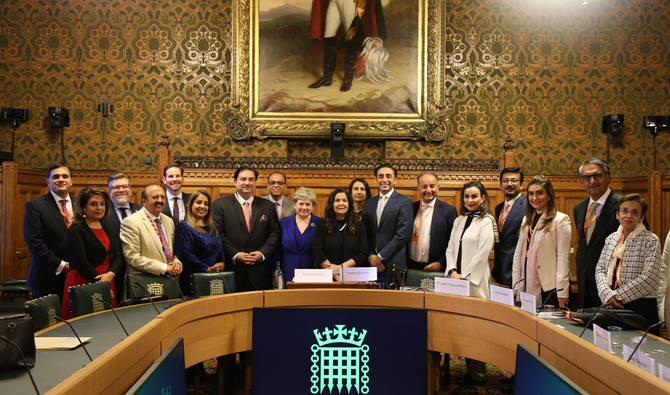
Pakistan's parliamentary delegation led by former Foreign Minister, Bilawal Bhutto Zardari (seventh right), with All Party Parliamentary Group (APPG) on Pakistan during a meeting hosted by the APPG on Pakistan at Westminster Palace, UK on June 10, 2025. (Government of Pakistan)
Short Url
Updated 10 June 2025
Follow

Pakistan tells UK lawmakers it wants Indus Waters Treaty revived amid India tensions

  • The Pakistani delegation in London says Islamabad wants ‘composite dialogue’ with New Delhi on all issues
  • It says Pakistan’s military response to the Indian actions was measured and consistent with international law

ISLAMABAD: A Pakistani parliamentary delegation visiting key global capitals in the wake of last month’s military standoff with India told British lawmakers Islamabad remains committed to ensuring the revival of the Indus Waters Treaty and promoting regional peace, according to an official statement issued on Wednesday. 

The outreach comes after India and Pakistan engaged in their most intense military exchange in years, sparking fears of a full-scale war under a nuclear overhang. Over four days in May, both sides exchanged missile strikes, launched drone attacks and engaged in air combat before a US-brokered ceasefire was announced by President Donald Trump on May 10.

The crisis was triggered by a militant attack that killed 26 tourists in Indian-administered Kashmir. New Delhi blamed the assault on Pakistan-based elements, an allegation Islamabad denied, instead calling for an independent international probe. As tensions escalated, the global community moved swiftly to defuse the situation.

Before launching its military strikes, India took several punitive measures against Pakistan, including suspending a decades-old, World Bank-backed water-sharing treaty between the two countries.

“The High-Level Parliamentary delegation from Pakistan, led by the Chairman of Pakistan People’s Party and former Foreign Minister Bilawal Bhutto-Zardari, briefed the All Party Parliamentary Group (APPG) on Pakistan during a meeting hosted by APPG Chair Yasmin Qureshi MP at Westminster Palace, which was attended by cross-party British parliamentarians,” the statement said.

“The delegation underscored Pakistan’s commitment to restraint, revival of the Indus Waters Treaty and initiation of a composite dialogue between the two countries on all outstanding issues, particularly the Jammu and Kashmir dispute.”

According to the statement, Bhutto-Zardari briefed lawmakers on the consequences of what he described as India’s unprovoked aggression, including violations of Pakistan’s sovereignty in the aftermath of the attack in Indian-administered Kashmir.

He rejected India’s allegations against Pakistan as baseless, saying they lacked credible investigation or verifiable evidence.

He further warned India’s unilateral suspension of the Indus Waters Treaty violated international law and could have serious implications for regional and global peace.

Pakistan’s Minister for Climate Change and Environmental Coordination Musadik Malik also addressed the session, highlighting the environmental and food security risks of disrupting the treaty. 

He warned the suspension threatened the survival of Pakistan’s 240 million people, most of whom rely on agriculture. 

The delegation also emphasized Pakistan’s military response to the Indian actions was measured and consistent with international law, including the right to self-defense under Article 51 of the UN Charter.


IMF warns against policy slippage amid weak recovery as it clears $1.2 billion for Pakistan

Updated 11 December 2025
Follow

IMF warns against policy slippage amid weak recovery as it clears $1.2 billion for Pakistan

  • Pakistan rebuilt reserves, cut its deficit and slowed inflation sharply over the past one year
  • Fund says climate shocks, energy debt, stalled reforms threaten stability despite recent gains

ISLAMABAD: Pakistan’s economic recovery remains fragile despite a year of painful stabilization measures that helped pull the country back from the brink of default, the International Monetary Fund (IMF) warned on Thursday, after it approved a fresh $1.2 billion disbursement under its ongoing loan program.

The approval covers the second review of Pakistan’s Extended Fund Facility (EFF) and the first review of its climate-focused Resilience and Sustainability Facility (RSF), bringing total disbursements since last year to about $3.3 billion.

Pakistan entered the IMF program in September 2024 after years of weak revenues, soaring fiscal deficits, import controls, currency depletion and repeated climate shocks left the economy close to external default. A smaller stopgap arrangement earlier that year helped avert immediate default, but the current 37-month program was designed to restore macroeconomic stability through strict monetary tightening, currency adjustments, subsidy rationalization and aggressive revenue measures.

The IMF’s new review shows that Pakistan has delivered significant gains since then. Growth recovered to 3 percent last year after shrinking the year before. Inflation fell from over 23 percent to low single digits before rising again after this year’s floods. The current account posted its first surplus in 14 years, helped by stronger remittances and a sharp reduction in imports. And the government delivered a primary budget surplus of 1.3 percent of GDP, a key program requirement. Foreign exchange reserves, which had dropped dangerously low in 2023, rose from US$9.4 billion to US$14.5 billion by June.

“Pakistan’s reform implementation under the EFF arrangement has helped preserve macroeconomic stability in the face of several recent shocks,” IMF Deputy Managing Director Nigel Clarke said in a statement after the Board meeting.

But he warned that Islamabad must “maintain prudent policies” and accelerate reforms needed for private-sector-led and sustainable growth.

The Fund noted that the 2025 monsoon floods, affecting nearly seven million people, damaging housing, livestock and key crops, and displacing more than four million, have set back the recovery. The IMF now expects GDP growth in FY26 to be slightly lower and forecasts inflation to rise to 8–10 percent in the coming months as food prices adjust.

The review warns Pakistan against relaxing monetary or fiscal discipline prematurely. It urges the State Bank to keep policy “appropriately tight,” allow exchange-rate flexibility and improve communication. Islamabad must also continue raising revenues, broadening the tax base and protecting social spending, the Fund said.

Despite the progress, Pakistan’s structural weaknesses remain severe.

Power-sector circular debt stands at about $5.7 billion, and gas-sector arrears have climbed to $11.3 billion despite tariff adjustments. Reform of state-owned enterprises has slowed, including delays in privatizing loss-making electricity distributors and Pakistan International Airlines. Key governance and anti-corruption reforms have also been pushed back.

The IMF welcomed Pakistan’s expansion of its flagship Benazir Income Support Program, which raises cash transfers for low-income families and expands coverage, saying social protection is essential as climate shocks intensify. But it warned that high public debt, about 72 percent of GDP, thin external buffers and climate exposure leave the country vulnerable if reform momentum weakens.

The Fund said Pakistan’s challenge now is to convert short-term stabilization into sustained recovery after years of economic volatility, with its ability to maintain discipline, rather than the size of external financing alone, determining the durability of its gains.