


ISLAMABAD: Pakistan’s coalition government will unveil the national federal budget today, Tuesday, for the fiscal year till June 2026 with Islamabad eyeing sustainable economic growth and vowing to continue ahead with painful fiscal reforms to ensure that.
The budget comes a day after the government unveiled the annual Economic Survey, a pre-budget document assessing the economy’s trajectory over the past year, which said Pakistan’s economy is expected to grow 2.7 percent in the outgoing fiscal year, missing Islamabad’s 3.7 percent target.
The budget every year highlights the government’s plans to raise revenue, outlines its expenditures, states inflation and growth assumptions as well as allocations for several areas such as defense, education, health and other sectors of the economy.
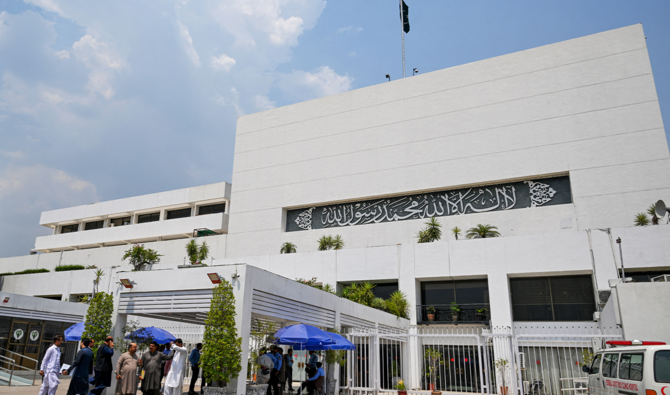
“The Federal Budget for the next fiscal year will be presented in the National Assembly on Tuesday,” state broadcaster Radio Pakistan reported, adding that the lower house of parliament will meet at 5:00 p.m. for the session.
“Finance Minister Muhammad Aurangzeb will present the Federal Budget in the National Assembly and later he will lay a copy of the Finance Bill, 2025, containing the Annual Budget Statement before the Senate.”
The budget comes as Pakistan undertakes efforts to navigate a tricky path to economic recovery. The South Asian country, which came to the brink of a sovereign default in June 2023, has since then undertaken painful macroeconomic reforms that it credits for gains such as a low inflation rate, increasing investors’ confidence in the stock market and current account surpluses.
Pakistan has vowed to stay the course of long-term reforms, which include widening the tax net, taking steps to privatize loss-making state-owned assets, slashing subsidies and undertaking reforms in energy and other vital sectors.
An International Monetary Fund (IMF) team concluded its visit to Pakistan last month after discussions with authorities regarding the budget, broader economic policy and reforms under its ongoing $7 billion loan program for the country.
The IMF last month approved the first review of Pakistan’s loan program, unlocking a $1 billion payment. A fresh $1.4 billion loan was also approved under the IMF’s climate resilience fund. The IMF’s loan is vital for Pakistan which is trying to revive its debt-ridden economy.
In a televised news briefing on Monday afternoon while releasing the Economic Survey, Aurangzeb reaffirmed the government’s commitment to implementing IMF-backed structural reforms to transform the fundamentals of Pakistan’s economy.
“The DNA of Pakistan’s economy has to be fundamentally changed through tax and energy reforms that have started showing remarkable results,” he said.
According to the survey, Pakistan’s revenues rose sharply over the past year. It said tax collections increased by 26.3 percent to Rs9.3 trillion ($32.9 billion), while total revenues stood at Rs13.4 trillion ($47.5 billion). The primary surplus also improved to 3.0 percent from 1.5 percent.
Government expenditure during this period rose to Rs16.3 trillion ($58 billion), with current and development spending increasing by 18.3 percent and 33 percent, respectively. On the external front, Pakistan recorded a sharp turnaround in its current account, moving from a $1.3 billion deficit to a $1.9 billion surplus, driven by improved exports and record remittance inflows.


