

Israeli left-wing leader calls for immediate end to Gaza war

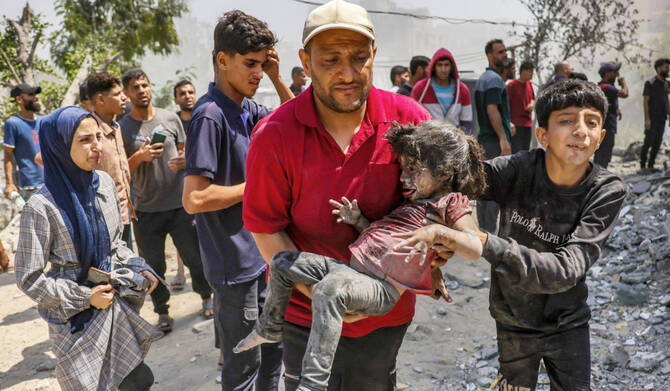
A Palestinian man carries a child pulled from the rubble of the Shaheen family home that was targetted in an Israeli strike in the Saftawi neighbourhood, west of Jabalia, in the northern Gaza Strip on June 9, 2025. (AFP)
Short Url
Updated 09 June 2025
Follow

Israeli left-wing leader calls for immediate end to Gaza war

  • Netanyahu’s government does not represent vast majority of people, Yair Golan says

JERUSALEM: Israeli left-wing opposition leader Yair Golan called on Monday for an immediate end to the Gaza war and said that Prime Minister Benjamin Netanyahu’s government no longer represented most Israelis.

“Today the government of Israel does not represent the vast majority of Israelis,” said Golan, chairman of the Democrats party and a former deputy army chief, days before a planned parliament vote which the opposition hopes would trigger a general election.
He told journalists in a briefing that after more than 20 months of fighting, Israel “should end the war as soon as possible.”
Golan’s party, a conglomeration of left-wing factions, has only four seats in Israel’s 120-member legislature, making it one of its smallest political groups.
But in a country where coalition building is essential to achieving a political majority, even relatively small parties can wield considerable power.

FASTFACT

Yair Golan’s party, a conglomeration of left-wing factions, has only four seats in Israel’s 120-member legislature, making it one of its smallest political groups.

Golan, a former deputy minister in a short-lived administration that replaced Netanyahu in 2021-2022, said that the current government — one of the most right-wing in Israel’s history — was a threat to democracy.
The opposition leader said he represents those “who want to save Israeli democracy ... from a corrupted future” and the “messianic-like and nationalistic and extremist vision of a very small faction in the Israeli society.”
“The vast majority wants to keep Israel as the homeland of the Jewish people and at the same time a free, egalitarian and democratic state,” Golan said.
He said that the vast majority of Israelis wanted to see an immediate end to the war in Gaza, the return of all hostages held by Palestinian militants in a single exchange deal, and the establishment of a national commission of inquiry into Hamas’s unprecedented 2023 attack, arguing that the Netanyahu government was opposed to these objectives.
“I believe that we can reach a hostage deal in a matter of days,” Golan said.
“I believe that by ending the war and freeing the hostages, we will be able to build an alternative to Hamas inside the Gaza Strip.”
Criticizing the government’s Gaza war policies, the former army general has recently drawn condemnation in Israel for saying that “a sane country ... does not kill babies for a hobby.”
Golan on Monday also said that most Israelis support legislation that would require ultra-Orthodox Jewish men, who are currently largely exempt from military service, to enlist.
The issue has sparked tension between Netanyahu and ultra-Orthodox parties in his government, with lawmakers threatening to topple the prime minister if no agreement is reached this week.
Some opposition parties are seeking to place a bill to dissolve parliament on Wednesday’s plenary agenda, hoping to capitalize on the ultra-Orthodox revolt.
“The vast majority wants new elections as soon as possible,” Golan said.


UN rights chief shocked by ‘unbearable’ Darfur atrocities

Updated 19 January 2026
Follow

UN rights chief shocked by ‘unbearable’ Darfur atrocities

  • Mediation efforts have failed to produce a ceasefire, even after international outrage intensified last year with reports of mass killings, rape, and abductions during the RSF’s takeover of El-Fasher in Darfur

PORT SUDAN: Nearly three years of war have put the Sudanese people through “hell,” the UN’s rights chief said on Sunday, blasting the vast sums spent on advanced weaponry at the expense of humanitarian aid and the recruitment of child soldiers.
Since April 2023, Sudan has been gripped by a conflict between the army and the paramilitary Rapid Support Forces that has left tens of thousands of people dead and around 11 million displaced.
Speaking in Port Sudan during his first wartime visit, UN Human Rights commissioner Volker Turk said the population had endured “horror and hell,” calling it “despicable” that funds that “should be used to alleviate the suffering of the population” are instead spent on advanced weapons, particularly drones.
More than 21 million people are facing acute food insecurity, and two-thirds of Sudan’s population is in urgent need of humanitarian aid, according to the UN.
In addition to the world’s largest hunger and displacement crisis, Sudan is also facing “the increasing militarization of society by all parties to the conflict, including through the arming of civilians and recruitment and use of children,” Turk added.
He said he had heard testimony of “unbearable” atrocities from survivors of attacks in Darfur, and warned of similar crimes unfolding in the Kordofan region — the current epicenter of the fighting.
Testimony of these atrocities must be heard by “the commanders of this conflict and those who are arming, funding and profiting from this war,” he said.
Mediation efforts have failed to produce a ceasefire, even after international outrage intensified last year with reports of mass killings, rape, and abductions during the RSF’s takeover of El-Fasher in Darfur.
“We must ensure that the perpetrators of these horrific violations face justice regardless of the affiliation,” Turk said on Sunday, adding that repeated attacks on civilian infrastructure could constitute “war crimes.”
He called on both sides to “cease intolerable attacks against civilian objects that are indispensable to the civilian population, including markets, health facilities, schools and shelters.”
Turk again warned on Sunday that crimes similar to those seen in El-Fasher could recur in volatile Kordofan, where the RSF has advanced, besieging and attacking several key cities.
Hundreds of thousands face starvation across the region, where more than 65,000 people have been displaced since October, according to the latest UN figures.