

King Abdullah II urges global ocean action at UN conference, holds key talks on Middle East stability

King Abdullah II delivered Jordan’s national address at the third United Nations Ocean Conference in Nice on Monday, underlining the urgent need for global action to protect oceans and marine life. (Jordan News Agency)
Short Url
Updated 09 June 2025
Follow

King Abdullah II urges global ocean action at UN conference, holds key talks on Middle East stability

  • Jordanian ruler highlights threat to ‘vital shared resource’ from climate change, overexploitation, biodiversity loss
  • King warns of dangerous consequences of further escalation in West Bank and Jerusalem, and calls for renewal of ceasefire

LONDON: King Abdullah II delivered Jordan’s national address at the third United Nations Ocean Conference in Nice on Monday, underlining the urgent need for global action to protect oceans and marine life, the Jordan News Agency reported.

The week-long conference, co-hosted by France and Costa Rica, has brought together hundreds of international leaders, officials, and experts to address the pressing environmental challenges facing the world’s seas.

In his remarks, King Abdullah described oceans as “a vital shared resource, sustaining billions of lives,” but warned that they are increasingly threatened by climate change, pollution, overexploitation, and biodiversity loss.

“This is a critical moment in time for action,” the king added, stressing the need for international collaboration to preserve marine ecosystems.

King Abdullah highlighted Jordan’s embrace of science as a tool for transformation, noting that the Gulf of Aqaba’s coral reefs show exceptional resilience to extreme temperatures. This unique feature, he said, positions Jordan as a global hub for marine research that could help save coral reefs worldwide.

To advance this vision, he announced the launch of two key initiatives: Aqaba Blue Ventures and the Global Center for Ocean Regeneration.

These projects will provide platforms to test new technologies that can be scaled up for global application, he added.

On the sidelines of the conference, King Abdullah held a bilateral meeting with French President Emmanuel Macron, during which he affirmed Jordan’s readiness to strengthen cooperation with France across various sectors, JNA reported.



King Abdullah held a bilateral meeting with French President Emmanuel Macron. (JNA)

The leaders stressed the importance of maintaining coordination on regional issues and called for immediate international efforts to reinstate a ceasefire in Gaza and facilitate the entry of humanitarian aid.

The king warned of the dangerous consequences of continued escalation in the West Bank and Jerusalem, reiterating that granting Palestinians their full legitimate rights remained the only path to lasting regional stability.

He also commended France’s role in promoting peace in the Middle East, particularly through its upcoming international conference in New York from June 17-20, organized in partnership with Saudi Arabia.

The meeting was attended by Jordanian Foreign Minister Ayman Safadi and Jordan’s ambassador to France Lina Al-Hadid.

Also on Monday, King Abdullah held additional high-level meetings with Cyprus President Nikos Christodoulides, Prince Albert II of Monaco, and UN Secretary-General Antonio Guterres.
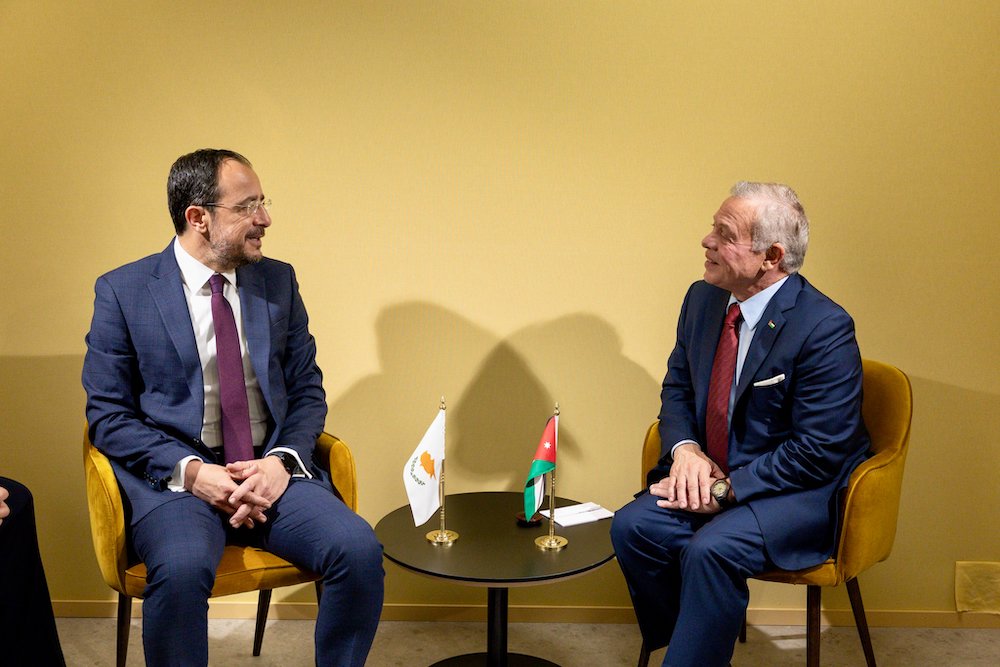


King Abdullah also held additional high-level meetings with Cyprus President Nikos Christodoulides. (JNA)

The talks were part of the king’s broader diplomatic efforts to mobilize international support for the rights of the Palestinian people.

During the discussions, King Abdullah again stressed that a two-state solution was the only viable route to regional peace and highlighted the importance of the forthcoming New York conference.

He also reiterated the need to restore the ceasefire in Gaza, guarantee unimpeded delivery of aid, and put an end to unilateral measures in the West Bank and Jerusalem.


Hundreds flee to government-held areas in north Syria ahead of possible offensive

Updated 2 sec ago
Follow

Hundreds flee to government-held areas in north Syria ahead of possible offensive

Many of the civilians who fled used side roads to reach government-held areas
Men, women and children arrived in cars and pickup trucks that were packed with bags of clothes

DEIR HAFER, Syria: Scores of people carrying their belongings arrived in government-held areas in northern Syria on Friday ahead a possible attack by Syrian troops on territory held by Kurdish-led fighters east of the city of Aleppo.
Many of the civilians who fled used side roads to reach government-held areas because the main highway was blocked with barriers at a checkpoint that previously was controlled by the Kurdish-led and US-backed Syrian Democratic Forces, Associated Press journalists observed.
The Syrian army said late Wednesday that civilians would be able to evacuate through the “humanitarian corridor” from 9 a.m. to 5 p.m. Thursday. The announcement appeared to signal plans for an offensive against the SDF in the area east of Aleppo.
There were limited exchanges of fire between the two sides.
Men, women and children arrived in cars and pickup trucks that were packed with bags of clothes, mattresses and other belongings. They were met by local officials who directed them to shelters.
In other areas, people crossed canals on small boats and crossed a heavily damaged pedestrian bridge to reach the side held by government forces.
The SDF closed the main highway but about 4,000 people were still able to reach government-held areas on other roads, Syrian state TV reported.
A US military convoy arrived in Deir Hafer in the early afternoon but it was not immediately clear whether those personnel will remain. The US has good relations with both sides and has urged calm.
Inside Deir Hafer, many shops were closed and people stayed home.
“When I saw people leaving I came here,” said Umm Talal, who arrived in the government-held area with her husband and children. She added that the road appeared safe and her husband plans to return to their home.
Abu Mohammed said he came from the town of Maskana after hearing the government had opened a safe corridor, “only to be surprised when we arrived at Deir Hafer and found it closed.”
SDF fighters were preventing people from crossing through Syria’s main east-west highway and forcing them to take a side road, he said.
The tensions in the Deir Hafer area come after several days of intense clashes last week in Aleppo, previously Syria’s largest city and commercial center, that ended with the evacuation of Kurdish fighters from three neighborhoods north of the city that were then taken over by government forces.
The fighting broke out as negotiations stalled between Damascus and the SDF over an agreement reached in March to integrate their forces and for the central government to take control of institutions including border crossings and oil fields in the northeast.
The US special envoy to Syria, Tom Barrack, posted on X Friday that Washington remains in close contact with all parties in Syria, “working around the clock to lower the temperature, prevent escalation, and return to integration talks between the Syrian government and the SDF.”
The SDF for years has been the main US partner in Syria in fighting against the Daesh group, but Turkiye considers the SDF a terrorist organization because of its association with Kurdish separatist insurgents in Turkiye.