

Pakistan economy to grow 2.7 percent in FY25, economic survey shows

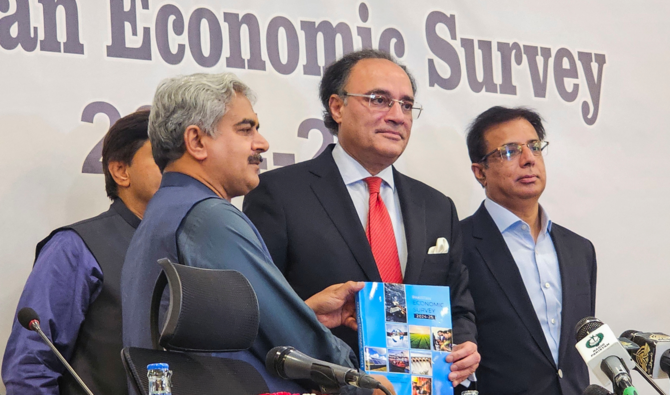
Pakistan Finance Minister Muhammad Aurangzeb shows a copy of the economic survey of fiscal year 2024-2025 during a news conference in Islamabad, Pakistan June 9, 2025. (REUTERS)
Short Url
Updated 09 June 2025
Follow

Pakistan economy to grow 2.7 percent in FY25, economic survey shows

  • The government initially targeted 3.6 percent GDP growth, but lowered it last month
  • Pakistan’s finance chief says the national economy is on an upward trajectory

ISLAMABAD: Pakistan’s economy is likely to expand 2.7 percent in the fiscal year ending June 2025 after growing 2.5 percent during the previous year, the government’s economic survey showed on Monday, a day before the country’s federal budget is unveiled.

The government initially targeted 3.6 percent GDP growth, but lowered it to 2.7 percent last month. The IMF expects real GDP to grow by 2.6 percent in FY25 and for the economy to grow 3.6 percent in FY26.

Prime Minister Shehbaz Sharif’s government aims for 4.2 percent GDP growth next year, the country’s planning minister said last week, amid competing priorities, including stimulating investment, maintaining a primary surplus, and managing defense expenditure amid heightened tensions with India.

Pakistan’s central bank, in a bid to encourage growth, cut its policy rate by more than 1,000 basis points in the current fiscal year. Its latest cut last month brought the key rate to 11 percent, resuming an easing cycle that had brought rates down from 22 percent after a brief pause in March.

Pakistan had a current account surplus of $1.9 billion in the July to April period of the current fiscal year compared to a deficit of $200 million in the same period last year, the survey showed.

“Pakistan’s economy has been globally acknowledged for achieving macroeconomic stabilization in the outgoing fiscal year,” Finance Minister Muhammad Aurangzeb said in his foreword to the survey.

“Pakistan is consistently advancing on an upward trajectory, built upon investment friendly reforms, enhanced domestic savings, and increased foreign direct investment, with GDP growth projected at 5.7 percent over the medium term,” he said.

The economic survey, a key pre-budget document, comes at a time when Pakistan’s economy is stabilizing but remains fragile as the country navigates reforms under a $7 billion International Monetary Fund program.

Pakistan’s federal budget for the next fiscal year starting July will be released on Tuesday.

The government’s total revenue for the first three quarters of the current year stood at 13.37 trillion rupees, the survey showed.

Increasing revenue to trim the fiscal deficit, a key demand of the IMF program, is considered challenging for Islamabad.

Other key performance indicators mentioned in the economic survey include fiscal deficit at 2.6 percent of GDP during the first three quarters of the fiscal year.

Inflation was seen at 4.6 percent for the year.


Pakistan, ADB sign $730 loan agreements to boost SOE reforms, energy infrastructure

Updated 25 December 2025
Follow

Pakistan, ADB sign $730 loan agreements to boost SOE reforms, energy infrastructure

  • Both sign $330 million Power Transmission Strengthening Project and $400 million SOE Transformation Program loan agreements
  • Economic Affairs Division official says Transmission Project will secure Pakistan’s energy future by strengthening national grid’s backbone

KARACHI: Pakistan and the Asian Development Bank (ADB) on Thursday signed two loan agreements totaling $730 million to boost reforms in state-owned enterprises (SOEs) and energy infrastructure in the country, the bank said.

The first of the two agreements pertains to the SOE Transformation Program worth $400 million while the second loan, worth $330 million, is for a Power Transmission Strengthening Project, the lender said. 

The agreements were signed by ADB Country Director for Pakistan Emma Fan and Pakistan’s Secretary of Economic Affairs Division Humair Karim. 

“The agreements demonstrate ADB’s enduring commitment to supporting sustainable and inclusive economic growth in Pakistan,” the ADB said. 

Pakistan’s SOEs have incurred losses worth billions of dollars over the years due to financial mismanagement and corruption. These entities, including the country’s national airline Pakistan International Airlines, which was sold to a private group this week, have relied on subsequent government bailouts over the years to operate.

The ADB approved the $400 million loan for SOE reforms on Dec. 12. It said the program seeks to improve governance and optimize the performance of Pakistan’s commercial SOEs. 

Karim highlighted that the Power Transmission Strengthening Project will enable reliable evacuation of 2,300 MW from Pakistan’s upcoming hydropower projects, relieve overloading of existing transmission lines and enhance resilience under contingency conditions, the Press Information Department (PID) said. 

“The Secretary emphasized that both initiatives are transformative in nature as the Transmission Project will secure Pakistan’s energy future by strengthening the backbone of the national grid whereas the SOE Program will enhance transparency, efficiency and sustainability of state-owned enterprises nationwide,” the PID said. 

The ADB has supported reforms by Pakistan to strengthen its public finance and social protection systems. It has also undertaken programs in the country to help with post-flood reconstruction, improve food security and social and human capital. 

To date, ADB says it has committed 764 public sector loans, grants and technical assistance totaling $43.4 billion to Pakistan.