

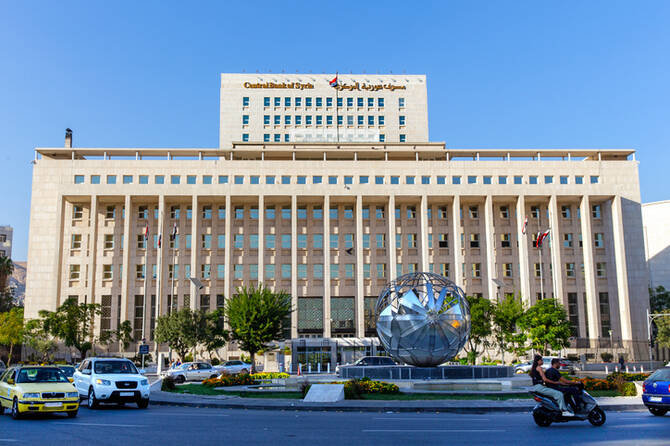

RIYADH: Syria will adopt a unified exchange rate before transitioning to a managed float system as it seeks to stabilize a currency that has lost nearly all its value against the US dollar.
In an interview with the Financial Times, Central Bank of Syria’s Governor Abdulkader Husrieh confirmed the reforms, emphasizing efforts to eliminate the role of unauthorized money changers in the country’s foreign exchange market as part of broader financial reconstruction.
Syria is also set to be fully reintegrated into the SWIFT international money transfer system within weeks, reconnecting the country to global finance after 14 years of war and sanctions.
The country is working to revive its economy after years of conflict, with its transitional government, led by President Ahmed Al-Sharaa, implementing reforms such as privatizing state-owned firms, easing import restrictions, and attracting foreign investment.

An armed member of Syria’s security forces stands guard outside the Damascus Securities Exchange as the stock market opens in the Ya’fur area near Damascus. AFP
“We aim to enhance the brand of the country as a financial hub given the expected foreign direct investment in rebuilding and infrastructure — this is crucial,” Husrieh told the FT.
Key developments in Syria include a $7 billion energy deal with Qatar, the reopening of the Damascus Securities Exchange, and a $300 million fiber-optic project with Gulf telecom companies. These initiatives come as Saudi Arabia and Qatar pledge financial support to help stabilize Syria’s economy amid a gradual easing of Western sanctions.
SWIFT reconnection to boost trade and investment
The reintegration into SWIFT marks a milestone in the new government’s economic liberalization efforts following the lifting of US sanctions last month.
The Society for Worldwide Interbank Financial Telecommunications is a global cooperative that facilitates secure international money and security transfers through a vast messaging network, enabling banks and financial institutions to exchange information and instructions for financial transactions.
Husrieh, who took office in April, said that significant progress has been made but acknowledged that there’s still much work ahead.

A money changer waits for customers on a street in Damascus. AFP
Post-war economic challenges
Since 2011, Syria has been isolated from global markets due to war and sanctions. The economy collapsed under ex-President Bashar Assad and when Al-Sharaa took power last December, his government swiftly introduced free-market reforms to revive the economy and reassure wary foreign investors.
Last month, President Donald Trump’s announcement of lifting sanctions provided a major boost, but Husrieh stressed that “a full policy shift is still needed,” calling for comprehensive sanctions removal rather than selective measures.
“The central bank previously micromanaged the financial system, overregulated lending, and restricted withdrawals,” he said. “We’re reforming through recapitalization, deregulation, and re-establishing banks as intermediaries between households and businesses.”
Reconnecting to SWIFT will reduce import costs, facilitate exports, and curb reliance on informal financial networks. Husrieh said all foreign trade will now go through formal banks, cutting out money changers who took a 40 percent cut on dollar transactions.
Before Assad left the presidency, the Syrian pound plummeted. While it has since strengthened, volatility remains. Husrieh aims to unify official and black-market rates before transitioning to a managed floating exchange rate system.
Gulf nations are actively supporting the reforms in Syria, and Saudi Arabia and Qatar cleared the country’s World Bank debt and pledged to cover public sector salaries for three months.
“Effective May 12, 2025, the arrears of approximately $15.5 million due to the International Development Association by the Syrian Arab Republic have been cleared,” the World Bank confirmed on May 16.


