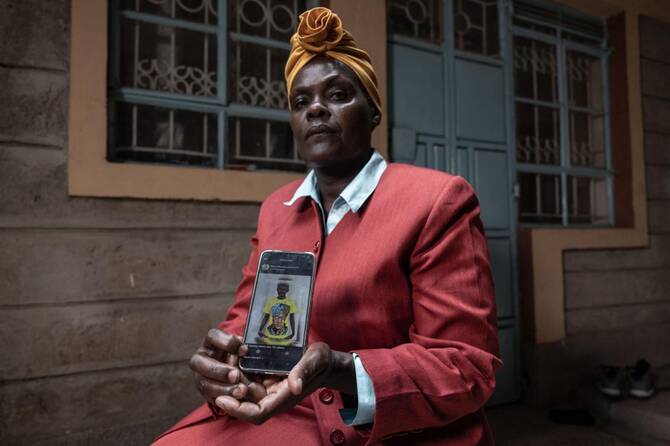
NAIROBI: Susan Wangari has lost count of the morgues, hospitals and police stations she has visited in search of her son, who went missing at the height of Kenya’s mass protests last June.
She last saw Emmanuel Mukuria, 24, on the morning of June 25, 2024, the day that thousands of Kenyan youths thronged the streets of Nairobi and stormed parliament in protest at planned tax rises and corruption.
“It would be better if my son were dead; at least I could visit his grave,” she told AFP.
Rights groups say at least 60 people were killed during the protests in June and July, and more than 80 abducted by the security forces since then, with dozens still missing.
Mukuria’s friends say he was arrested during the protests in the city center, where he worked as a minibus tout.
“We do not have peace in this house,” his mother, 50, told AFP during a visit to her single-room home in the Kasarani slum area.
“I sleep lightly at night in case he comes knocking at my window like he always did,” she said.
“Every time we hear that bodies have been found somewhere, we are anxious to know whose they are.”
Two men told her they shared a cell with Mukuria, but they are too afraid to speak publicly about their ordeal.
One was only released in February, giving her hope that her son is still alive in captivity.
“They told me they were beaten and questioned about the protests. They were being asked who paid them to participate,” Wangari said.
Last month, President William Ruto, in a clear admission that security forces had engaged in kidnappings, said all those abducted during the protests had been “returned to their families.”
Rights groups say dozens are still missing and police have shown little progress in investigating the disappearances despite Ruto claiming an “accountability mechanism” was put in place.
Questioned by AFP, the president’s office said the police were “handling the brief,” while a police spokesman referred AFP back to the president’s office.
The police spokesman said they had no information on Mukuria’s case. An officer-in-charge at the station where Wangari reported him missing said the matter was still under investigation.
Many other families are still dealing with the aftermath of the violence.
Rex Masai, 29, was the first to die during the protests, shot and killed in the city center on June 20.
The inquest into his death is still dragging on.
“We are hoping for the best but we are not near the truth,” Masai’s mother Gillian Munyao told AFP at her home, where a photo of her dreadlocked son hangs on the wall.
She found her son lying lifeless in a pool of blood at a clinic where he was taken that day.
The state prosecutor has said a lack of witnesses has delayed progress in the case.
One potential witness was scared off for fear he might be “forcibly disappeared” by the police, Munyao said.
Hussein Khalid, head of rights group Vocal Africa, blamed a “lack of cooperation by the authorities.”
“When you get evidence, the unfortunate bit is you have to take it to the police themselves,” he said.
He lost count of the number of funerals he attended after the protests, estimating between 20 and 30.
“Was it necessary to unleash this kind of brute force against young, innocent Kenyans?” he said.
Politicians have shown little interest in accountability or learning from the unrest.
“People were killed, we sympathized, we moved on,” Bashir Abdullahi, a member of the ruling coalition, told parliament during a debate on the protests last month.
But for victim’s families, the search for justice “means a lot,” said Masai’s father, Chrispin Odawa.
“The wound will never heal,” he said.


![]()

‘Better if he was dead’: Kenyan mother’s search for son year after protests
Short Url
https://arab.news/wwvmv
‘Better if he was dead’: Kenyan mother’s search for son year after protests
- Susan Wangari has lost count of the morgues, hospitals and police stations she has visited in search of her son, who went missing at the height of Kenya’s mass protests last June


Latest updates


© 2026 SAUDI RESEARCH & PUBLISHING COMPANY, All Rights Reserved And subject to Terms of Use Agreement.