

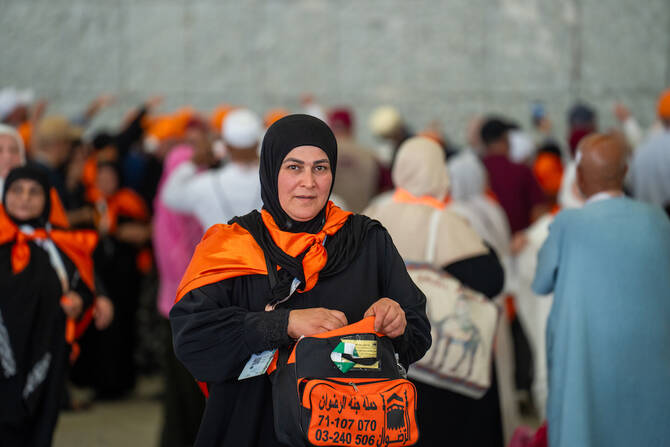
Saudi Arabia achieves unprecedented integration, efficiency during 2025 Hajj, says minister

Saudi Arabia has achieved unprecedented levels of integration, efficiency, and service excellence during this year’s Hajj, according to the Minister of Hajj and Umrah. (Abdulrahman bin Shalhoub)
Short Url
Updated 08 June 2025
Follow

Saudi Arabia achieves unprecedented integration, efficiency during 2025 Hajj, says minister

MINA: Saudi Arabia has achieved unprecedented levels of integration, efficiency and service excellence during this year’s Hajj, according to the Minister of Hajj and Umrah.

Tawfiq Al-Rabiah was speaking at the annual reception for dignitaries and senior Islamic figures who performed Hajj this year, which was held on Saturday in Mina and attended by Crown Prince Mohammed bin Salman.

This year saw the launch of the Hajj Transport Center, which served as the central hub for transportation across Makkah and the holy sites and was one of this year’s notable achievements, said Al-Rabiah.

In terms of infrastructure, he added, the electric power capacity in the holy sites increased by 75 percent, with total investments exceeding SR3 billion ($800 million).

Logistically, the minister said: “More than 7,000 flights from 238 destinations around the world were received. In addition, 4,700 Haramain High-Speed Railway trips and 2,500 shuttle bus journeys were operated, supported by the deployment of over 20,000 buses.”

He added: “In the health sector, hospital bed capacity was expanded by over 60 percent. A new emergency hospital was inaugurated, and 71 rapid response units were deployed, tripling the emergency response capacity compared to previous years.”

Al-Rabiah also emphasized the success of the “No Hajj Without a Permit” campaign, which played a vital role in maintaining order, protecting pilgrims and ensuring the safe management of crowds.

He said the campaign was launched to reinforce discipline, protect legitimate pilgrims and facilitate crowd management in a safe environment, enhancing smooth flow and improving organizational efficiency.

On the volunteer front, the Ministry of Health announced the participation of more than 5,000 health volunteers during this year’s Hajj season, as part of ongoing efforts to enhance the quality of medical services provided to pilgrims.

This initiative aligns with the objectives of the Health Sector Transformation Program and the Guests of God Service Program, launched in 2019 under Saudi Vision 2030, which aim to increase the number of volunteers and enhance their contribution to serving pilgrims.

The ministry said: “The volunteers supported healthcare services across three main areas, preventive, therapeutic and support services, in various locations throughout the holy sites … as well as through active participation in hospitals and health centers.”

Authorities also praised the role of advanced technology and digital platforms that streamlined pilgrims’ movements and access to services, while thousands of security personnel, health workers, and volunteers were deployed to offer support.


Northern Borders rock art reveals ancient life

Updated 58 min 29 sec ago
Follow

Northern Borders rock art reveals ancient life

  • Among the most notable remains are stone structures scattered northwest of Arar
  • Evidence ranges from the Neolithic era to Islamic times, forming a chronological record

JEDDAH: Saudi Arabia’s Northern Borders region contains numerous archaeological sites, reflecting a long history of human settlement dating back to early periods, the Saudi Press Agency reported.
Among the most notable remains are stone structures scattered northwest of Arar.
Varying in shape, size and design, specialists believe these structures date to the end of the Neolithic period and the beginning of subsequent eras. They are thought to have been used as stone tombs to preserve the remains of the dead.
Evidence ranges from the Neolithic era to Islamic times, forming a chronological record that highlights the diversity of communities that once lived in the region and how they interacted with their natural environment over centuries.
Ajab Al-Otaibi, director general of antiquities at the Heritage Commission, said the stone structures and rock art sites in the Northern Borders region represent an integral part of Saudi Arabia’s national cultural heritage and serve as an important resource for archaeological studies and scientific research.
He highlighted the importance of surveys, documentation and protection efforts to preserve these cultural landmarks as a historical legacy for future generations.
The region is also home to several important rock art sites, such as Shu’ayb Hamer, which features a wide and diverse collection of drawings carved on natural rock surfaces, marking it as a key site that documented early human activity in the area.
The artworks depict scenes of hunting, horsemanship, dancing, daily life and social rituals. They were created using a variety of artistic styles, most notably framed and abstract forms, and produced through different techniques including incizing and pecking, both direct and indirect.
The carvings portray human figures and a range of animals, including camels, horses and gazelles, as well as some wild and predatory species that have long since disappeared.
These images provide insight into the richness of the natural environment in earlier periods and help researchers understand the evolving relationship between humans and their surroundings.