

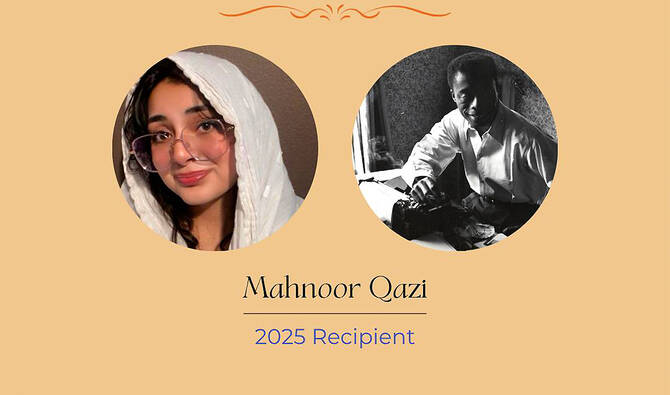
Pakistan-origin Mahnoor Qazi wins James Baldwin award for fiction

The picture posted on June 4, 2025, shows announcement of Pakistan-origin Mahnoor Qazi winning James Baldwin award. (James Baldwin)
Short Url
Updated 08 June 2025
Follow

Pakistan-origin Mahnoor Qazi wins James Baldwin award for fiction

  • The James Baldwin Award for Fiction is one of six creative writing awards given by Penguin Random House
  • Qazi, whose entry ‘Eternity’ won $10,000 prize, aims to connect literature with the deepest human emotions

ISLAMABAD: Mahnoor Qazi, a Pakistani-origin high school student in the US state of California, has won the inaugural James Baldwin Award for Fiction, the organizers announced this week.

The James Baldwin Award for Fiction is one of six creative writing awards given by Penguin Random House, touted as the world’s largest trade book publisher, as part of their signature Creative Writing Awards (CWA) program. The award is named after Baldwin, a novelist, essayist, playwright, poet and critic.

Qazi, an aspiring writer who attends Golden Valley High School in California, is dedicated to connecting the art of literature with the deepest human emotions. Her entry ‘Eternity’ won the first-place prize of $10,000.

“As his niece, it has been an honor to select the recipient of the James Baldwin Award for fiction. Traveling the creative landscape of students with insightful narrative voices has been inspiring,” Baldwin’s niece Darlene Burnett said.

“They continue to demonstrate that the power of words can inform minds, fuel the imagination, and construct narratives that compel us to read and to feel. They are the literary architects of the future.”

Other categories included the Freedom of Expression Award, Michelle Obama Award for Memoir, the Amanda Gorman Award for Poetry, and the Maya Angelou Award for Spoken Word.

Since 1993, the Penguin Random House CWA program has awarded more than $2.9 million to public high school students for their original compositions.

In addition to scholarships, the publisher hosts a virtual development week for the CWA winners each summer that includes networking workshops, a panel about career opportunities in publishing, and fireside chats with Penguin Random House authors.


Pakistan urges equal application of international law, flags Indus treaty at UN debate

Updated 4 sec ago
Follow

Pakistan urges equal application of international law, flags Indus treaty at UN debate

  • Pakistani envoy says silence over violations of international law are fueling conflicts from South Asia to Gaza
  • He urges the UN secretary-general to use the Charter’s preventive tools more proactively to help avert conflicts

ISLAMABAD: Pakistan’s UN ambassador on Monday called for equal application of international law in resolving global conflicts, warning that India’s decision to hold the 1960 Indus Waters Treaty in abeyance and the unresolved dispute over Kashmir continued to threaten stability in South Asia.

Speaking at an open debate of the UN Security Council on “Leadership for Peace,” Ambassador Asim Iftikhar Ahmad said selective enforcement of international law and silence in the face of violations were fueling conflicts worldwide, undermining confidence in multilateral institutions.

His remarks come months after a brief but intense military escalation between India and Pakistan in May, following a gun attack on tourists in Indian-administered Kashmir. India blamed the attack on Pakistan, a charge Islamabad denied while calling for a transparent international probe.

The attack triggered a military standoff between the two South Asian nuclear neighbors and prompted New Delhi to suspend the World Bank-brokered Indus Waters Treaty, a move Pakistan says has no basis in international law and has described as “an act of war.”

“India’s unilateral suspension of the Indus Waters Treaty — a rare and enduring example of successful diplomacy — is yet another blatant breach of international obligations that undermines regional stability and endangers the lives and livelihoods of millions,” Ahmad told the council.

He said Jammu and Kashmir remained one of the oldest unresolved disputes on the Security Council’s agenda and required a just settlement in line with UN resolutions and the wishes of the Kashmiri people, a position India has long rejected.

Ahmad broadened his remarks to global conflicts, citing Gaza, Ukraine, Sudan and other crises, and said peace could not be sustained through “selective application of international law” or by sidelining the United Nations when violations occur.

The Pakistani envoy also referred to the Pact for the Future, a political declaration adopted by UN member states this year aimed at strengthening multilateral cooperation, accelerating progress toward the 2030 development goals and reforming global governance institutions.

While welcoming the pact, Ahmad warned that words alone would not deliver peace, pointing to widening development financing gaps, rising debt distress and climate shocks that he said were reversing development gains across much of the Global South.

He called for a stronger and more proactive role for the UN Secretary-General, including earlier use of preventive tools under the UN Charter, and urged the Security Council to demonstrate credibility through consistency, conflict prevention and greater respect for international court rulings.

“No nation can secure peace alone,” Ahmad said. “It is a collective endeavor, requiring leadership, cooperation and genuine multilateralism.”