

Pakistan’s Punjab deploys over 43,000 police personnel for security on Eid Al-Adha

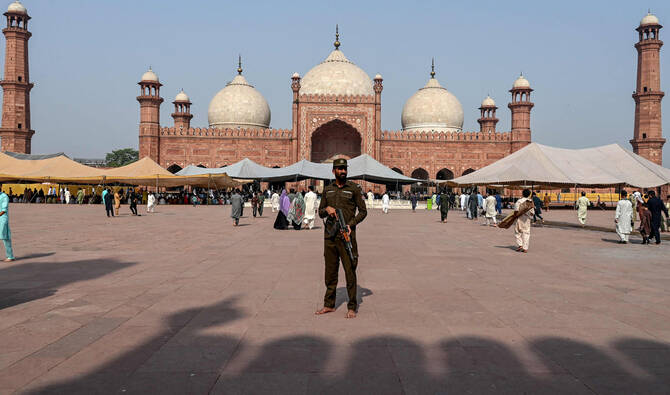
A policeman stands guard as Muslim devotees arrive to offer prayers at the Badshahi Mosque during the Eid Al-Adha, or feast of sacrifice, in Lahore on June 7, 2025. (AFP)
Short Url
Updated 07 June 2025
Follow

Pakistan’s Punjab deploys over 43,000 police personnel for security on Eid Al-Adha

  • Punjab Police places province on “high alert” amid deteriorating security situation across Pakistan
  • Police personnel deployed to secure 28,074 mosques and 890 open-air Eid prayer venues, says report

ISLAMABAD: Pakistan’s Punjab has deployed over 43,000 police officers and personnel across the province for the Eid Al-Adha holidays, state-run media reported, with police placing the province on high alert amid the prevalent security situation in the country.

As per a report in the state-run Associated Press of Pakistan (APP) on Friday, the police personnel have been deployed to secure 28,074 mosques and 890 open-air Eid prayer venues.

Pakistan has seen a surge in militant violence in recent months. Scores of citizens have been killed in the past in militant attacks that have targeted mosques and tourist destinations on public holidays.

“According to the Punjab Police spokesperson, a comprehensive security strategy has been formulated to ensure the safety of mosques, Imambargahs, Eid congregations, and the general public,” APP said on Friday.

The report said 445 Quick Response Force (QRF) teams will be stationed to enhance security readiness while 11,912 metal detectors, 225 walk-through gates and 10,466 CCTV cameras will be utilized during Eid prayers.

In Punjab’s provincial capital Lahore, over 9,000 personnel will be assigned to secure more than 5,000 Eid gatherings, the spokesperson confirmed.

“Inspector General of Police (IGP) Punjab Dr. Usman Anwar has ordered heightened security measures for Eid-ul-Adha, citing the current national security situation,” the report said.

Additional police will be deployed at parks and recreational spots during the Eid holidays to ensure public safety.

The Punjab Police chief also issued a strict warning against one-wheeling, aerial firing, kite flying and rowdy behavior, the report said, stating such acts will not be tolerated.

He stressed all mosques, Imambargahs and Eid grounds must be thoroughly checked and cleared before Eid prayers. High-security mosques and Imambargahs (in category A) will have snipers posted on rooftops while plainclothes commandos will be deployed inside Eid congregations, the report said.

“The IG [inspector-general] also directed the Additional IG Traffic to personally oversee the traffic management plan across Punjab, ensuring smooth flow of traffic during Eid,” APP said.

It said police have been ordered to take preventive measures to combat street crimes and highway robberies, while extra personnel will be posted at key locations to maintain traffic flow during the holidays.

“Special instructions have been issued to ensure tourist safety in Murree and other tourist destinations,” it said. “Authorities are required to enforce SOPs for vehicle entry and exit in Murree, the IG added.”


Pakistan urges UN Security Council to sanction separatist BLA group after recent attacks

Updated 05 February 2026
Follow

Pakistan urges UN Security Council to sanction separatist BLA group after recent attacks

  • Separatist BLA launched attacks in multiple Balochistan cities last week, killing over 50 as per official figures
  • Pakistan envoy says since Taliban assumed control of Afghanistan, BLA, other militant groups have a “new lease of life“

ISLAMABAD: Pakistan’s UN Ambassador Iftikhar Ahmed this week urged the Security Council to impose sanctions against the separatist Baloch Liberation Army (BLA) militant group and designate it as a “terrorist” group, after its recent coordinated attacks in southwestern Balochistan province. 

Pakistan’s military said on Thursday it has concluded security operations in Balochistan against separatists that was launched since Jan. 29, killing 216 militants. The military launched counteroffensive operations in Balochistan after the BLA said it launched coordinated attacks in several parts of the province last Friday and Saturday. 

The attacks killed 36 civilians and 22 law enforcement and security forces personnel, Pakistan’s military said. Pakistan’s government has accused India of being involved in the attacks, charges that New Delhi has dismissed. 

“We hope the Council will act swiftly to designate BLA under the 1267 sanctions regime acceding to the listing request that is currently under consideration,” Iftikhar said on Wednesday during a UNSC briefing on the topic ‘Threats to International Peace and Security caused by Terrorist Acts.’

The 1267 sanctions regime is a UNSC program that seeks to impose sanctions on individuals and entities associated with “terrorism.”

The regime seeks to impose travel bans, freeze assets and impose an arms embargo on individuals and groups primarily associated with Al-Qaeda or the Taliban. 

Ahmad said that after the Taliban takeover of Afghanistan in 2021, “externally sponsored and foreign-funded proxy terrorist groups” such as the Tehreek-e-Taliban Pakistan and the BLA have got a “new lease of life.”

“Operating with virtual impunity from Afghan soil and with the active support of our eastern neighbor, these groups are responsible for heinous terrorist attacks inside Pakistan,” he said. 

The Pakistani envoy said it has become imperative to prevent billions of dollars of sophisticated weapons and equipment, which were left behind by foreign forces in Afghanistan, “from falling into the hands of terrorists.”

“There must be accountability of external destabilizing actors who support, finance and arm these groups, including their proxies in Afghanistan,” Ahmad said in a veiled reference to India. 

Pakistan’s largest and poorest province, mineral-rich Balochistan borders Iran and ‌Afghanistan and is home to China’s investment in the Gwadar deep-water ‍port and other projects.

Balochistan has been the site of a ‍decades-long insurgency led by ethnic Baloch separatists seeking greater autonomy and a larger share of its natural ‍resources. 

They accuse the state of denying locals a fair share of the province’s mineral wealth, charges that are denied by the Pakistani government.