

Kenya NGO saves turtles from nets, plastic and rising tides

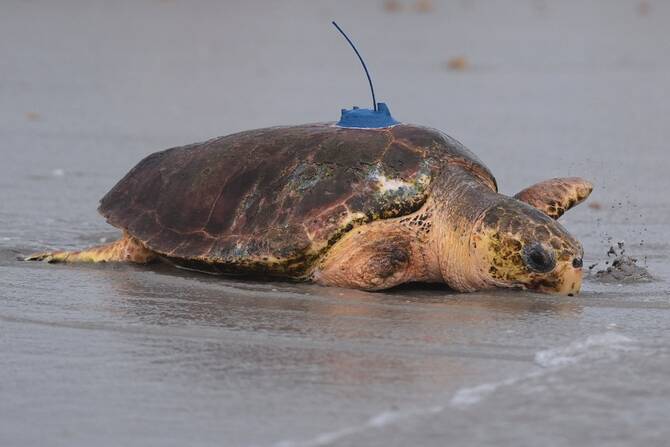
A loggerhead sea turtle crawls back into the Atlantic Ocean after being treated and released in Marinelife Center, Florida, US. (AFP)
Short Url
Updated 07 June 2025
Follow

Kenya NGO saves turtles from nets, plastic and rising tides

  • Turtles are still poached for their shells, meat and oil
  • But through the charity’s awareness campaigns in schools and villages, perceptions have significantly changed

WATAMU: A small charity on the Kenyan coast has become vital to the region’s majestic turtle population, saving thousands from poachers, fishermen’s nets and ever-worsening plastic pollution.
On the beach of the seaside town of Watamu, it takes four men to heave the huge Loggerhead sea turtle into the back of a car.
She has just been saved from a fishing tackle and will be taken to a nearby clinic to be checked for injuries, then weighed, tagged and released back into the sea.
A Kenyan NGO, Local Ocean Conservation (LOC), has been doing this work for almost three decades and has carried out some 24,000 rescues.
“Every time I release a turtle, it’s a really great joy for me. My motivation gets stronger and stronger,” said Fikiri Kiponda, 47, who has been part of LOC’s 20-odd staff for 16 years.
LOC began life in 1997 as a group of volunteers who hated seeing the creatures being eaten or dying in nets.
Turtles are still poached for their shells, meat and oil.
But through the charity’s awareness campaigns in schools and villages, “perceptions have significantly changed,” said Kiponda.
LOC, which relies mostly on donations, compensates fishermen for bringing them injured turtles.
More than 1,000 fishermen participate in the scheme and mostly do so for the sake of conservation, the charity emphasizes, since the reward does not offset the hours of lost labor.

At the NGO’s nearby clinic, health coordinator Lameck Maitha, 34, says turtles are often treated for broken bones and tumors caused by a disease called Fibropapillomatosis.
One current in-patient is Safari, a young Olive Ridley turtle around 15 years old — turtles can live beyond 100 — transported by plane from further up the coast.
She arrived in a dire state, barely alive and with a bone protruding from her flipper, which ultimately had to be amputated — likely the result of fighting to free herself from a fisherman’s net.
Safari has been recovering well and the clinic hopes she can return to the sea.
Other frequent tasks include removing barnacles that embed themselves in shells and flippers, weakening their host.
But a growing danger is plastic pollution.
If a turtle eats plastic, it can create a blockage that in turn creates gas, making the turtle float and unable to dive.
In these cases, the clinic gives the turtle laxatives to clear out its system.
“We are seeing more and more floating turtles because the ocean has so much plastic,” said Maitha.

LOC also works to protect 50 to 100 nesting sites, threatened by rising sea levels.
Turtles travel far and wide but always lay their eggs on the beach where they were born, and Watamu is one of the most popular spots.
Every three or four years, they produce hundreds of eggs, laid during multiple sessions over several months, that hatch after around 60 days.
The charity often relocates eggs that have been laid too close to the sea.
Marine biologist Joey Ngunu, LOC’s technical manager, always calls the first to appear Kevin.
“And once Kevin comes out, the rest follow,” he said with a smile, describing the slow, clumsy procession to the water, preferably at night to avoid predators as much as possible.
Only one in a thousand reaches adulthood of 20-25 years.
“Living in the sea as a turtle must be crazy. You have to face so many dangers, fish and poachers, and now human pressure with plastic and commercial fishing,” he said.
“Turtles are definitely survivors.”


Myanmar, Afghan hopeful scholars mourn UK study visa ban

Updated 4 sec ago
Follow

Myanmar, Afghan hopeful scholars mourn UK study visa ban

  • Myanmar, Afghanistan, Sudan and Cameroon citizens will be barred from obtaining university visas
  • Britain’s travel block is “really painful” for Afghan women hoping to escape to an education abroad, said one female

YANGON, Myanmar: Aspiring students are lamenting Britain’s ban on education visas for their war-weary countries — dashing dreams of bettering themselves and their home nations.
Myanmar, Afghanistan, Sudan and Cameroon citizens will be barred from obtaining university visas, London announced this week, saying asylum applications by visiting students had “rocketed” nearly 500 percent from 2021 to 2025.
“It’s like the country is punishing the weak, the most vulnerable people,” said one woman from Myanmar.
She was preparing for a scholarship interview for a master’s in climate change finance when her plans were upended by Downing Street’s decree on Wednesday.
“I could not focus the whole morning,” the 28-year-old told AFP from Yangon, speaking on condition of anonymity for security reasons in a country riven by civil war since a 2021 military coup.
“I can’t picture my future.”
Like in much of the developed world, immigration has become a divisive issue in Britain.
Efforts to beat back arrivals mirror the sweeping travel bans issued by US President Donald Trump which have shut out citizens of Myanmar, Sudan and Afghanistan.
Since the chaotic military withdrawal of Britain, the United States and other NATO nations in 2021, Afghanistan has been ruled by a resurgent Taliban government which has banned women over age 12 from attending school.
Britain’s travel block is “really painful” for Afghan women hoping to escape to an education abroad, said one female child social worker in Ghazni province, who asked to remain anonymous for security reasons.
She has now canceled her plans to study for a master’s in both the US and the UK.
“Now I am trying to be hopeful, but I think it would also be a mistake,” said the 27-year-old.
In the summer of 2024, Arefa Mohammadi fled to neighboring Pakistan, living in limbo as she applied to universities.
She got an offer to study public health in England but now cannot accept it.
“It was truly shocking for me,” said the 24-year-old.
“This situation put me in a place where I haven’t any goals, because all my goals and all my futures are unpredictable.”

- ‘Cruel and short-sighted’ -
In Kabul, a 39-year-old man faces similar heartbreak.
He was accepted to study specialist subjects related to water management at three universities in England and Scotland.
“When I was a child I witnessed several challenges like flash floods, water scarcity, environmental neglect, inefficient irrigation systems,” he said, asking to remain anonymous for security reasons. “To address these challenges I made my application.”
“I hoped to acquire modern knowledge. It’s impossible to acquire in Afghanistan,” he added.
Some 33 million people in the country face severe water shortages, aid agencies say, a result of compounding multi-year droughts, climate change and infrastructure battered by decades of war.
Britain’s Labour government made the decision to curb visas as the right-wing Reform UK party surges in opinion polls with its hard-line stance against immigration.
The UK Home Office said almost 135,000 asylum seekers had entered the country through legal routes since 2021.
Activist organization Burma Campaign UK called the visa ban “exceptionally cruel and shortsighted.”
“The opportunity to come to the UK to study is life-changing for the individual student but also an investment in the future of Myanmar,” said program director Zoya Phan in a statement.
One exiled Myanmar journalist has been living over the border in Thailand after escaping the military rule which has clamped down on press freedoms.
“When the military coup happened I was just 22, so I had a lot of dreams,” she said. “But over the past five years there have been a lot of struggles — I couldn’t complete my dreams.”
Every year since the junta takeover she applied for further education to buoy her spirits.
But she received an email Thursday morning canceling her place to study for a master’s at a London university.
“Everything is gone,” she said. “My UK dream is all disappeared.”
