US fund commits $10 million for startup investment initiative led by Pakistani tech leaders 

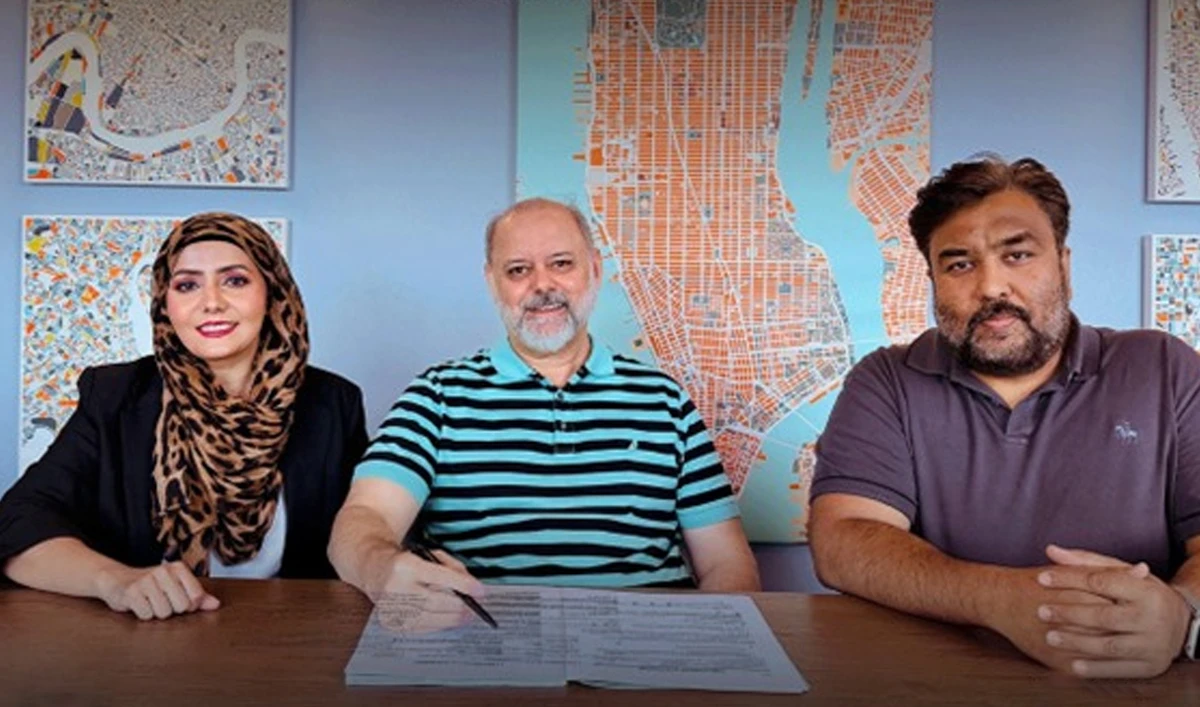
The handout photograph released by JR Dallas Tech Fund on June 6, 2025, shows Jehangir A. Raja, Managing Partner at JR Dallas Tech Fund (center), Mehwish Salman Ali, founder and CEO of Data Vault (left) and Malik Mudassir founder and CEO of AppsGenii Technologies, posing for a group photo. (JR Dallas Tech Fund)
Short Url
Updated 06 June 2025
Follow

US fund commits $10 million for startup investment initiative led by Pakistani tech leaders 

  • Mehwish Salman Ali, Malik Mudassir to receive $10 million to invest in high-potential startups planning to scale US operations 
  • Target investment range is $250,000 to $1.5 million per startup, portfolio size will be 15-20 carefully selected companies over 2 years

ISLAMABAD: The JR Dallas Tech Fund on Friday announced a “groundbreaking” $10 million commitment to globally recognized technology leaders, Pakistan’s Mehwish Salman Ali and Malik Mudassir, to spearhead an exclusive US-focused startup investment initiative.

Under the agreement, Ali and Mudassir will receive $10 million in dedicated capital to identify, evaluate, and invest in high-potential startups planning to scale operations in the United States. The duo will serve as lead investment partners with full authority to deploy capital across artificial intelligence, cloud computing, digital health, and frontier technology ventures.

“We are entrusting $10 million to two of the most visionary technology leaders of our generation,” said Jehangir A. Raja, Managing Partner at JR Dallas Tech Fund. 

“Mehwish and Malik represent the perfect combination of technical expertise, entrepreneurial success, and strategic vision needed to identify the next generation of game-changing startups ready to conquer the American market.”

According to the statement by JR Dallas, economic impact projections of the funding include direct job creation, with portfolio companies expected to generate 300-500 high-skilled technology positions within 24 months.

The target investment range is $250,000 to $1.5 million per startup and focus areas are AI/Machine Learning, Cloud Infrastructure, Digital Health, Quantum Computing, Cybersecurity.

The portfolio size will be 15-20 carefully selected companies over 24 months.

The commitment will also strengthen Texas as a hub for international tech talent entering the US market and accelerate breakthrough technologies in AI, health care, and cloud infrastructure. Portfolio companies are also projected to contribute $50-100 million in US economic activity within three years.

Ali is the founder and CEO of Data Vault, Pakistan’s first solar-powered and quantum-encrypted AI data center, co-founder of Zahanat AI, the country’s first indigenous GPT model, and COO of AppsGenii Technologies. 

As a TEDx speaker and Forbes Technology Council member, Ali’s track record in AI innovation, cybersecurity, and operational excellence “makes her uniquely qualified to identify transformative technologies ready for US market expansion,” JR Dallas said. 

Mudassir is the founder & CEO of AppsGenii Technologies, operating across the US, UK, and Pakistan, and co-founder of multiple successful ventures including GharPar, BoxesGen, and Dental Connect. He is also a Central Executive Committee Member at P@SHA, Pakistan’s largest IT trade association. 

Pakistan strikes $4 billion deal to sell weapons to Libyan force, officials say

Updated 22 December 2025
Follow

Pakistan strikes $4 billion deal to sell weapons to Libyan force, officials say

  • Pakistan’s defense industry spans aircraft, vehicles, and naval construction
  • The deal, spread over two-and-a-half years, includes JF-17 jets, officials say

KARACHI: Pakistan has reached a deal worth over $4 billion to sell military equipment to the Libyan National Army, four Pakistani officials said, despite a UN arms embargo ​on the fractured North African country.

The deal, one of Pakistan’s largest-ever weapons sales, was finalized after a meeting last week between Pakistan military chief Field Marshal Asim Munir and Saddam Khalifa Haftar, deputy commander-in-chief of the LNA, in the eastern Libyan city of Benghazi, said the four officials.

The officials, all involved in defense matters, declined to be identified because of the sensitivity of the deal.

Pakistan’s foreign ministry, defense ministry and military did not respond to requests for comment.

Any arms agreement with the LNA is likely to face scrutiny given Libya’s long-running instability following a 2011 NATO-backed uprising that toppled Muammar Qaddafi and split the country between rival authorities.

A copy of the deal before it was finalized that was ‌seen by Reuters listed ‌the purchase of 16 JF-17 fighter jets, a multi-role combat aircraft that has ‌been ⁠jointly ​developed by Pakistan ‌and China, and 12 Super Mushak trainer aircraft, used for basic pilot training.

One of the Pakistani officials confirmed the list was accurate while a second official said the arms on the list were all part of the deal but could not provide exact numbers.

One of the Pakistani officials said the deal included the sale of equipment for land, sea and air, spread over 2-1/2 years, adding it could also include the JF-17 fighter jets. Two of the officials said the deal was valued at more than $4 billion, while the other two said it amounted to $4.6 billion.

The LNA’s official media channel reported on Sunday that ⁠the faction had entered a defense cooperation pact with Pakistan, which included weapons sales, joint training and military manufacturing, without providing details.

“We announce the launch of a ‌new phase of strategic military cooperation with Pakistan,” Haftar said in remarks broadcast ‍on Sunday by Al-Hadath television.

Authorities in Benghazi also did ‍not immediately respond to a request for comment.

The UN-recognized Government of National Unity, led by Prime Minister Abdulhamid Dbeibah, controls ‍much of western Libya, while Haftar’s LNA controls the east and south, including major oilfields, and does not recognize the western government’s authority.

ARMS EMBARGO

Libya has been subject to a UN arms embargo since 2011, requiring approval from the UN for transfers of weapons and related material.

A panel of experts said in a December 2024 report to the UN that the arms embargo on Libya remained “ineffective.” The panel said some foreign ​states had become increasingly open about providing military training and assistance to forces in both eastern and western Libya despite the restrictions.

It was not immediately clear whether Pakistan or Libya had applied for ⁠any exemptions to the UN embargo.

Three of the Pakistani officials said the deal had not broken any UN weapons embargo.

One of the officials said Pakistan is not the only one to make deals with Libya; another said there are no sanctions on Haftar; and a third said Benghazi authorities are witnessing better relations with Western governments, given rising fuel exports.

PAKISTAN EYEING MARKETS

Pakistan has been seeking to expand defense exports, drawing on decades of counterinsurgency experience and a domestic defense industry that spans aircraft production and overhaul, armored vehicles, munitions and naval construction.
Islamabad has cited its Air Force’s performance in clashes with India in May.

“Our recent war with India demonstrated our advanced capabilities to the world,” military chief Munir said in remarks broadcast by Al-Hadath on Sunday.

Pakistan markets the Chinese co-developed JF-17 as a lower-cost multi-role fighter and has positioned itself as a supplier able to offer aircraft, training and maintenance outside Western supply chains.

Pakistan has also been deepening security ties with Gulf partners, signing a Strategic Mutual Defense Agreement ‌with Saudi Arabia in September 2025 and holding senior-level defense talks with Qatar.

The Libya deal would expand Pakistan’s footprint in North Africa as regional and international powers compete for influence over Libya’s fragmented security institutions and oil-backed economy.