

Pakistan accelerates push to operationalize regulatory framework for digital assets

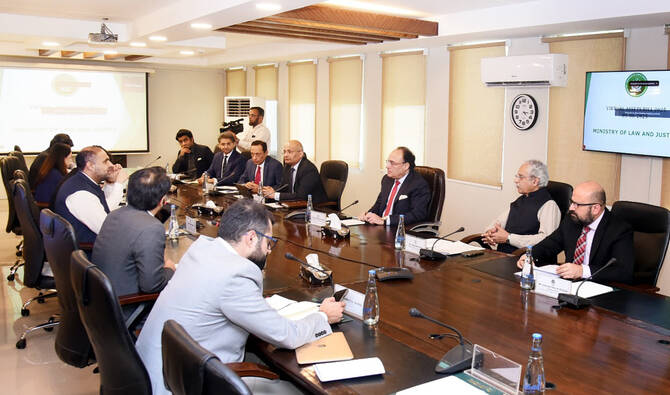
Pakistan Finance Minister Muhammad Aurangzeb speaks during a meeting with the officials from the Pakistan Crypto Council at the Finance Division in Islamabad on June 5, 2025. (Photo courtesy: Finance Ministry)
Short Url
Updated 05 June 2025
Follow

Pakistan accelerates push to operationalize regulatory framework for digital assets

  • Finance Minister Muhammad Aurangzeb chairs key meeting on Pakistan’s digital assets legislation
  • Pakistan state minister for crypto meets US lawmakers to strengthen digital assets cooperation

KARACHI: Pakistan’s Finance Minister Muhammad Aurangzeb on Thursday stressed operationalizing a framework to harness blockchain and crypto technologies’ economic potential and to fast-track their approval process, the Finance Division said amid Islamabad’s push to adopt digital assets.

Islamabad established the Pakistan Crypto Council (PCC) in March to help guide national policy on blockchain, digital currencies and crypto-related investments. This was followed by the government’s announcement of a Strategic Bitcoin Reserve (SBR) at the Bitcoin 2025 Conference in Las Vegas, making Pakistan one of the first Asian countries to integrate Bitcoin into its sovereign asset strategy. The government also plans to establish an autonomous regulatory body to oversee the country’s digital finance and crypto ecosystem.

Aurangzeb chaired a meeting at the Finance Division to review progress on the development of a comprehensive regulatory framework for digital and virtual assets in the country. The law ministry tabled a draft of the proposed legal framework during the meeting, which was developed through close collaboration with members of the PCC, key stakeholders and technical experts.

“During the meeting, the draft was thoroughly reviewed and refined,” the Finance Division said. “It was collectively agreed that in-principle approval process will be fast-tracked to ensure timely enactment and effective implementation.”

The draft legislation outlines a regulatory structure for digital and virtual assets, encompassing governance mechanisms, licensing protocols and investor protection provisions, the statement said. The proposed framework seeks to position Pakistan as a forward-looking participant in the digital asset ecosystem, it added.

‘BEST IDEAS’

Separately, Pakistan’s State Minister for Crypto and Blockchain Bilal Bin Saqib met over a dozen key American officials and lawmakers in Washington to strengthen cooperation in digital assets, blockchain regulation, and financial innovation, his office said.

Saqib met Senator Cynthia Lummis, co-author of the Lummis-Gillibrand Responsible Financial Innovation Act and co-sponsor of the BITCOIN Act, which seeks to designate Bitcoin as a strategic reserve asset.

Saqib’s office said Lummis has been a leading advocate for “thoughtful and comprehensive” crypto legislation in the US.

He also met Senator Ted Cruz, Congressman Troy Downing, who is a member of the House Financial Services Subcommittee on Digital Assets, Congressman Ryan Zinke, Congressman Rick McCormick, and Congressman Derrick Van Orden.

Saqib’s office said these lawmakers were engaged in shaping policy frameworks related to emerging technologies in the US.

“We came to learn, to listen, and to contribute,” Bilal said. “Pakistan is actively studying how global leaders are approaching regulation, innovation, and financial inclusion — not to copy, but to adapt the best ideas for our own unique landscape.”

Pakistan’s broader digital asset strategy includes allocating 2,000 megawatts of surplus power to support Bitcoin mining and AI-driven data zones, aiming to turn untapped energy into economic productivity, job creation and digital infrastructure growth.

As regulatory frameworks continue to evolve globally, Pakistan says it is taking proactive steps to integrate private sector innovation with state policy and international partnerships, positioning itself as a key player in the next phase of the global digital economy.



‘Pakistan Cyber Force’ group hacks India’s ABP News day after Pakistani channels targeted

Updated 5 sec ago
Follow

‘Pakistan Cyber Force’ group hacks India’s ABP News day after Pakistani channels targeted

  • ‘Pakistan Cyber Force’ group hacks India’s ABP News day after Pakistani channels targeted
  • Multiple Pakistani news channels were hacked on Sunday, during which broadcasts were interrupted with anti-army messages, local media reported

ISLAMABAD: A group by the name of ‘Pakistan Cyber Force’ on Monday hacked an Indian news channel ABP News to ran pro-Pakistan Army content, state media reported on Monday, a day after multiple Pakistani news channels were also hacked. 

Pakistan Cyber Force launched a “retaliatory attack” by hacking Hindi-language news channel ABP News, state broadcaster Radio Pakistan said. It added that excerpts of speeches by Pakistan’s Chief of Defense Forces Field Marshal Syed Asim Munir ran on the Indian news channel as well as other content related to the Pakistan Army. 

“Pakistan Cyber Force launched a retaliatory attack on India with slogans of Pakistan Zindabad started echoing on an Indian channel,” Radio Pakistan said. 


The development takes place a day after prominent Pakistani news channel, Geo News, was hacked just as its 9 p.m. bulletin was about to begin. 

Geo Managing Director Azhar Abbas confirmed the breach on Sunday, saying that the news channel was facing repeated hacking attempts since 24 hours by “unknown elements” trying to disrupt its transmission.

“For some time now, Geo News’ broadcast has been continuously disrupted,” he wrote on X. “The channel’s screen was hacked and an inappropriate message was aired.”

He distanced Geo News from the messages that were displayed on the channel, urging authorities to launch an investigation and hold elements responsible for the breach to account. 

Pakistani English news website Express Tribune reported that other than Geo News, other local channels such as ARY News and SAMAA were also hacked. It said messages critical of the Pakistani military and its leadership were displayed during the broadcasts.

“In addition to hijacking broadcasts, several Pakistani news channels’ websites were allegedly used to run Google advertisement campaigns in support of Mossad,” Express Tribune said.

The development takes place as tensions in the Middle East surged on Saturday after the US and Israel launched joint attacks against Iran, killing its Supreme Leader Ayatollah Ali Khamenei. 

A wave of cyber-enabled operations took place early Saturday morning alongside the coordinated US-Israel strikes on targets across Iran, international news agency Reuters reported, citing cybersecurity experts and observers.

It said multiple Irani news websites were hacked to display various messages. BadeSaba, an Iranian religious calendar app with more than 5 million downloads, was also hacked and used to display messages telling users, “It’s time for reckoning” and urging armed forces to give up their weapons.